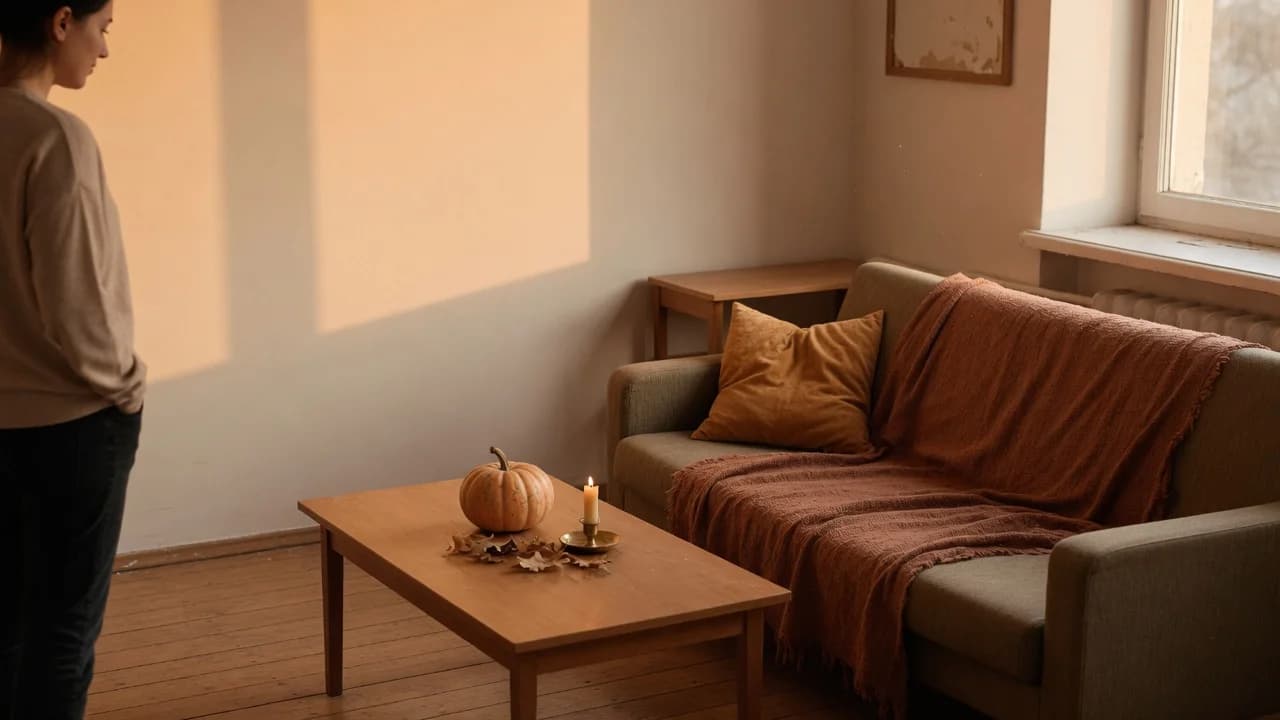
A studio renter in Chicago unpacks mini pumpkins and plaid throws across 450 square feet in late September. By October, the apartment feels smaller than it did in August. Every added object shrinks a small room, and you feel it before you can name it.
But the promise of fall decor is warmth and abundance. In 450 square feet, abundance reads as chaos.
Horizontal surfaces act as visual anchors in rooms under about 900 square feet. Cover one and the room reads as styled; cover three and it reads as storage.
Why Your Apartment Fights Back Against Fall Decor
The average US apartment measures 908 square feet.[1] Studios and one-bedrooms, which make up more than half of all rentals, run considerably smaller: 457 and 735 square feet on average.[1] These numbers leave almost no margin for decorative error. A 700-square-foot one-bedroom might have three horizontal surfaces in the living area alone. A coffee table, an end table, a console. Adding seasonal objects to all three doesn't triple the effect. It triples the visual traffic.
What's happening isn't aesthetic. It's spatial. In rooms where walking paths and sightlines are already compressed, every new object becomes a decision the eye has to process. Designers call this visual weight. A ceramic pumpkin on an empty side table reads as intentional. That same pumpkin on a table already holding a lamp, a coaster set, and a book stack reads as clutter. The object hasn't changed. Its context has.
Most fall decor advice treats the room as a blank canvas. Your apartment isn't blank. You're decorating on top of your actual life: the mail, the remote, the water glass, the book you're halfway through. The answer isn't buying less stuff. It's putting it in fewer places.
The One-Surface Rule
If every horizontal surface in a small room becomes a display zone, none of them feel deliberate. The fix is a constraint: pick one surface per room for seasonal decor. One. That surface gets the pumpkins, the candle, the small woven tray with dried stems. Every other surface stays clear of seasonal objects.
Contrast is what matters here. A decorated surface only registers as decorated when the surfaces around it are calm. In a small living room, the coffee table might carry the fall focal point while the end tables stay functional. In the bedroom, the dresser top becomes the seasonal anchor and the nightstand stays clean.
The reframe here: cozy isn't about how much you add; it's about what you choose to keep. That one decorated surface will do more atmospheric work than five half-decorated ones.
Professional organizer Barbara Brock frames it more sharply: layering seasonal decor on top of everyday decor without removing anything first creates "cluttered with conflicting themes."[2] The mess people blame on fall decorating usually isn't the fall stuff. It's the summer stuff still sitting underneath it.
Swap, Don't Add
Most fall decor shopping lists read like an inventory audit: buy this, add that, stack these. For a small apartment, that approach is backwards. The most effective thing you can do to shift a room into fall is change what's already there, not introduce new things.
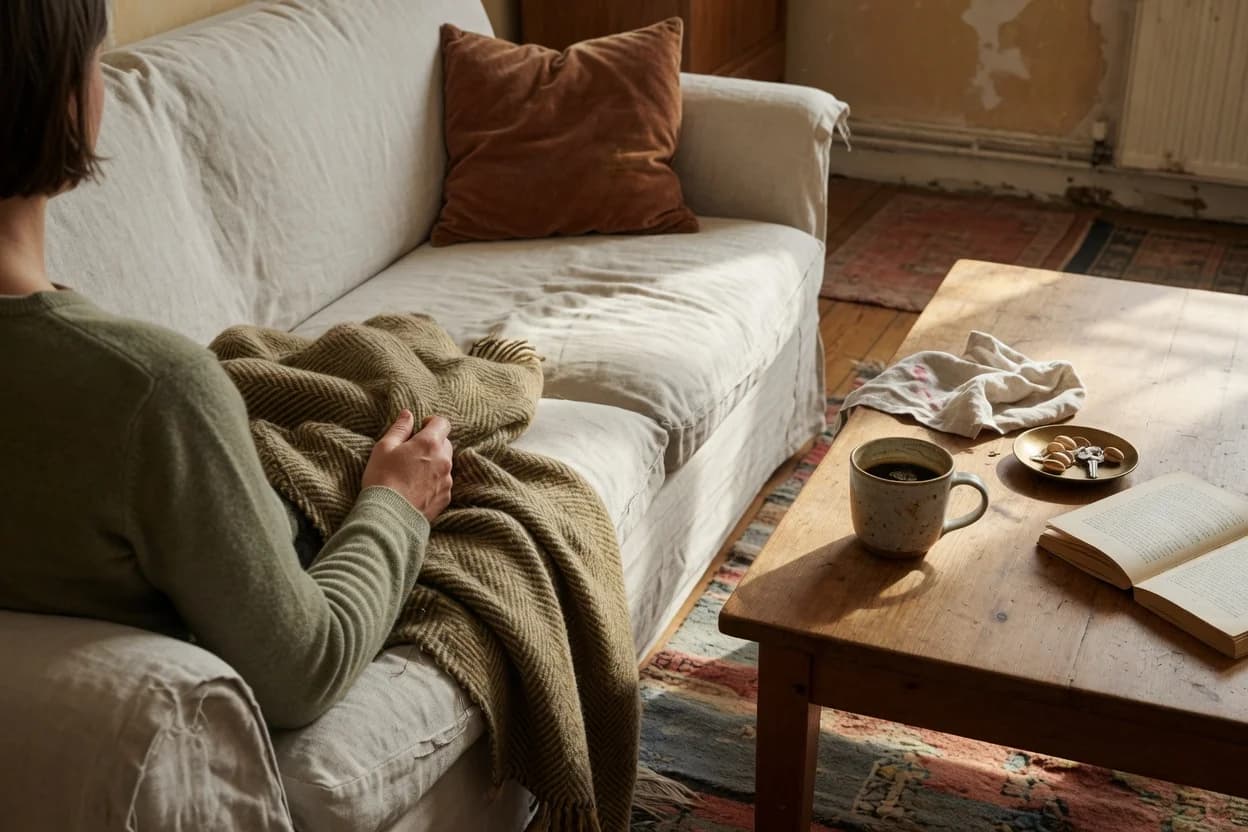
Textiles do the heavy lifting. Swap cotton or linen throw pillow covers for velvet, wool, or chunky knit versions in burnt orange, deep ochre, or forest green. Replace a summer-weight throw blanket with something heavier in a textured weave. Switch lightweight curtain panels for fabric with more body. The fabric change alone makes a neutral room read as seasonal without adding a single object to a surface.[3]
Swap and add feel different when you're living with the result. A new velvet pillow cover replaces a linen one. The sofa holds the same number of pillows. A heavier throw replaces a lighter one. The armchair still has one blanket, not two. You get the texture shift, the color shift, the psychological shift toward warmth, and the room's object count stays flat.
At roughly $15 to $30 per pillow cover and $25 to $45 for a textured throw, a two-swap fall refresh lands around $40 to $75. The seasonal decor bin most people fill at HomeGoods runs closer to $100 to $200, and every item in it demands a surface you don't have.
That understates it. The object count should move downward. Every fall item that enters the apartment needs a summer counterpart that leaves the visible space. Pack away the bright cotton throws. Stow the beach-read stack from the coffee table. Box up the seashell bowl from the entryway. A labeled bin under the bed or on a high closet shelf works fine. But the seasonal objects have to rotate, not accumulate.
One situation where this framework reverses: if your apartment reads as sparse rather than crowded. Beige walls, bare floors, a single throw pillow. In that case, you do need to add. The swap method assumes the issue is too much, not too little. If your space feels cold rather than cluttered, start by adding texture through textiles before worrying about subtraction. The one-surface rule still applies. The swap rule doesn't.
Your 20-Minute Room Audit
The quickest way to test whether your fall decor plan will work is to walk the apartment with fresh eyes before you buy anything. Start with the surfaces. Count every horizontal plane in each room. Coffee table, side tables, console, dresser, nightstand, kitchen counters, bathroom vanity. Now ask which one in each room earns the fall focal point. Not which one is biggest. Which one you actually look at when you walk in. I'd start with the coffee table or dresser. Those read fastest from the doorway.
Then clear the rest. Not permanently. Just for the season. A storage bin for everyday objects that usually live on surfaces you're retiring for fall keeps the space functional and reversible. You have to remove before you decorate, or you're piling on. Skip this step and you'll spend money on decor that makes the apartment feel worse, not better. A room with cleared surfaces already looks better than a room accessorized on top of clutter ever will.
Finally, decide your two texture swaps: one textile change and one color shift. Velvet pillow covers and a rust-toned throw, for example. Or flannel sheets and deeper curtain panels. Two changes signal fall in a small room. Three if you have a dining table or kitchen bar you want to dress with a small seasonal tray. More than that and you're back to the horizontal surface problem.
Fall Decor Rule: One decorated surface per room. All others stay clear.
Texture Swap: Linen to velvet or wool. Cotton throws to chunky knits.
Color Shift: Swap 2-3 accent pieces into rust, ochre, forest green, or deep brown.
Storage Rule: One seasonal item in equals one off-season item out. Under-bed bin or high shelf.
Time Budget: 20-minute surface audit before buying anything.
Check your apartment against these four conditions. If you answer no to any of them, pause before browsing fall decor.
- Is every horizontal surface in your living area carrying objects right now? If yes, which one gets cleared for the season?
- Do your pillows and blankets read as summer? If yes, pick your two texture swaps first.
- Is at least one under-bed bin or high closet shelf available for off-season storage?
- Does the room feel sparse and cold rather than furnished? If yes, skip the subtraction and add texture instead.
Start tonight. Walk your apartment, count the horizontal surfaces, and choose one per room. Remove everything seasonal or non-essential from the rest. That's your immediate move. It costs nothing and takes under half an hour.
This weekend, make two textile swaps. Order or pull from storage the pillow covers, throw, or curtain panel that shifts the room's texture toward fall. One swap per room is enough. Two if you're enthusiastic and have the storage space for what comes out.
By the end of the month, step back and assess. Does the room feel warmer? If the answer is yes and you haven't added anything to the horizontal surfaces beyond the one designated focal point, you've solved the problem. If the room still feels sparse, add one more texture element: a wool rug, a heavier duvet, a warm-toned lamp shade. Fall decor in a small apartment isn't a display problem. It's an editing problem. The rooms that feel best this time of year aren't the fullest ones. Edit first. Then decorate.