A typical nightstand surface measures roughly 18 by 16 inches. That's 288 square inches to hold a lamp, a phone, a glass of water, your current book, and the remote. Even before the mail piles up, the math doesn't work.
The same surface that feels serene at 10 PM becomes a chaos zone by Thursday. You clear it on Sunday, and by midweek it's accumulated yesterday's mug, a stack of unread magazines, and a charging cable that has become permanent infrastructure. The frustration isn't that you're disorganized. It's that the surface is small and the day keeps leaving things on it.
What gets missed in most nightstand advice is that styling and clutter prevention aren't competing goals. They're the same outcome approached from different angles. A styled surface is one where every object was placed intentionally. A clutter-free surface is one where only intentional objects remain. The gap between them is maintenance, not aesthetics.
There's a reason professional organizers look at the nightstand first. It's the last thing you see before sleep and the first thing you reach for in the morning. Research has found that visible bedroom clutter elevates cortisol and disrupts sleep quality, even when people don't consciously register the mess.[1] Your nightstand is the bookend to your day.
So the question isn't how to style a tiny nightstand. The real question is how to build a surface that stays styled because it structurally can't hold anything that doesn't belong there.
Why Tiny Nightstands Become Clutter Magnets
The mechanism isn't laziness. It's that small surfaces have zero buffer. On a kitchen counter, a stray envelope looks incidental. On 288 square inches, a single coffee mug consumes 10% of the available real estate. The surface reads as cluttered after just two or three unplanned additions.
Visual clutter does more than look messy. Neuroscience research at Princeton has demonstrated that objects in your visual field compete for attention. Each item your brain registers as out of place triggers a low-grade cognitive load that accumulates throughout the day.[2] When that load sits inches from where you sleep, your brain never fully disengages. You wake up already behind.
A nightstand isn't storage; it's a landing strip for the day's two most important transitions. That's the reframe. Once you treat the surface as a transition zone rather than a horizontal shelf, the question shifts from "what fits?" to "what earns the space?"
Professional organizers see the same pattern repeatedly: people use the nightstand as a drop zone for objects that have no other home. Receipts, abandoned earrings, yesterday's to-do list. The surface becomes a junk drawer turned on its side.[3] The fix isn't better organizing products. It's a permission structure that filters every object before it touches the surface.
The Permission-Zone Framework
Every object that wants a spot on your nightstand has to answer one question: does this serve the first 15 minutes of my day or the last 15? That's the permission test. No exceptions for decorative items, no grandfather clauses for things that have "always been there."
The test sounds rigid. Put more precisely: it's strict about function but generous about what counts as functional. A book you're actively reading serves the last 15 minutes. A book you finished three months ago and left there because the spine looks nice does not. A small tray holding earplugs and lip balm passes. A decorative ceramic bird that collects dust does not.
Here's where most people push back: "But I want it to look nice." The surface looks nicer when there are four intentional objects on it than when there are twelve objects, half of which you don't see anymore because your brain has learned to filter them out. The aesthetic argument collapses under its own weight on a small surface. Clutter doesn't read as "decorated." It reads as neglect.
That framing misses something. The permission test doesn't eliminate beauty. It redirects it. When only functional items remain, you start caring about which water carafe, which lamp, which tray. The objects themselves become the styling, because there are so few of them that each one carries visual weight. You stop accessorizing and start curating.
Now, a caveat. If you manage a health condition that requires bedside equipment — a CPAP machine, medications with specific timing, a glucose monitor — the permission test expands. Function includes medical function, always. The rule still applies but with a wider definition of "essential." Don't let an organizing framework shame you out of keeping what your body needs within arm's reach.
The 15-Minute Permission Test
Only objects serving the first or last 15 minutes of your day earn surface space.
Lamp, water, and one transition object form the non-negotiable core.
A daily two-minute morning reset prevents accumulation.
No decorative-only items. Beauty comes from curation, not quantity.
The Three-Item Core (and What to Do with Everything Else)
Strip the surface to three categories. Light, hydration, and one transition object.
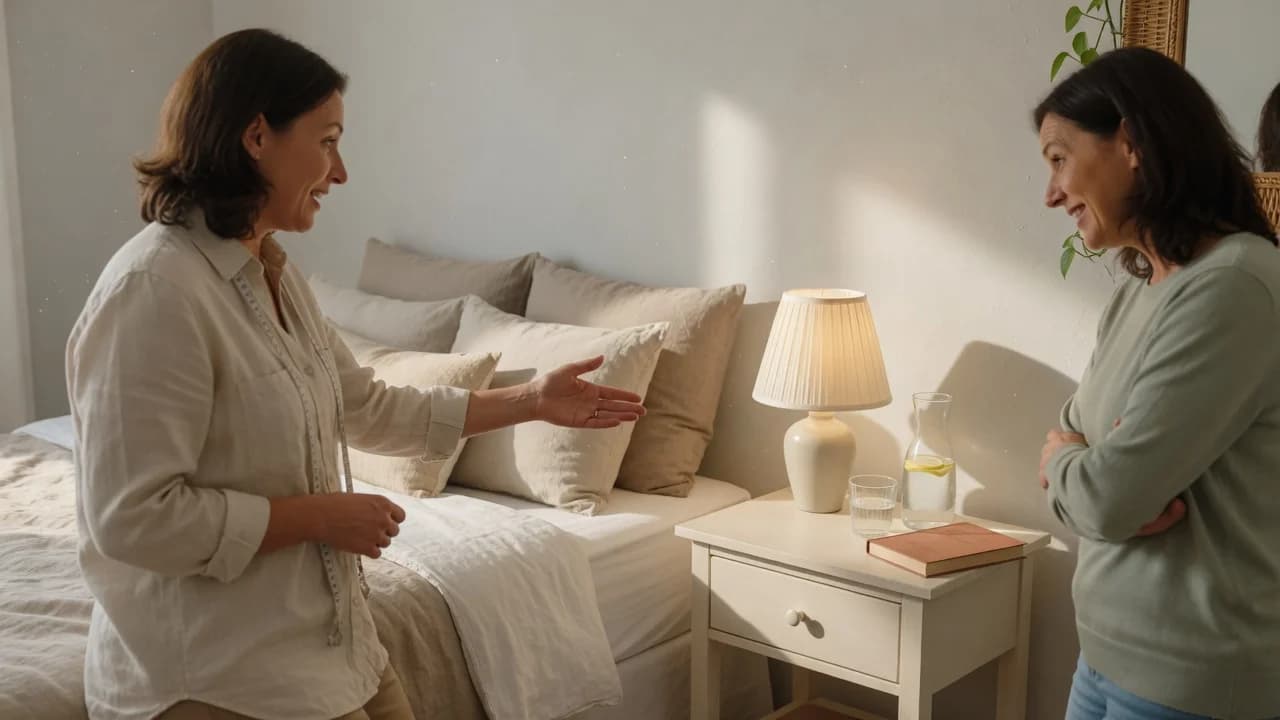
Light means a lamp with a warm-spectrum bulb, placed on the side opposite your dominant hand so you reach across your body to turn it off. Hydration means a water vessel — carafe, bottle, or glass — that gets refilled nightly, not one that sits half-empty for days. The transition object is the wildcard: a book, a journal, earbuds, a sleep mask. Something that actively moves you from waking to sleeping or sleeping to waking.
Four items total if your phone charges there. That's it. A surface this intentionally sparse looks styled by default, because there's nothing to fight for attention.
Everything else goes into the drawer, onto a separate shelf, or out of the bedroom entirely. Not relegated. Promoted to a home where it belongs. The hand cream lives in the bathroom where you apply it. The magazine stack moves to the living room where you actually read. The remote sits on a small tray under the bed, within reach but off the surface.
If your nightstand doesn't have a drawer, use a small tray or shallow basket on the surface to contain the smallest essentials — lip balm, earplugs, a hair tie. The tray creates a visual boundary. Three items inside a tray read as one object to the eye, which keeps the surface feeling open even when it's functioning fully.
The Two-Minute Reset That Makes It Stick
The permission framework collapses without a daily reset. You can curate the perfect surface on Saturday and by Tuesday it'll look the same as before, because the day keeps depositing things and you keep letting them stay.
Here's the reset: every morning, before you leave the bedroom, remove anything that wasn't there when you went to sleep. Empty water glass to the kitchen. Phone off the surface once you're up — the alarm already did its job. Receipt from yesterday's coffee run into the trash. This takes under two minutes.
That's the whole maintenance system. A weekly deeper clean — wipe the surface, launder any fabric elements, rotate the book — keeps it from feeling stale. But the daily two-minute reset is what prevents the slow accumulation that makes you want to give up and accept the clutter.
Ignore this and the cycle repeats. You'll spend another Sunday clearing the surface, feel satisfied for 36 hours, and watch it fill back up. The objects aren't the problem. The absence of a daily gatekeeper is. Without the reset, the permission test is just a one-time audit that fades. With it, the surface stays intentional by default.
Stop adding. Start removing, tonight. Take everything off the surface, wipe it clean, and put back only what passes the 15-minute test. Do this once, without buying anything new. The framework works immediately with the objects you already own. Everything else is maintenance.