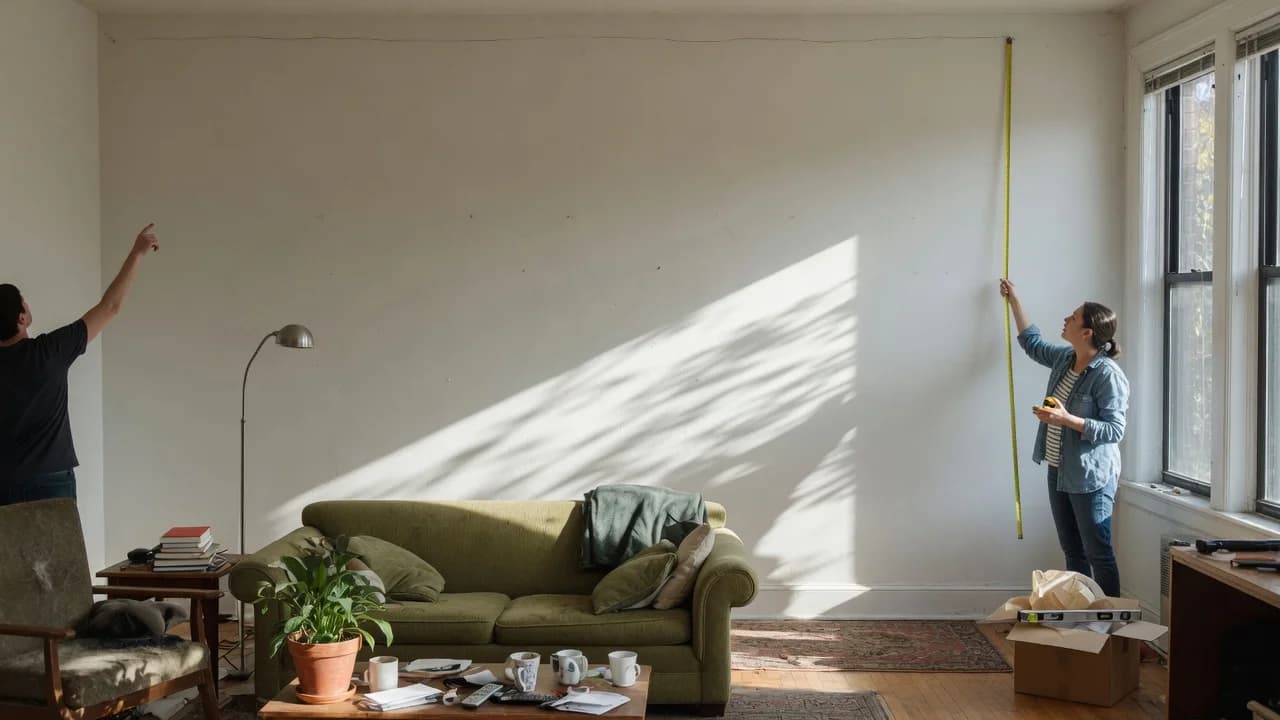
A friend of mine just moved into a rental with a 14-foot living room wall and a strict no-paint clause. She spent three weekends scrolling Pinterest and two trips to HomeGoods before admitting the obvious: nothing she brought home looked right. The frames were too small. The tapestry sagged. The mirror she loved in the store reflected an empty room.
The problem isn't about finding decor ideas. Search "decorate large wall without painting" and you'll get a hundred listicles recommending gallery walls, oversized mirrors, and floating shelves. The problem is that most of those suggestions were written for 6-foot apartment walls, not the 12-to-16-foot expanses common in American living rooms and open-plan rentals.
Three things determine whether your solution works: the actual width of the wall, the weight capacity of whatever is holding it up, and the proportion between the decor and the space around it. None of those are about taste. They're about math.
Here's the tension most articles skip: if you're renting, your best hanging options max out at 15 pounds and a 24-by-36-inch frame. That's a constraint that eliminates roughly half the solutions you'll find online before you even start shopping.
Why Scale Matters More Than Style
Interior designers use a rule of thumb that sounds simple but changes everything once you apply it: wall art or decor should fill roughly 60 to 75 percent of the available wall width.[1] For a 6-foot wall, that means art between 43 and 54 inches wide. For a 14-foot wall, you're looking at 101 to 126 inches. That's not a bigger frame. That's a different category of solution.
The 60-75% rule is the reason that canvas print you bought at Target, which looked enormous in the store, shrinks to postage-stamp size against your actual wall. It's not that you bought the wrong thing. It's that the thing was never designed for the wall you have.
What makes this harder for renters is the weight constraint. The largest Command picture hanging strips hold 15 pounds across four pairs and max out at a 24-by-36-inch frame.[2] A single large piece of framed art that fills 60% of a 12-foot wall will almost certainly exceed that weight limit. You're stuck between proportional correctness and physical possibility.
Or rather: you're not stuck. You just need to think in categories, not individual items. The wall width determines which category of solution you should even be considering.
What Actually Works, by Wall Width
Here's the breakdown by wall width, assuming you're renting and can't drill into studs.
Wall width is the organizing principle. Everything else follows from it.
| Wall Width | Best Solution | Why It Works | Approximate Cost |
|---|---|---|---|
| Under 6 feet | Single large framed piece or mirror | Fits within Command strip weight limit at 60-75% fill | $50-200 |
| 6 to 10 feet | Gallery wall or triptych (3-panel set) | Distributes weight across multiple hanging points; each piece under 15 lbs | $100-400 |
| 10 to 14 feet | Peel-and-stick wallpaper or fabric panel system | No weight-bearing hardware; covers surface rather than hanging from it | $150-600 |
| Over 14 feet | Combination: wallpaper plus leaning art or floor-anchored decor | Single surface treatment plus furniture-scale pieces that don't hang | $300-1,000+ |
The width bands are guidelines, not engineering specs. A 10-foot-2-inch wall doesn't suddenly demand wallpaper. But the cost ranges are real, and they assume you're buying new rather than thrifting. The 6-to-10-foot range is where most American living rooms land, and it's also where gallery walls genuinely earn their reputation. Below 6 feet, you can get away with one bold piece. Above 10 feet, a gallery wall starts to look like a museum gift shop unless you're using very large individual frames, which brings the weight problem back.
For the 10-to-14-foot range, peel-and-stick wallpaper deserves a closer look. It's the solution that most directly solves the tension between scale and weight.
The Peel-and-Stick Reality Check
Peel-and-stick wallpaper has become the default recommendation for renters with large walls, and for good reason. It covers surface area without requiring anything to hang from the wall. No weight limits. No holes. If you hate it, you peel it off.
But the seams.
Standard peel-and-stick panels are roughly 20.5 inches wide.[3] For a 12-foot wall, that's seven panels side by side. Pattern matching across seven panels is not trivial. If your pattern has a 24-inch repeat and you're off by even a quarter inch on panel three, the error compounds across the remaining four panels. By panel seven, you've got a visible seam misalignment.
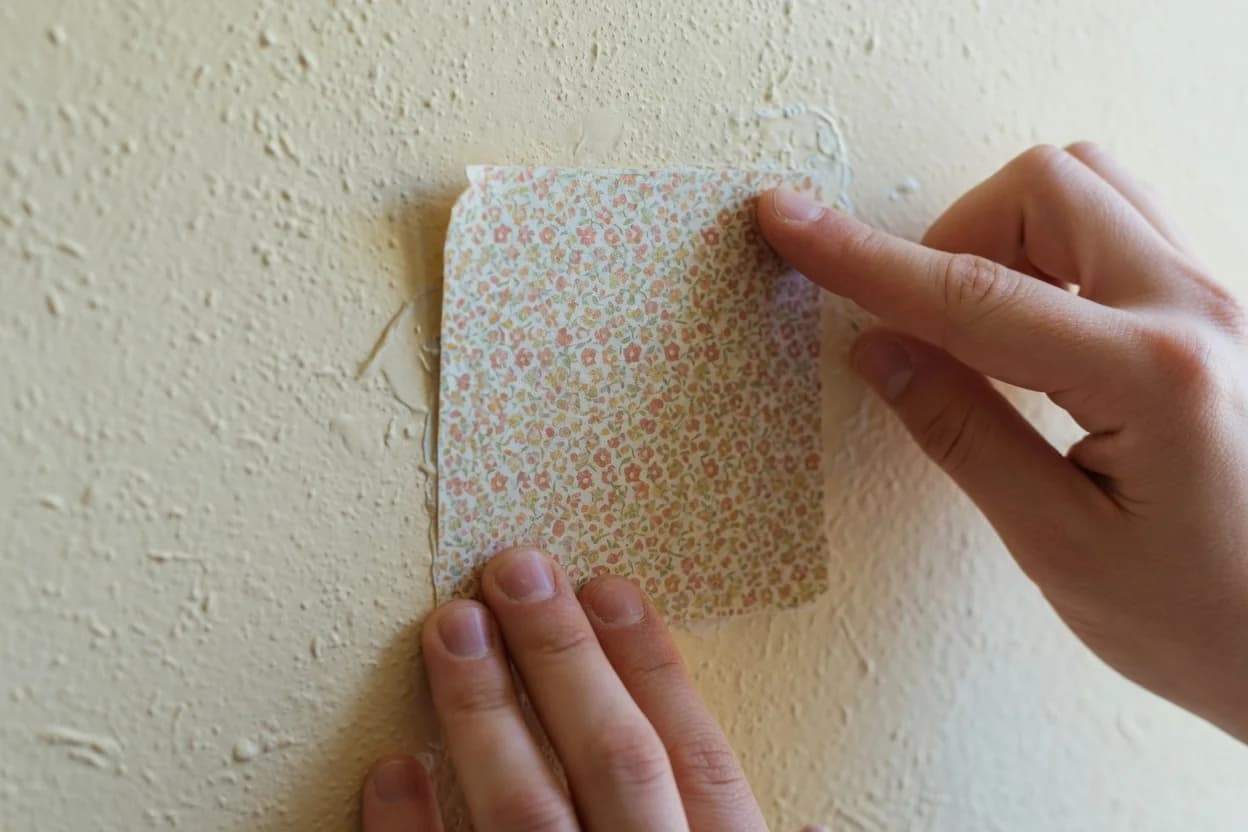
This isn't a reason to skip wallpaper. It's a reason to choose your pattern strategically. Small-scale repeats and organic patterns (florals, abstract textures, marbling) hide seams better than geometric grids or stripes. If you're set on a geometric print, budget for an extra panel as a margin-of-error spare. Most manufacturers recommend ordering 10 to 15 percent more than your calculated square footage for this exact reason.[4]
The other thing nobody mentions: textured walls. If your rental has orange-peel or knockdown texture, which is common in apartments built after the 1990s, peel-and-stick wallpaper may not adhere evenly. You'll get bubbles, lifted edges, and eventual peeling. Test a single panel in an inconspicuous spot before committing to the whole wall.
Where This Advice Breaks Down
The wall isn't blank because you can't paint. It's blank because it's large, and most decor isn't built for that.
Here's where even the best category-matched solution can fail.
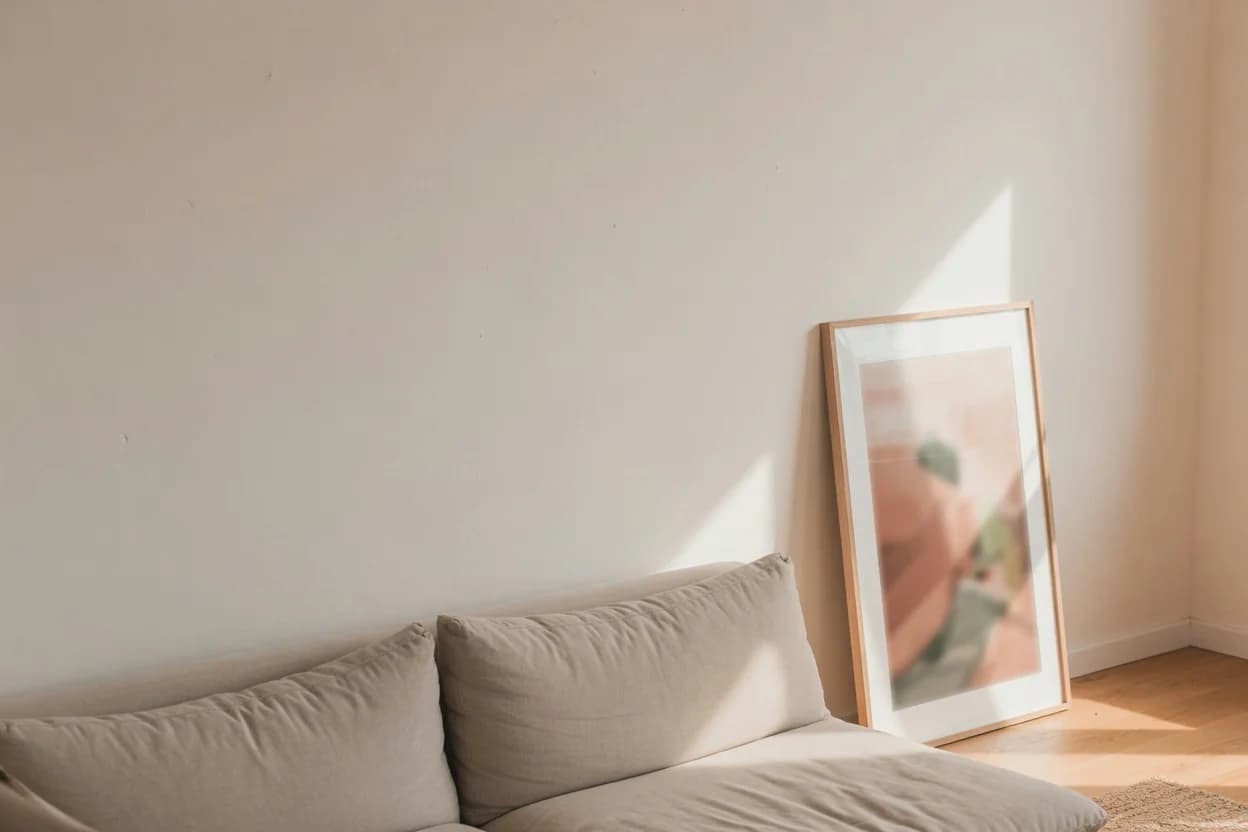
If your wall exceeds 16 feet and you're in a rental that forbids any wall modification beyond adhesive strips, your options narrow to roughly two: fabric hung with a tension rod system (which requires adjacent walls or a ceiling track) or leaning oversized art against the wall from the floor. Both have drawbacks. Tension rods spanning more than 12 feet need intermediate support, and leaning art on a grand scale means investing in pieces that are genuinely furniture-sized. A 5-by-7-foot canvas on the floor makes a statement, but it's also a tripping hazard in a small room.
And the humidity.
Peel-and-stick wallpaper in bathrooms or kitchens near steam sources will lift at the edges within months, sometimes weeks. The adhesive is water-resistant, not waterproof. If your large blank wall is in a bathroom, your best non-paint option is probably vinyl decals or a moisture-rated tension rod with a shower-curtain-weight fabric panel. Neither is going to look like a designer treatment.
If you own rather than rent, this whole analysis shifts. Once you can drill into studs and mount proper anchors, the weight limit disappears. A single 60-inch-wide canvas with a French cleat becomes feasible on a 10-foot wall, and the proportional math works cleanly. But if you own, you can also paint, which means the entire premise of this article stops applying to you. The no-paint constraint is what makes the problem hard, and the renter's weight limit is what makes it specific.
Measure the wall first. Not the furniture. Not the room. The wall.
Everything else in this article is secondary to that one action. Get the actual width in inches, multiply by 0.6 and 0.75, and write down the range. That range is your target. If the number is over 80 inches, skip the single-frame aisle entirely. You're in gallery-wall or wallpaper territory. If it's under 50 inches, one bold piece on Command strips will do the job.
The reason most people get this wrong isn't that they lack taste. It's that they shop for the item before they shop for the dimensions. Reverse the order and the wall stops looking blank. It starts looking like a problem with a specific answer.