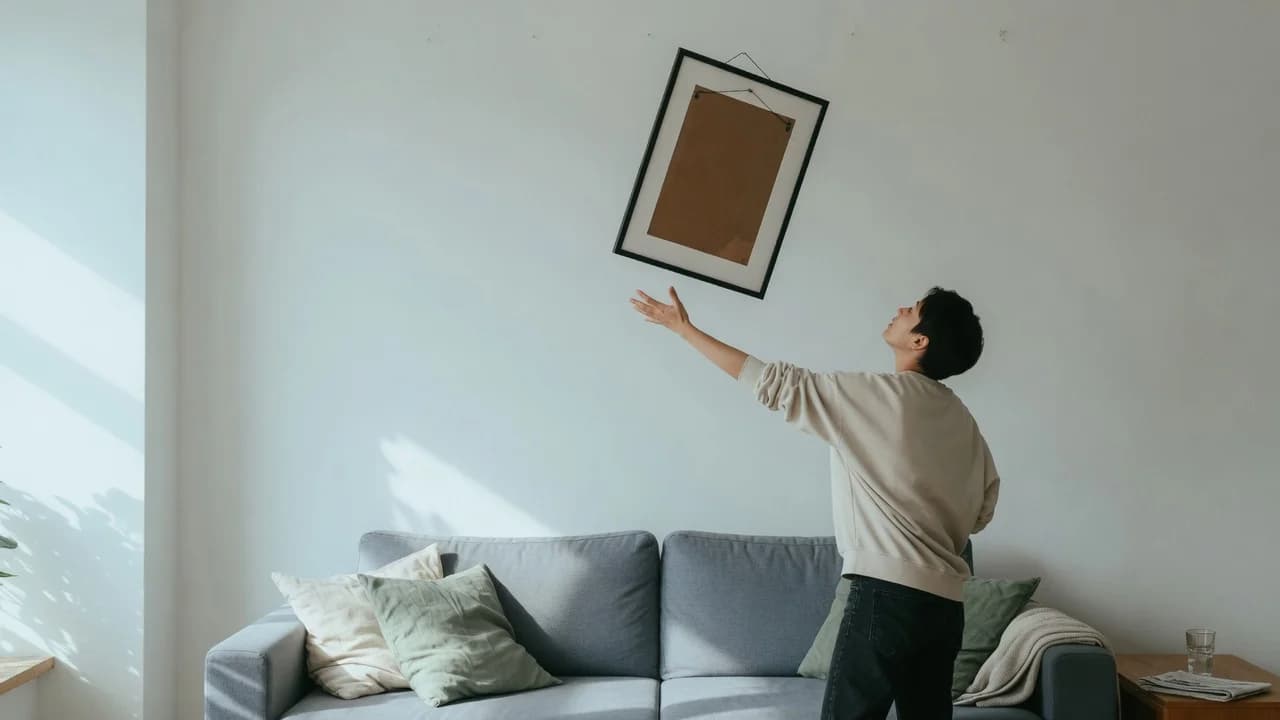
Not long ago, filling the wall above a sofa meant a hammer, a nail, and a deposit you'd never see again. Command strips changed that—sort of. A tall wall above a sofa isn't solved by a couple of strips and a prayer.
It depends on three things: how much your art weighs, what your wall's made of, and the gap between your sofa back and the ceiling. Get any one of those wrong and you're waking up to broken glass.
The standard advice says buy a big framed print and stick it up with adhesive strips. Most product pages won't tell you when that fails. And that gap—between what the package says and what your wall does—is where this article lives.
Weigh It Before You Stick It
You need a number. Your bathroom scale gets you one. Hold the framed art, step on, subtract your weight. That's your frame weight. Every method in this article has a ceiling, and guessing wrong is what sends frames crashing down.
Wall prep matters more than the product. Command's own instructions say wipe the wall with rubbing alcohol first.[1] No multi-surface cleaners. No water. Alcohol cuts the invisible film of dust and cooking grease that sits on every wall near a living space. Skip this and you've halved the strip's holding power before you start.
Paint type counts too. Flat or matte paint—the kind landlords slap on between tenants—bonds poorly to drywall. When you pull a strip off that surface years later, the paint can lift with it. Gloss and semi-gloss hold better. Fresh paint needs seven full days to cure before anything adhesive touches it.[1]
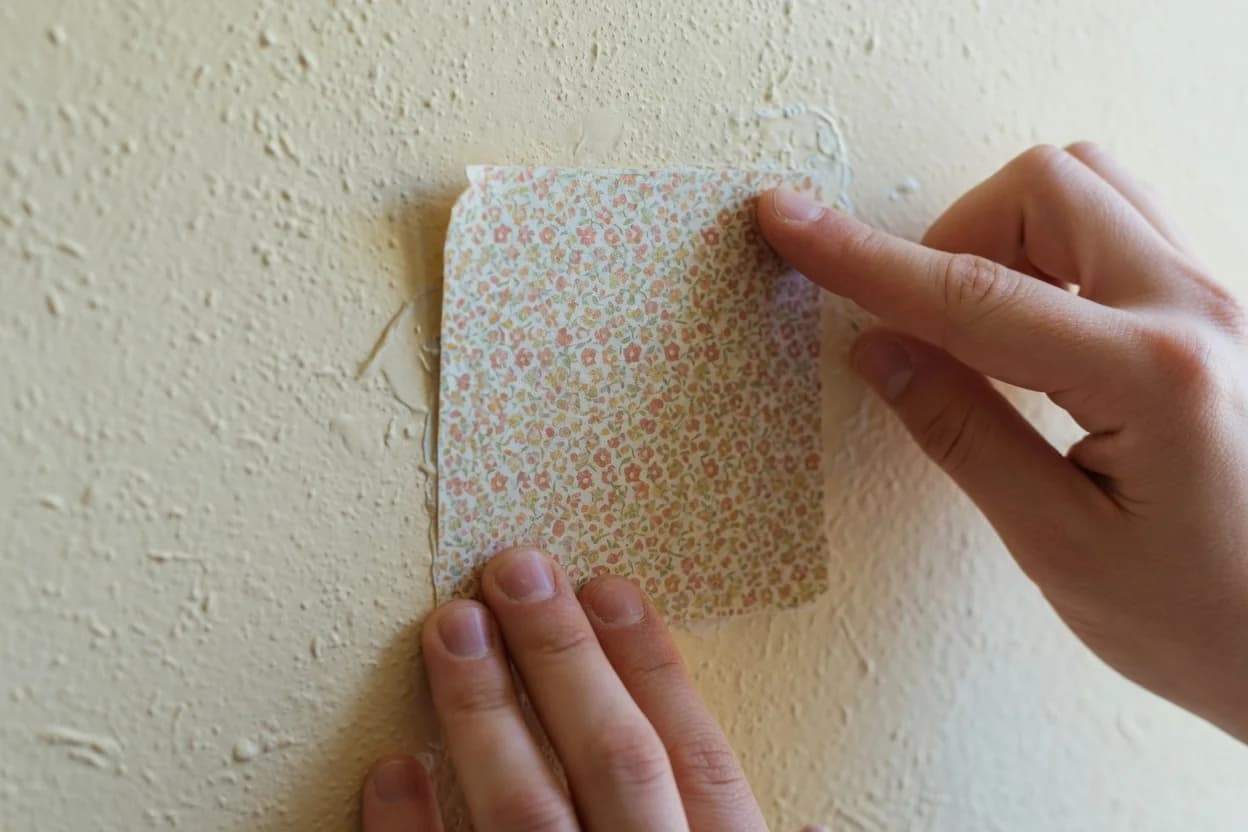
And wall texture is the killer variable. Smooth drywall is the ideal surface. Light orange peel might work if you press firmly and cross your fingers. Heavy knockdown, popcorn, or actual brick? Adhesive strips are not your solution. You'll need a method that doesn't rely on surface contact at all.
Adhesive Strips: The Numbers That Matter
Command's picture hanging strips come in sizes, and the weight ratings are not suggestions. They're failure points. Exceed them and the strip releases, often slowly enough to give you false confidence before a 3 AM crash.[2]
Command strips are the go-to for most no-nail jobs, but the rated weight and the real-world weight your wall can handle are different numbers. Use this table as your starting point.
| Strip Size | Capacity Per Set | Max Frame Size | Best For |
|---|---|---|---|
| Small | 1 lb | 5" x 7" | Postcards, tiny prints |
| Medium | 3 lb | 11" x 17" | Lightweight small frames |
| Large | 4 lb | 16" x 20" | Standard frames |
| X-Large (4 pairs) | 20 lb total | 24" x 36" | Large canvases, mirrors |
Look at the jump from Large to X-Large. A single pair of large strips holds 4 pounds. Four pairs of X-Large strips hit 20 pounds. That scales. A 24-by-36-inch framed piece with glass can push 15 to 18 pounds easily. You'll want four pairs of the X-Large and a level.
Put more precisely: the rated weight tells you when the strip releases under lab conditions. Your wall, with its dust and humidity and three-year-old landlord paint, gives you maybe 70 percent of that number. Plan for it.
The height rule changes above a sofa. The museum standard is 57 to 60 inches from floor to art center.[3] But above a sofa, you hang lower. The bottom of the frame should sit 6 to 8 inches above the sofa back. For a standard 36-inch-tall sofa, that puts the bottom edge around 42 to 44 inches up. Measure twice. The adhesive grip has no forgiveness for repositioning.
Picture Ledges Give You Options Adhesive Can't
A picture ledge—a narrow shelf mounted behind the sofa, or even a freestanding console table behind it—solves the weight problem entirely. The ledge carries the load. Frames lean against the wall, layered and overlapping. You can swap them seasonally without peeling anything off.
You still need to mount the ledge itself. Some slim aluminum ledges work with heavy-duty adhesive strips if the wall is smooth. But for anything holding more than 5 pounds of framed art, you're looking at two screws into drywall anchors. That's technically holes. Two screw holes behind a permanent ledge are easier to patch than eight strip marks across the wall when the adhesive fails.
The visual payoff is different too. A ledge creates depth and shadow that a single hung frame doesn't. Leaning art reads as intentional, curated. And if your wall has orange peel or knockdown texture, a properly anchored ledge doesn't care what surface it's on. The screws go into the drywall beneath the texture.
Tension Rods: When the Wall Stops Being the Point
If adhesive is out and you won't drill, tension rods are the nuclear option. A rod stretched between two walls or floor-to-ceiling carries weight without touching the wall behind the sofa at all. Steel tension rods rated for 20 to 30 pounds hold multiple light frames hung from S-hooks or clips.[4]
Here's the reframe: the wall isn't the problem—the weight, the texture, and the 6 inches above your sofa back are. A tension rod makes the wall irrelevant. The rod becomes the structure, and your art hangs from it like a curtain.
This works best in rooms with a nook or alcove above the sofa, where two side walls are close enough for a rod to span. But a floor-to-ceiling tension system with a crossbar works anywhere. It's more hardware than most renters want, and the look is industrial. For a tall wall with brutal texture and a heavy piece, it's the only no-nail method that doesn't compromise on weight.
When None of This Works
Here's the honest part: some walls beat every no-nail method.
Heavily textured walls—popcorn, thick knockdown, rough stucco—defeat adhesive entirely. The contact area shrinks to points, and the grip fails under half the rated weight. You can't clean them properly with alcohol because the surface is too irregular. Every guide that says "just use Command strips" assumes a smooth wall.
Cheap flat paint is another deal-breaker. The adhesive bond ends up stronger than the paint-to-drywall bond. When you remove the strip—even correctly, pulling the tab straight down parallel to the wall—the paint lifts with it. That's a wall repair, not damage-free removal. Fresh paint less than a week old will do the same but worse.
And anything over 20 pounds has no adhesive solution, period. Four pairs of X-Large strips top out at 20 pounds on a perfect wall.[2] An oversized framed mirror with thick glass can weigh 30. That's screw-and-anchor territory.
If you check these conditions and three of them apply—textured wall, flat paint, heavy art—the no-nail approach is a gamble. You've got two honest choices left: use a few screws and patch them when you leave, or lean the art on the floor against the wall in a deliberate, low-slung arrangement that reads as design. Spackle costs eight bucks. A broken frame costs more.
Which Method Matches Your Wall
If your wall is smooth painted drywall and your art weighs under 20 pounds, use four pairs of X-Large Command strips. Clean with alcohol, wait the full hour, and measure from the sofa back up, not the floor.
If your wall has light texture, downgrade your weight expectations to half the package rating and test one strip in a hidden spot for 24 hours before committing to anything.
If your wall is brick, popcorn, or heavy knockdown, skip adhesive entirely. Install a picture ledge with two small anchors or use a tension rod system. Both leave marks you can fix in ten minutes with a spackle knife.
If your art tops 20 pounds, stop looking for a no-nail solution. It doesn't exist. Put in the screws, patch later, and sleep knowing your wall is intact and your frame is on the wall.