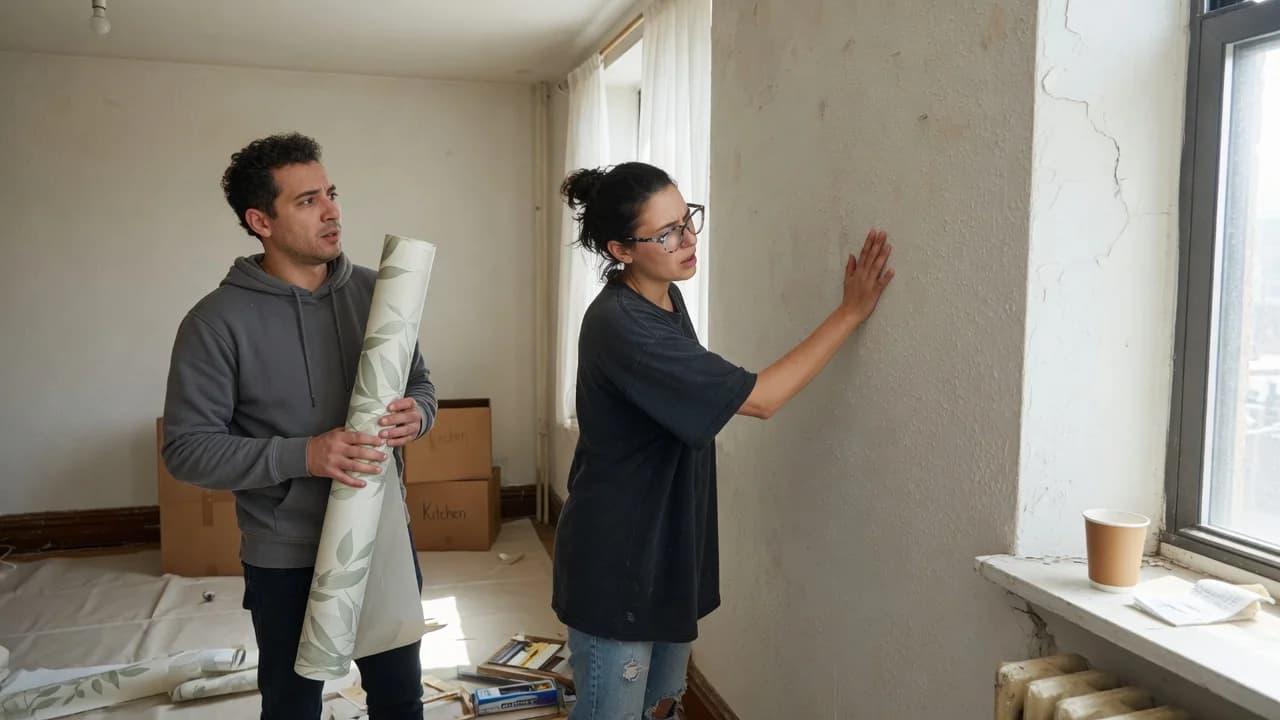
Will peel-and-stick wallpaper actually stay up on your textured apartment walls?
The answer splits along three variables most product packaging ignores: the geometry of your wall texture, the sheen of the paint underneath, and whether you're willing to run a five-dollar test before committing to a full wall.
A renter in a 1990s Dallas complex with orange-peel walls and eggshell paint faces fundamentally different odds than someone in a 1970s Chicago walk-up with popcorn texture and flat landlord-special beige.
Manufacturers photograph their products on flawless smooth drywall, but most US rental units haven't seen a smooth wall since the contractor sprayed texture to hide imperfect drywall seams decades ago.
Both the industry and the horror stories are telling partial truths.
Peel-and-stick wallpaper can hold on textured walls, and it can remove cleanly, but the overlap between those two outcomes is narrower than most buying guides acknowledge.
Before you spend a weekend and a couple hundred dollars finding out the hard way, you need to understand what the adhesive is actually doing on an uneven surface and what makes it quit.
The better question is whether your wall's texture pattern creates continuous air channels that expand and contract with room temperature, slowly peeling the adhesive away from the peaks it's clinging to.
Why Peel-and-Stick Wallpaper Fails on Textured Walls
You'll find renters who swear their peel-and-stick wallpaper held for two years on orange-peel walls without a single lifted corner. You'll also find people whose panels started curling within 72 hours on what looked like the same surface. The difference isn't luck. It comes down to how much of the adhesive actually touches the wall. And that gap only widens with time.
Peel-and-stick wallpaper uses a pressure-sensitive adhesive, a solid polymer layer that activates under firm pressure. Unlike traditional wallpaper paste, which flows as a liquid into surface irregularities and cures into a mechanical bond, a pressure-sensitive adhesive can only bond where it makes physical contact.[1] On a smooth wall, the adhesive contacts nearly the entire surface. On a textured wall, it hits the raised peaks and bridges across the valleys, leaving pockets of trapped air.
Those air pockets aren't static. As the room warms during the day and cools at night, the trapped air expands and contracts. Each cycle pushes outward against the wallpaper from behind. Combined with the vinyl substrate's mechanical memory (its natural tendency to return to a flat state), edges and seams begin lifting within weeks.[2] The deeper the texture pattern, the faster this happens.
On a popcorn wall, failure is measured in hours.
Which Textures Can Work (and Which Can't)
Not all texture is created equal. The three textures you'll encounter in US rentals, orange peel, knockdown, and popcorn, each interact with adhesive differently. This isn't a how-to-install guide. This is about whether installation is worth attempting on your specific wall.
Here's how the common rental textures compare for peel-and-stick compatibility.
| Texture Type | Common In | Surface Contact | Verdict |
|---|---|---|---|
| Orange peel (light) | Post-1990 apartments | ~70 to 80% | Works with thick product and prep |
| Orange peel (heavy) | 1980s to 1990s builds | ~50 to 70% | Risky. Test a sample first |
| Knockdown | Sun Belt, custom homes | Inconsistent | Not recommended without wall smoothing |
| Popcorn | Pre-1980 units | Minimal | Will fail. Don't attempt |
Orange peel is the most forgiving texture for peel-and-stick wallpaper and the most common in US apartments built after 1990. The shallow, rounded bumps reduce adhesive contact but thicker vinyl products in the 6-mil-and-above range can bridge these small gaps well enough to hold for months or years.[2] Polyester fabric-backed products perform even better, maintaining contact across uneven surfaces where thinner vinyls collapse into the valleys.
Knockdown creates a trickier problem. The flattened peaks look less aggressive than popcorn, but irregular contact makes edge lifting unpredictable. Most sources recommend smoothing the wall first via skim coating or a paste-the-wall liner. That's a level of commitment most renters can't justify for a temporary upgrade.
Popcorn texture on walls appears in pre-1980 units. The gaps are too deep for any pressure-sensitive adhesive to bridge. Do not attempt peel-and-stick on popcorn.
Here's where the whole recommendation weakens. If your walls are painted with flat or matte paint, the cheapest option landlords default to, the adhesive bond degrades regardless of texture type. Apartment Therapy's testing confirms that flat paint has a porous, chalky surface pressure-sensitive adhesives cannot grip, while eggshell, satin, and semi-gloss finishes hold reliably.[3] A wall with light orange peel and eggshell paint holds wallpaper far longer than a perfectly smooth wall with flat paint. If your walls are both heavily textured and flat-painted, peel-and-stick is unlikely to work without priming first. And priming a rental wall, then undoing it at move-out, is a commitment most tenants rightfully avoid.
If you're checking your own walls right now and can't tell orange peel from knockdown: orange peel looks like the skin of an orange (unsurprisingly), with small rounded bumps of varying sizes. Knockdown looks like flattened splotches, as if someone sprayed texture and then ran a trowel over it to knock the peaks down. Popcorn looks like cottage cheese on your wall. If it's the third one, skip to the alternatives.
How to Test Your Wall Before You Buy
The question isn't whether your walls are textured. It's whether the texture traps air.
A five-dollar sample and 48 hours will tell you more than any guide can. Order a sample of the specific wallpaper you're considering. Most manufacturers sell them for four to seven dollars. Apply it to the most textured section of the wall you want to cover. Don't test on the smoothest spot. You need the worst-case scenario, not the best.
Here's what to check after two full days.
Check every edge, all four sides, for lifting. Even a millimeter of curl at a corner predicts failure at scale. Press the center of the sample firmly with your thumb and release. If you hear or feel a crackling sound, adhesive separation has already begun. Run your hand across the surface under directional light, from a lamp or window at a low angle. If the texture pattern reads through the wallpaper like braille, choose a darker or busier pattern to mask it.[3]
If the sample holds flat with no edge lift and no audible separation after 48 hours, your wall and that product are compatible. Buy the full order and install with a smoothing tool, not your hands, pressing firmly from the center outward on every panel to maximize contact at the peaks.
If it lifts, curls, or crackles, you have your answer before spending 150 dollars on enough rolls for a full wall. That's a five-dollar insurance policy against a ruined weekend and a security-deposit dispute. But you have to actually run it. If you skip the patch test and buy a full order anyway, you're not taking a calculated risk. You're running the experiment at full cost.
Six brands held for the full five months in independent real-world testing on orange-peel walls: Rifle Paper Co., Threshold, Opalhouse, Anewall, Love vs. Design, and Spoonflower.[4] That's not a guarantee for your specific wall. It's a starting list. Test your own sample.
Order a sample of the exact wallpaper you want and apply it to the most textured section of your target wall.
Wait 48 hours.
Check every edge for lift, press the center for crackling, and inspect under angled light for telegraphing.
If all three checks pass, buy the full order. Install with firm pressure from the center outward using a smoothing tool to maximize contact on every peak the adhesive can reach.
If any check fails, don't try to force it with extra adhesive or a primer you'll need to undo later. Switch to tension rods with fabric panels or adhesive-mounted wall panels. Both cost roughly the same as quality peel-and-stick, install in under an hour, and remove without a trace.
The people whose wallpaper stays up for years on textured rental walls aren't luckier than the people whose wallpaper peels in a week. They ran the test first.