A decent faux mantel shelf runs about $120, and that's before you realize your apartment's 8-foot ceilings make it look like a prop from a community theater set. You wanted a cozy fall focal point. You got an awkward shelf hovering above your TV like it's waiting for permission to land. A fall mantel display doesn't need a fireplace, and it doesn't need a shelf pretending to be one.
But the real problem isn't finding fall decor. It's knowing which surface in your apartment can carry the visual weight of a mantel display without looking like you scattered pumpkins on whatever was flat. That's the gap between "I decorated for fall" and "my apartment looks intentional."
Get the surface wrong, and no amount of dried wheat bundles saves you. Get it right, and a $40 Target run looks better than most $300 faux mantel installations. The answer turns on three variables most fall decor guides never name: horizontal sightline height, surface depth, and visual anchor weight. None of them require a fireplace, and none of them show up on the packaging of the faux mantel you were about to buy.
The Surface Problem
Most fall mantel tutorials assume you have a fireplace. They mention "the mantel" like it's a universal feature, a shelf that came with your home the way a faucet came with your sink. If you rent, it probably didn't. If you own a condo built after 1990, it probably didn't either. So you spent your Saturday scrolling through photos of rooms that look nothing like yours.
The common fix is buying a faux mantel shelf and mounting it above a console table or TV stand. This works in about one out of three apartments. In the other two, your ceilings are too low, your wall already has a TV occupying the sightline, or the shelf ends up at a height that makes the whole arrangement look unmoored from the room. So you spent $120 to create a new problem.
That framing misses something. The question isn't "how do I fake a mantel?" The better question is "which horizontal surface in this room already sits near standing height?" A real mantel sits roughly 36 to 54 inches off the floor, and that's the zone where displays feel anchored. Once you identify your surface, the styling rules are the same whether there's a fireplace underneath or not. The surface is what matters, not what's below it.
Pick Your Anchor
A mantel is just a horizontal sightline at standing height; your apartment already has one. The question is which one makes the best fall focal point. Four surfaces do the job reliably, and which you pick depends on your room's layout and how much styling real estate you need.
Before the table, one guideline: the surface typically works best between 6 and 14 inches deep. Shallower than 6 inches and your pumpkins look precarious. Deeper than 14 and you're decorating a table, not a mantel, which is a different project with different rules.
| Surface | Best For | Cost | Renter-Friendly | Visual Impact |
|---|---|---|---|---|
| Console / Entryway Table | Entryways, behind sofas | $0 (you own it) to $150 | Yes | High |
| Floating Shelf (Command-strip mounted) | Blank walls, above seating | $25-60 | Yes (under 5 lbs) | Medium-High |
| TV Stand / Media Console | Living rooms, bedroom setups | $0 (you own it) | Yes | Medium |
| Wide Window Sill (6"+ deep) | Living rooms, kitchens | $0 | Yes | Medium |
The console table wins for most apartments. It's already the right height, already a focal point in an entryway or behind a sofa, and it gives you the longest uninterrupted run of styling real estate. The floating shelf is your best option when you have a blank wall begging for a focal point, but it demands discipline: you're working with 4 to 5 feet of width and maybe 7 inches of depth, so every item has to earn its spot.
The Three Rules That Make Any Surface Read as a Mantel
Mantel styling isn't mysterious. Interior designers have been teaching the same framework for years: anchor, flank, layer. Marie Flanigan, an interior designer whose work has appeared in The Spruce, puts it simply: decor that's too small gets lost, pieces that are too large overwhelm, and the most stylish mantels feel intentional, not overdone.[1]
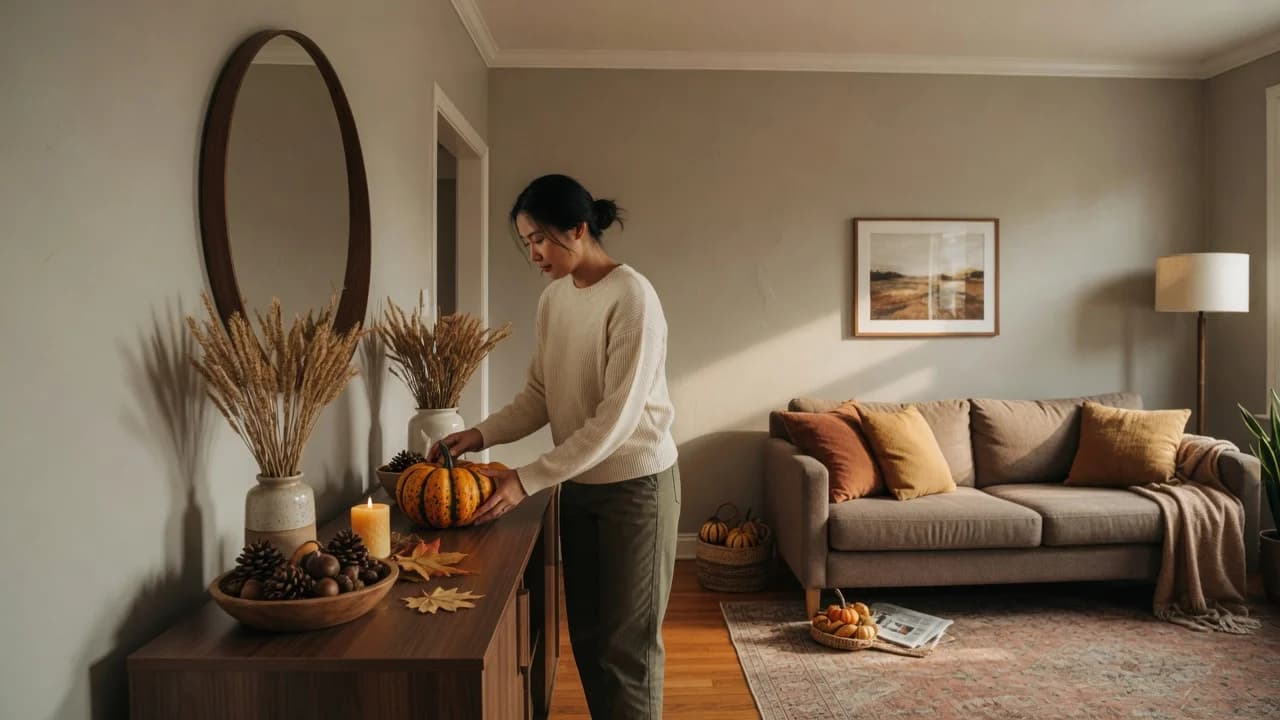
Rule 1: Anchor with one large piece. A mirror, a framed print, or a wreath centered above your surface. The anchor does the heavy lifting. It fills vertical space and tells the eye where to land. Without an anchor, your display becomes a line of small objects that reads as clutter regardless of what you paid for them. The anchor should fill 50 to 75 percent of the wall width above your surface.
Rule 2: Flank with height variation. Tall candlesticks, a vase with dried branches, or a lamp on one side. A cluster of shorter items on the other. The goal is asymmetrical balance, not matching bookends. Items of identical height on both sides read as formal and stiff. Better Homes and Gardens recommends varying item heights and mixing textures to avoid the flat, one-note look that makes displays feel like a store shelf.[2]
Third: Layer in front of your anchor. Lean a smaller frame or a seasonal sign against your mirror from behind. Place a row of mini pumpkins in front of candlesticks so they overlap visually. Layering creates depth on a surface that's inherently shallow. Without it, your display looks two-dimensional. No matter what you spent.
If you do nothing else, pick an anchor, add something tall on one side, and layer one object in front of the anchor. Three items. Intentional placement. That's already better than 80 percent of the fall displays in your building.
Fall Decor at Apartment Scale
Full-size pumpkins on a console table look like you're storing produce. Dried corn stalks leaning against a floating shelf look like a seasonal crime scene. Mantel styling at apartment scale means shrinking the fall vocabulary to fit surfaces that are 4 to 6 feet wide, not 6 to 8.
Mini pumpkins and gourds (3 to 5 inches across) do the work of full-size ones without dominating the frame. Dried wheat bundles cut to 18 inches give you height without the farmstand look. Pillar candles (3-wick, 4 to 5 inches tall) add warmth and fill vertical gaps between your anchor and your flanking items. They're cheap, they're the right scale, and they store flat in January. These three materials, in cream, rust, and amber, cover about 90 percent of fall displays worth looking at.
Skip the garland unless your surface is at least 5 feet wide. On anything narrower, garland reads as visual noise. (And yes, that includes the eucalyptus garland everyone on Instagram hung last year.) A few single stems of dried eucalyptus or oak leaves tucked behind your anchor piece does the seasonal signaling without the mess. The Spruce's designers confirm this applies doubly in small spaces: employ your walls and vertical surfaces before sacrificing counter space to seasonal clutter.[3]
The most common mistake I see is buying fall decor at full scale and then wondering why it doesn't fit. Open your phone right now and measure your surface. Width, depth, and the wall space above it. If an item's footprint eats more than a third of your depth, it's too big.
When the Rules Break
The anchor-flank-layer framework assumes a surface between 6 and 14 inches deep and a wall with at least 18 inches of clearance above it. When those conditions don't hold, the standard advice produces worse results than doing nothing.
Surfaces under 4 inches deep (narrow window sills, thin ledges) can't hold layered items. The fix is going vertical only: a single anchor piece on the wall above, flanked by wall-mounted candle sconces or a hanging wreath to one side. You're decorating the wall plane, not the shelf. Surfaces over 18 inches deep (dining tables, deep sideboards) invite the tableau problem: you start adding objects until the display spreads into functional territory and your remote control ends up next to a decorative gourd.
Ceilings under 8 feet create a separate constraint. Your anchor piece needs to be shorter and wider rather than tall and narrow, or it will compress the visual space and make the room feel shorter than it is. A horizontal landscape-oriented print or a wide, shallow bowl works better than a tall mirror in this scenario.
Before you spend a dollar, check:
- Is your surface 30 to 54 inches off the floor?
- Is it between 6 and 14 inches deep?
- Do you have at least 18 inches of wall clearance above it?
- If renting, can you mount anything on the wall without losing your deposit?
Three yeses means the standard rules apply. Two or fewer means use the depth-specific adjustments above before proceeding.
And if your apartment genuinely has no horizontal surface between 30 and 54 inches off the ground, buy the floating shelf. But mount it with Command strips if you rent. Keep the total loaded weight under 5 pounds. And accept that.
This weekend: Identify your anchor surface. Measure its depth and the wall space above it. If it's between 6 and 14 inches deep with at least 18 inches of clearance, you're set. If not, adjust per the depth rules above before buying anything.
Same day: Pick your anchor piece. A mirror you already own, a fall print from a craft store, or a wreath you can hang with a removable hook. Place it centered above the surface. Do not buy anything else until the anchor is up.
Within the week: Add flanking height on one side (candlesticks, dried stems in a vase), layer two or three small objects in front of the anchor (mini pumpkins, a candle, a small stacked book), and stop. Take a photo. If it looks balanced from your sofa, it's done. Most mantels fail because someone added one more thing.
If your surface is a TV stand, keep the display to one side of the television. The TV is your anchor, whether you like it or not, and competing with it produces visual chaos. Style the other two-thirds of the surface and leave the TV to do its oversize job.