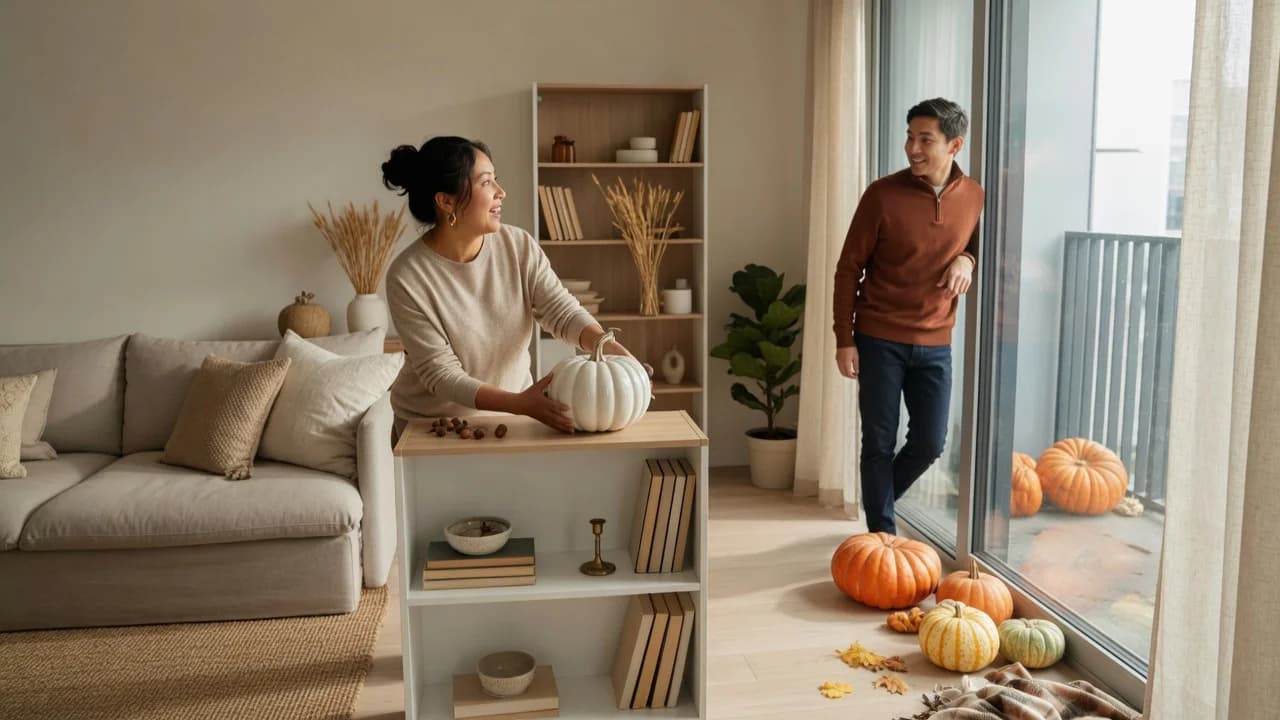
Since 2019, spending on Halloween decorations has grown from $2.6 billion to $4.2 billion.[1] The standard advice for renters — buy faux pumpkins, reuse them forever, skip the rotting mess — sounds sensible. But it ignores the single cost variable that makes renting different from owning.
Apartment storage costs about $1.93 per square foot every month,[2] and a bin of faux pumpkins stashed from November through August is quietly billing you.
The real question isn't aesthetics. It's whether you're paying rent on dead seasonal inventory.
The Hidden Cost of 'Reusable' Decor
The real-versus-faux pumpkin question isn't about aesthetics. It's a storage-space math problem most renters never run.
Most renter-focused decor articles talk about durability and appearance. Fine. But the math changes when you treat your closet as leased real estate. A medium storage bin holding six faux pumpkins takes up about 2 square feet of floor space. That bin costs you roughly $46 per year in rent. Over five years, those pumpkins have consumed $230 in storage cost before you factor in what you paid for them.
Or rather, that's the generous version of the math. In New York City, where apartments average $4.10 per square foot, that same bin runs you nearly $100 annually. The most common mistake I see is renters calculating the upfront cost of faux versus real pumpkins while completely ignoring the storage carrying cost. A $6 real pumpkin from the farmers market costs $6 and is gone by Thanksgiving. A $25 polyresin faux pumpkin costs $25 plus 10 months of closet rent every year you own it.
Whether that trade-off works depends on three things: how much you pay per square foot, whether you have genuinely free storage — a parent's basement, not your apartment — and how many seasons you'll actually reuse the pumpkins before your taste changes or you move.
Real Pumpkins: What Renters Actually Get
Picture this: you buy three beautiful heirloom pumpkins in early October for your apartment balcony. By October 20th, one has a soft spot. By Halloween, the second one's stem has gone moldy. By the time your friends come over for Friendsgiving, you're down to one sad, wrinkled gourd and a cleanup job you didn't sign up for. That's the worst case.
But it's not inevitable. An uncarved pumpkin stored at 50 to 55°F lasts 2 to 3 months, according to Oregon State University Extension research.[3] At room temperature, which is where most apartment pumpkins live, you get about a month. On a sunny balcony in October? Maybe two weeks before things get soft.
Real pumpkins work if you have a covered outdoor space that stays cool, you're buying them in October, and you accept that they're disposable. At $3 to $15 each, a seasonal pumpkin budget of $20 to $45 buys a respectable display that you throw out in November with zero storage cost. No bin. No closet rent. No mental load of remembering where you stashed them last January.
The catch: read your lease. Many apartment buildings restrict what goes on balconies, and fire codes in most US cities prohibit combustible materials near building facades. Some leases explicitly ban organic material outdoors because of pest concerns. If your balcony pumpkin rots and attracts rodents, your landlord can charge you for pest control. Real pumpkins are the right call for renters with unrestricted outdoor space and no desire to store decor. For everyone else, the math tilts toward faux. But which faux?
Faux Pumpkins Are Not One Product
The phrase "faux pumpkin" covers at least three fundamentally different products, and treating them as interchangeable is where most buyers get burned.
Styrofoam pumpkins, the kind sold at craft stores for $1 to $10, are indoor-only decor. They dent. They fade in direct sun within a single season. Paint chips off. They're essentially disposable — which defeats the purpose of buying faux in the first place.
Polyresin and UV-treated plastic pumpkins, priced $10 to $40, are the workhorses. They handle rain, typically hold their color for 3 to 5 seasons outdoors, and have enough weight to not blow off a balcony in a gust. Michaels, Target, and Home Depot all carry these in September and October. Look for "UV-resistant" or "outdoor-safe" on the label. If it doesn't say it, assume it isn't.
Ceramic and stoneware pumpkins, $15 to $50 and up, are permanent pieces. They're heavy, fragile, and stunning indoors. They won't survive a fall from a shelf, but they'll last decades. For renters with shelf space — not closet space — ceramic pumpkins that double as year-round decor solve the storage problem differently: they never go into storage. They sit on a bookshelf in July and look like intentional pottery, not forgotten Halloween decorations.
| Material | Price Range | Outdoor? | Lifespan | Best For |
|---|---|---|---|---|
| Styrofoam | $1–$10 | No | 1 season | Indoor crafts, single use |
| Polyresin/UV plastic | $10–$40 | Yes | 3–5+ seasons | Balconies, porches, repeat use |
| Ceramic/stoneware | $15–$50+ | Covered only | Decades | Indoor, year-round styling |
What you'll notice when you compare these in person is that price and material are loosely but not perfectly correlated. A $30 styrofoam pumpkin exists — it's just large and well-painted. A $12 polyresin pumpkin exists — it's small and sold at a discount retailer. Shop by material first, price second.
The Decision Framework
So which direction makes sense? It depends on three renter-specific variables that most generic decor guides ignore.
If you have a balcony or patio with no lease restrictions, and you don't want to store anything: buy real pumpkins. Spend $20 to $45 in October, enjoy them for 3 to 6 weeks, compost or trash them after Thanksgiving. Your annual cost stays low, and you pay zero in storage. The downside is the annual trip and the possibility of early rot if October stays warm.
If you have free storage space — a parent's garage, a storage unit you're already paying for and have room in, a genuinely large closet where 2 square feet of bin space costs you nothing marginal — buy 3 to 5 quality polyresin pumpkins for about $60 to $120 upfront. They'll last 5 seasons minimum. Break-even against real pumpkins happens around year 3. After that, you're saving money every fall.
If you have neither outdoor space nor free storage: skip the bulk faux pumpkins. Buy 2 or 3 ceramic pumpkins that live on your shelves year-round. They're fall decor when you want them to be and sculptural objects the rest of the year. No storage bin. No seasonal swap. Total cost: $30 to $100, permanently.
That understates it. What most people actually need isn't a binary choice between real and faux. It's a decision about whether seasonal decor is worth a permanent footprint in your apartment. For some renters, the answer is no, and that's fine. A bundle of dried wheat stalks costs $12, stores flat under a bed, and reads as fall without any pumpkin at all.
When Neither Option Works
Real pumpkins rot. Faux pumpkins need storage. And some rental situations make both choices bad.
Studio apartments under 400 square feet have no closet space to spare. If your off-season wardrobe already lives in under-bed bins and a coat rack, adding a pumpkin bin is not realistic. In these units, the storage cost isn't measured in dollars per square foot. It's measured in sanity.
Buildings with strict balcony rules — common in newer luxury apartment complexes — may prohibit any decoration visible from outside the unit. Organic materials like pumpkins can violate pest-control clauses. In fire-prone regions like California, Colorado, and parts of the Southwest, local fire codes give landlords broad authority to restrict what sits on balconies, including dried vegetation and anything combustible.
If either condition applies to you, the real-versus-faux debate is the wrong question. The better question is whether you need pumpkins at all. Flat-storing alternatives like fabric leaf garlands, string lights with fall-toned bulbs, or a single ceramic pumpkin that stays out all year solve the problem without triggering the storage-or-rot dilemma. If you ignore this and buy faux pumpkins anyway, the likely outcome is a bin you resent, a lease violation notice, or decor that spends 11 months a year taking up space you pay for and 1 month looking festive.
If you have outdoor space and no storage: buy real pumpkins each October. Spend $20 to $45, enjoy them, toss them. No guilt.
If you have free storage: invest in 3 to 5 UV-resistant polyresin pumpkins. They'll pay for themselves by year 3.
If you have neither: buy 2 ceramic pumpkins that live on your shelf permanently. Skip the seasonal swap entirely.
And if you live in a studio with a restrictive lease, skip pumpkins. Use flat-storing alternatives. The worst outcome isn't spending too much on decor. It's paying monthly rent on a bin of fake gourds you use 8% of the year.