The standard advice says buy a set of decorative bed risers and call it done. For anyone who actually cares what their bedroom looks like, that advice is wrong. Bed risers solve the storage problem. But the plastic ones scream college apartment, and even wooden versions can look like an afterthought when they don't match your frame.
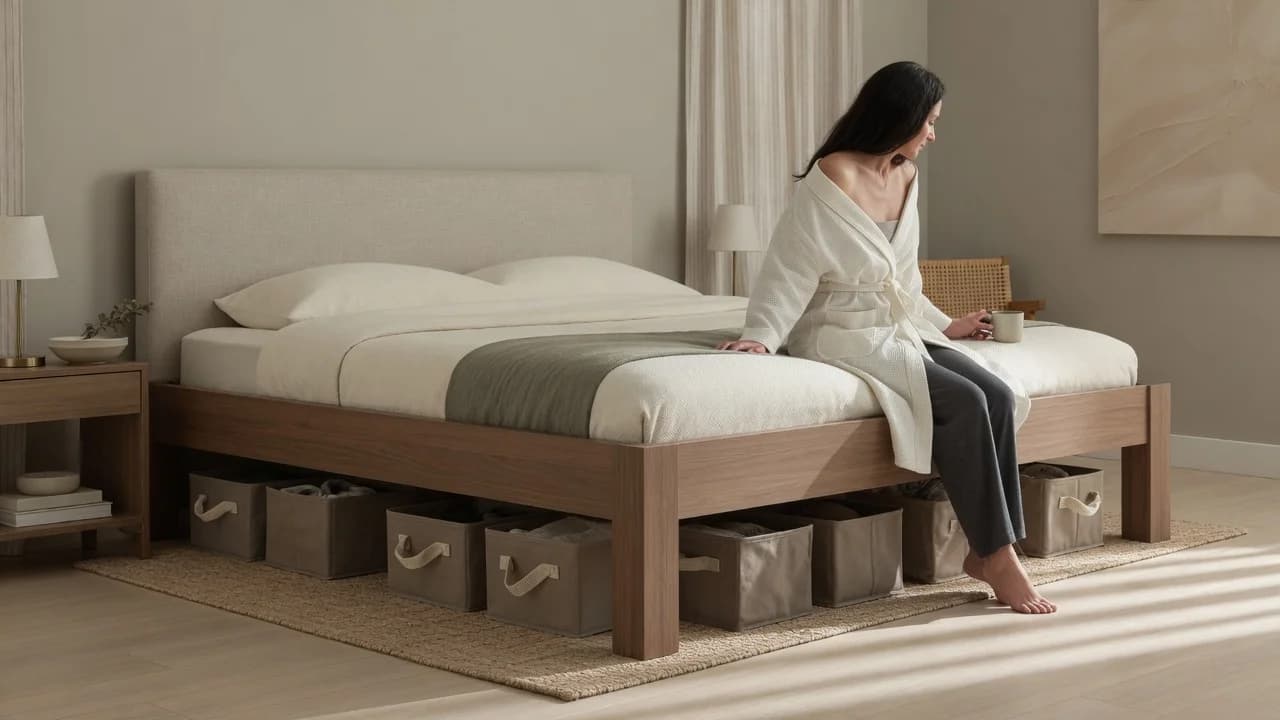
You want 8 to 12 inches of clearance under your bed, enough for bins, off-season clothes, and the shoes you swear you'll wear again. You want it to look intentional rather than improvised. Those two goals pull in opposite directions, and most how-to articles solve one at the expense of the other.
What gets overlooked is that your bed frame type dictates everything. A platform bed, a traditional panel bed with a box spring, and a basic metal frame each need a different approach. Apply the wrong method and you get wobble, visible hardware, or both. That's not a minor distinction, it's the difference between a solution that works and one that wobbles.
This isn't a guide to hiding clutter under your bed. It's about choosing a raising method that disappears into the design of the room. The fix isn't finding prettier risers. It's matching the approach to the frame you actually own.
Your Bed Frame Decides What Works
Your bed falls into one of three categories. Knowing which one you have changes everything about how you raise it.
Traditional panel beds use side rails, a headboard, and a footboard. The mattress sits on a box spring, which rests on a ledge inside the rails. The legs are usually integrated into the headboard and footboard panels, not separate pieces you can unscrew. On these frames, risers go under the four corners, but the box spring hides them from most sightlines. A bed skirt does the rest.
Platform beds have a built-in support surface, solid wood or slats, and skip the box spring entirely. The legs are typically separate, screwed into corner brackets. This is the category where replacing legs beats any riser solution. Most platform bed legs use a standard hanger bolt or threaded insert. You unscrew the old leg, measure the thread size, and order taller replacements in the same thread. M8 is common on IKEA frames. 5/16-inch or 3/8-inch is typical on American-made frames.
Then there are basic metal frames, the four-sided rail type that hold a box spring. They have thin, sometimes hollow legs or casters. Risers work here, but the narrow leg profile means you need ones with a deep recessed pocket, the kind that cups the leg rather than letting it sit on a flat surface.[1] Without that, the metal leg can slip off the riser under lateral force.
That understates it. The real distinction isn't panel versus platform versus metal. The distinction is whether your frame's legs are replaceable or fixed. If replaceable, you have options that eliminate visible risers entirely. If fixed, your game is concealment.
Raising Methods, Ranked by Finish Quality
Four approaches exist. Three work. One is the right call for your frame, and the other two will frustrate you.
Here's how the methods compare when finish quality matters as much as function.
| Method | Height Gain | Finish Quality | Best Frame Type | Cost |
|---|---|---|---|---|
| Replacement legs | 4-10 inches | High. Invisible once installed. | Platform, any frame with removable legs | $30-120 |
| Wooden riser blocks | 3-5 inches | Medium. Visible but can match frame finish. | Panel, metal frames | $20-50 |
| Stackable risers (plastic or metal) | 3-8 inches | Low. Visible hardware, dorm aesthetic. | Metal frames, temporary setups | $10-30 |
| Replace entire bed frame | 12-18 inches (built-in) | High. Designed as one unit. | Any (full replacement) | $200-800 |
The replacement leg approach wins on finish quality for a reason: there's nothing to hide. The leg is the leg. You're not adding hardware. You're changing dimensions. For platform beds, this method makes the dorm-room look impossible because the modification disappears.
Wooden risers occupy the middle ground. Furniture-grade versions exist, solid oak or walnut blocks with recessed leg cups, that look intentional against a wood bed frame. The catch: they're still visible from across the room. If your frame doesn't have a bed skirt or low-hanging cover, the gap between riser and floor reads as "I added these." And that's a hard aesthetic ceiling.
The goal isn't hiding risers; it's choosing a raising method your bed frame was actually designed for. That's why replacement legs beat every riser approach when your frame supports them. The leg swap uses the frame's existing hardware, same thread, same bracket, same load path. Risers introduce a new interface between leg and floor, which is where stability problems start.
There is a hard limit here. Platform beds with cast-in or welded legs cannot accept replacements. Same goes for frames where the legs are part of a single molded side panel, common on inexpensive upholstered beds. If your leg doesn't have a visible screw, bolt, or bracket connection, risers or a new frame are your only options. And raising any bed more than 8 inches, regardless of method, demands you check for a center support leg. Most queen and king frames have one. Without mid-span support at that height, your slats will bow within months. And that can void most mattress warranties.
What Goes Underneath Matters Just as Much
Gaining clearance is half the job. What you slide underneath determines whether the whole setup looks organized or chaotic.
Fabric bins with lids read as intentional storage. Clear plastic bins do not, they broadcast clutter even when neatly arranged. Under-bed drawers on rollers offer the cleanest look but require precise height clearance: measure the drawer's total height plus an inch for carpet pile or uneven floors.
Standard rolling under-bed drawers run about 6 to 7 inches tall. If you're raising your bed specifically for storage, target at least 9 inches of clearance. That gives you room for two stacked bins or one drawer unit with space to reach in. The 7-inch figure you'll see in product descriptions is the minimum, not the target.[2]
Color matters more than material here. Matching bins to your bed frame or bedding creates visual continuity. Contrasting bins draw the eye straight to what you're storing, which is the opposite of what you want.
The Budget Reality Check
Spending $15 on plastic risers and $40 on bins puts you at $55 with a setup that still looks like a temporary fix. Spending $60 on replacement legs and using bins you already own gets you a finished look for roughly the same outlay.
The alternative most people should at least price out: a storage bed frame with built-in drawers or a lift-up platform. These start around $200 for basic models and reach $800 to $1,000 for upholstered versions. The Amerlife lift-up storage bed runs about $350 for a queen and gives you the entire under-bed footprint as storage without any visible modification.[3]
If you plan to stay in your current place more than two years, the math tilts toward a storage frame. If you're renting and might move, the replacement leg approach preserves your current frame and costs less than a moving truck upgrade.
Ignore this and you'll spend money twice: once on risers that annoy you every time you notice them, and again when you eventually buy the frame you should have bought first.
Check whether your bed frame legs unscrew. Do that now. If they do, measure the thread diameter and order taller replacement legs in a matching finish. That single change eliminates the dorm-room look because there's nothing to hide. If your legs are fixed, get a bed skirt and wooden risers in your frame's finish. That's the best available solution for your setup.