Since 2020, the market for under-bed storage, vacuum compression bags, and modular organizers has matured past the warped plastic bins that cracked after one season. The gap between what a small bedroom can store and what most storage guides assume you own is still wide enough to swallow a winter wardrobe. But here is the mistake that sends people to The Container Store twice: they treat off-season storage as a container problem. It isn't. The first question isn't which bin to buy. It's whether your bedroom's humidity, under-bed clearance, and fabric mix will cooperate with a plan you haven't made yet.
You can spend $50 on vacuum bags and under-bed bins and still open them in October to find wool sweaters that smell like a damp basement. That's the part most organization guides skip. Storage failures are almost never about running out of space. They're about moisture trapped where you can't see it, compression destroying fabrics that needed to breathe, and clearance measurements you never took.
Your Bedroom Already Has the Square Footage
Grab a tape measure. The single most expensive mistake in off-season storage is buying bins that don't fit under your bed.
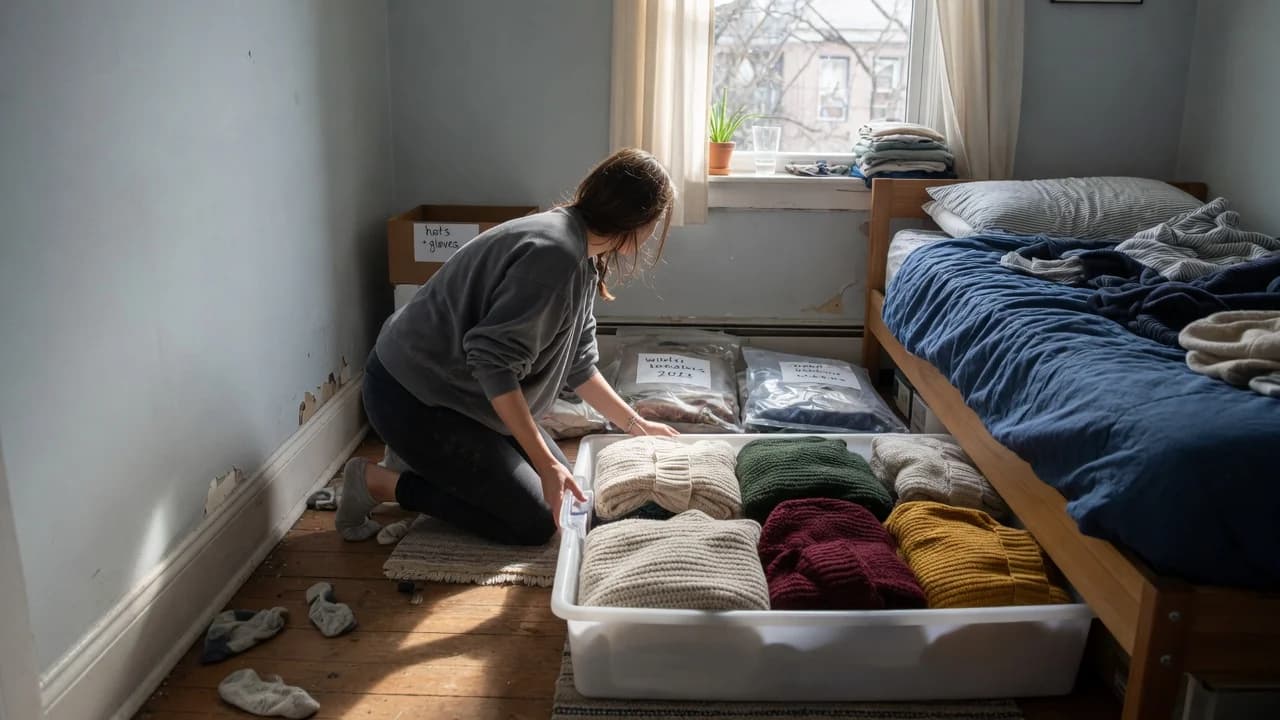
Measure the distance from the floor to the bottom of your bed frame rail. Then subtract one inch. That's your maximum bin height. A platform bed might give you 6 inches of clearance. A traditional box-spring setup on a standard metal frame often provides 12 inches or more. The difference between those two numbers is the difference between storing a full seasonal wardrobe and storing almost nothing.[3]
If your bed sits low, bed risers are the cheapest square footage you'll ever buy. A set of four adds 5 to 6 inches of lift for about $15 at any hardware store. That turns a too-low 6-inch clearance into a usable 11 inches, unlocking roughly 12 to 15 cubic feet of storage under a twin or full mattress. Two large bins holding a complete off-season rotation fit easily in that volume.
But here is where failure usually strikes first. People buy the bins before they measure. Then they stack sweaters in cardboard boxes that wick moisture from the floor, or stuff soft-sided bags until the zippers burst. Measure first. Buy second. The sequence matters.
Vacuum Bags: The Math That Actually Matters
Vacuum storage bags are sold on a promise of 80 percent volume reduction. That promise is real, but only for specific fabrics under specific conditions. You aren't solving a storage shortage. You're solving an access problem you pay for in square footage six months at a time.
Down jackets, synthetic comforters, fleece, and cotton knitwear compress dramatically: 50 to 75 percent of their original volume.[2] A stack of six bulky sweaters shrinks to roughly the size of a shoebox. Dense fabrics are different. Denim jeans or structured wool blazers compress 20 to 30 percent because they contain less trapped air to begin with. And not all vacuum bags hold their seal. Consumer Reports testing found that cheaper no-name bags tend to leak and re-inflate within weeks, undoing the space savings.[2]
That understates it. The real risk with vacuum bags isn't that they fail to compress. It's that they succeed so thoroughly you forget what's inside until next season, then discover wool fibers crushed flat for eight months have lost their loft. Natural fibers need to breathe. Down loses insulating power under prolonged compression. For wool coats and down parkas, a breathable cotton garment bag under the bed beats a vacuum bag every time. Save the compression for synthetics, fleece, denim, and cotton tees.
Here is the derived math most people skip. If your under-bed area gives you 7 inches of height across a 38-by-75-inch footprint, you have about 11.5 cubic feet to work with. A vacuum bag that compresses winter clothing from 4 cubic feet to 1.5 cubic feet means a full wardrobe plus bedding fits where a few loose boxes would fill the space. But the calculation only works if your bin height matches your measured clearance, the vacuum seal actually holds, and the fabrics inside tolerate the compression.
Moisture Is the Dealbreaker
The EPA recommends keeping indoor relative humidity between 30 and 50 percent to prevent mold growth.[1] Above 60 percent, mold spores that are always present in household air find enough moisture to colonize fabric. A sealed plastic bin under your bed in a bedroom that hits 65 percent humidity in July becomes a mold incubator whether you vacuum-sealed the contents or not.
What you'll notice when you open stored clothes after a humid summer is the smell first. Musty, faintly sour. By then the damage is done. Mold can stain cotton, weaken wool fibers, and leave odors that survive multiple wash cycles.
You need two things before you seal a single bin. First, a hygrometer (ten to fifteen dollars at any hardware store) that tells you the actual humidity in your bedroom across seasons, not the number you assume. Second, a plan for when that number climbs above 55 percent in August.
If you have central air conditioning, you're probably fine. AC dehumidifies as it cools. If you use window units or live in a humid climate like the Gulf Coast or the Southeast, silica gel packs inside each bin are not optional. Toss in two or three 40-gram desiccant packs per container. Replace them every three months. For rooms that stay persistently damp, a small electric dehumidifier costs around $40, runs on a timer, and pulls a pint of water from the air daily. Water that would otherwise end up in your sweaters.
Quick humidity guide for clothing storage:
- Under 50% RH: sealed bins are safe for most fabrics
- 50 to 60% RH: use breathable containers (canvas, cotton), add desiccants
- Above 60% RH: fix the humidity first. No bin will save fabric from sustained damp.
When Under-Bed Storage Fails
There are bedrooms where under-bed storage is the wrong answer. Recognizing yours early saves you the cost of bins, bags, and ruined clothes.
If your bed sits on wall-to-wall carpet with a thick pad, the carpet traps moisture from floor-level humidity cycles. Bins resting directly on carpet stay cooler than the surrounding air. Condensation forms on the underside. Mold starts where you can't see it. A sheet of rigid plastic or quarter-inch plywood between the carpet and the bins solves this, but if the carpet already smells musty, under-bed storage will amplify the problem.
If your bedroom has less than 5 inches of clearance and you can't use risers, under-bed bins simply won't fit. Your alternatives: over-the-door hanging organizers with clear pockets for folded sweaters and tees, a narrow shelving unit behind the bedroom door, or vacuum bags stored on a high closet shelf or inside a storage ottoman. Same compression, different footprint.
If you store leather jackets, structured blazers, or silk, skip compression entirely. These items need airflow and shape retention. Fold them in breathable garment bags and store them wherever you have flat surface area: a top shelf, a storage bench, a hanging bag behind your wardrobe.
The alternative most people reach for is a storage unit at $40 to $80 per month. That's the expensive version of the same problem. You're paying for climate-controlled cubic footage you already have under your bed, with worse access and a recurring bill. Do the math. Fifty dollars per month for six months is $300. That buys a dehumidifier, four high-quality bins, a set of risers, and a hygrometer, and you still have money left over.
If your bedroom has at least 6 inches of under-bed clearance and you can keep humidity in the 30 to 50 percent range, under-bed bins with vacuum bags for bulky synthetics and cotton are your answer. Measure clearance first. Subtract an inch. Buy bins that match.
If your clearance is tight, between 5 and 6 inches, add bed risers before you buy anything else. A $15 set unlocks storage that otherwise doesn't exist.
If humidity is your real problem, pause on the bins. Get a hygrometer. Run a dehumidifier. Switch to breathable storage until your numbers stabilize below 55 percent RH for at least two weeks. Sealed bins in a damp room will cost you more in ruined clothes than you save in reclaimed space.
And if you're storing leather, wool suiting, or silk, skip the vacuum bags and under-bed bins entirely. These fabrics need airflow, not compression. A breathable hanging bag or a cedar chest works where bins won't.
The cost of getting this wrong isn't theoretical. Open a bin in November and find your cashmere riddled with moth holes or your parka smelling like mildew, and you're out the replacement cost. That runs far more than the $60 to $100 a proper setup requires.