A queen mattress covers roughly 30 square feet of floor space, and the clearance underneath, anywhere from 7 to 12 inches on most bed frames, gives you that same footprint back if you use it right.[1] Use it wrong and the bedroom feels heavier, not lighter. The question isn't whether under-bed storage can hide clutter. It's whether your specific bed and your specific stuff make it a good idea.
Most storage advice starts with product recommendations. That's backwards. The product that works for a platform bed with 10 inches of clearance is useless under a standard metal frame with 6. The gap between what the listing photo shows and what actually fits under your particular bed is where most purchases fail.
Why Under-Bed Storage Usually Goes Wrong
Walk through any big-box store's storage aisle and you'll see the same three mistakes repeated across every option. Containers too tall for the clearance. Containers with no wheels or handles that become a pain to retrieve. Fabric bags that collapse and spill their contents when you pull them out. None of these problems show up in the product photo. They show up at 11 PM when you're digging for spare sheets.
The root problem is simple: under-bed storage is a fit problem before it's a product problem. If the container doesn't clear the frame by at least half an inch, it scrapes. If you can't reach the back of it without lying on the floor, you won't use it. And if it's ugly enough that a bed skirt becomes mandatory, you've traded one eyesore for another.
This article isn't a product roundup. The right bin for a California king with 12 inches of clearance is wrong for a twin platform bed with 5. Get the fit right and under-bed storage vanishes. That's the whole point. Not "organize the clutter." Make it disappear.
The Clearance Rule: Measure Before You Even Browse
Before you open a single product page, grab a tape measure. Measure from the floor to the lowest point under your bed frame, not the side rail if there's a center support bar hanging lower. Subtract at least half an inch. That's your maximum container height.
Standard metal bed frames on box springs typically leave 7 to 9 inches. Platform beds range from 6 inches on the low end to over a foot on taller models. Bed risers add 3 to 5 inches instantly and cost under $15 for a set of four, the cheapest way to turn a no-storage bed into a yes-storage bed.
If your clearance is under 5 inches, stop. Soft fabric bags or vacuum-seal bags are your only realistic option. Between 5 and 8 inches, you can use slim plastic bins or fabric zipper cases. Above 8 inches, rolling drawers and rigid boxes with lids open up. Above 10 inches, you've got room for stacked bins and tall containers. Measure at three points: head, foot, and center. Frames sag and floors aren't level.
That framing misses something. Clearance isn't just about height. It's about what you can actually reach. A 30-inch-deep bin under a queen bed pushed against a wall is only accessible from one side, so the back half becomes dead space unless you buy something with wheels and a pull handle.
Container Types Compared: Bins, Drawers, and Bags
Under-bed storage splits into three formats, and each one solves a different problem. Pick the wrong format and you'll hate using it. Pick the right one and the container practically disappears under the bed.
Here's how the main types compare by clearance, cost, and what they're built for.
| Type | Best For | Clearance Needed | Typical Cost | Watch Out For |
|---|---|---|---|---|
| Fabric zipper cases | Clothing, bedding, seasonal items | 5 to 7 inches | $10 to $25 | Can collapse if overstuffed; not rodent-proof |
| Rolling plastic bins | Frequent-access items, shoes, kids' toys | 7+ inches | $15 to $40 | Visible plastic; wheels catch on thick carpet |
| Rigid drawers on casters | Heavier items, daily-use storage | 8+ inches | $30 to $100 | Heavy; requires smooth floor surface |
| Vacuum-seal bags | Bulky bedding, off-season coats, maximum compression | 3 to 5 inches | $15 to $30 for multi-pack | Re-inflate over weeks; items come out wrinkled |
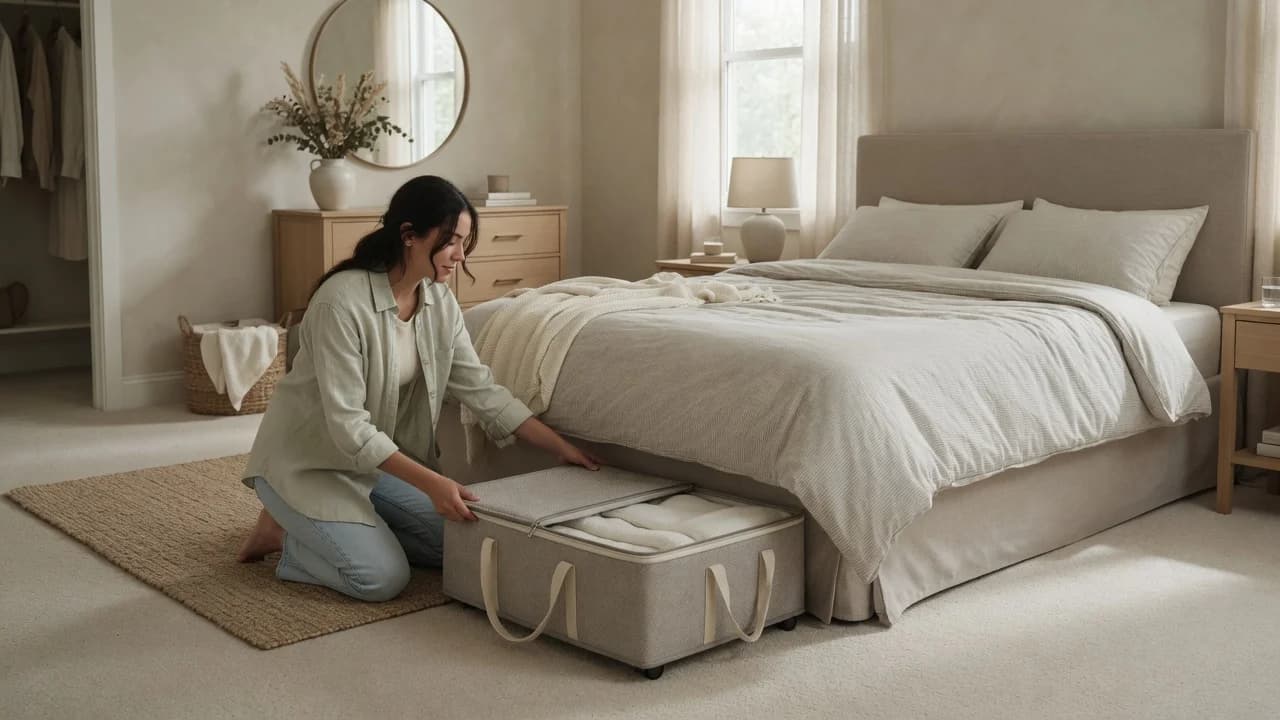
Under-bed storage isn't about fitting more things under your bed. It's about choosing containers that vanish. A soft gray fabric bin that sits flush with the bed frame edge reads as intentional. A clear plastic tub jutting out three inches reads as clutter you couldn't find a home for. The container you notice is the container that failed.
For most bedrooms, fabric zipper cases strike the best balance. They're inexpensive. IKEA's SKUBB runs $12.99 for a 35-and-a-half-by-20-and-three-quarter-inch case[2], they flex around center supports, and the neutral fabric blends with carpet and bedding. The ventilation mesh in the corners keeps clothes from developing that stale under-bed smell.
Rolling plastic bins earn their cost when you need frequent access. Sterilite's 66-quart wheeled box, which Reviewed's testing team named a top pick, slides out with one hand and the clear sides let you see what's inside without opening anything.[3] The trade-off: you need at least 7 inches of clearance, and they look like plastic bins. A bed skirt hides them. If you're fine with that, they're the most practical option.
What You're Storing Decides the Material
The same container that works for sweaters is wrong for photo albums. Material choice matters as much as dimensions, and the rule is simpler than most guides make it sound.
Clothing and textiles need airflow. Polyester fabric cases with ventilation mesh, like IKEA's SKUBB line, let moisture escape. Sealed plastic bins trap humidity, and after six months under the bed in a humid climate, that trapped moisture smells like mildew. If you live in the Southeast or anywhere with summer humidity, fabric is non-negotiable for clothes.
Paper goods, electronics, and anything vulnerable to pests need sealed plastic. Dust isn't the only thing living under your bed. A latching lid keeps out silverfish, carpet beetles, and the occasional curious pet. The Container Store's long under-bed boxes and Sterilite's latching bins both seal tightly enough for document storage.
And don't store anything under the bed that generates heat or needs ventilation. That rules out electronics in use, anything with a lithium battery, and, this trips people up, partially used paint cans or chemical products, which off-gas into the same air you breathe while sleeping.
When Under-Bed Storage Makes Your Bedroom Worse
Under-bed storage fails in specific, predictable ways. The worst-case scenario isn't "it doesn't fit." It fits but makes the room feel smaller every time you walk in.
If your bed is the visual anchor of the bedroom, no footboard, low headboard, positioned so you see underneath from the doorway, any storage that protrudes or creates visual noise undercuts the entire room. The eye goes straight to the gap. In those rooms, under-bed storage needs to be invisible: fabric cases in a color that matches the carpet or bed frame, pushed back far enough that nothing breaks the sightline.
Skip under-bed storage entirely if your bed clearance is under 4 inches. At that height, the only things that fit are items you'll never retrieve, and the frustration of scraping your knuckles against the frame every time isn't worth the minimal gain. For those beds, wall-mounted shelving or a slim dresser against the opposite wall serves the same need without the daily annoyance.
One more: if you have allergies or asthma, under-bed storage traps dust in a way that open shelving doesn't. Fabric bins collect dust on top. Plastic bins collect dust underneath and around. Either way, you're adding surfaces that need vacuuming. If your vacuum can't reach under the bed comfortably, you're building a dust reservoir that makes every breath in the room worse.
If your bed clearance is 7 inches or more, start with two fabric zipper cases for off-season clothes and extra bedding. IKEA's SKUBB at $12.99 each keeps the total under $30, and the neutral fabric blends into most bedrooms without a bed skirt. If clearance sits between 5 and 7 inches, vacuum-seal bags handle bulky textiles while slim plastic bins take everything else. If you're under 5 inches, spend the $12 on a set of bed risers before buying any storage. They multiply your options for less than the cost of one wrong container. And if your bed sits under 4 inches with no riser option, leave the space empty. A dust-free gap under the bed reads cleaner than a stuffed one, and the money you don't spend on containers that won't fit is better put toward a wall shelf or narrow dresser.