A floating shelf rated for 50 pounds costs about $60 at any home center. A fabric headboard panel runs $40 to $120. Those numbers hide the real constraint.
The obvious trade is storage versus comfort. Open any comparison guide and that's the chart you'll see. But the choice that actually matters is structural versus cosmetic. And the thing that decides it sits behind your drywall.
Which option fits your wall determines everything else. And that check is what most guides never walk you through.
Two Headboards, Two Sets of Rules
A floating shelf headboard is a wall-mounted shelf behind your bed, 6 to 10 inches deep, roughly mattress-width. It holds your phone, a lamp, a book. It replaces a nightstand and headboard in one horizontal run. That's the pitch.
But here's what the pitch leaves out: that shelf only works if your wall studs line up with your bed. US building code sets stud spacing at 16 inches on center for most residential walls.[1] A queen mattress spans 60 inches. You get three, maybe four studs behind the bed, and they're fixed in place. You can't move them. If your bed doesn't align, the shelf becomes a structural problem, not a décor one.
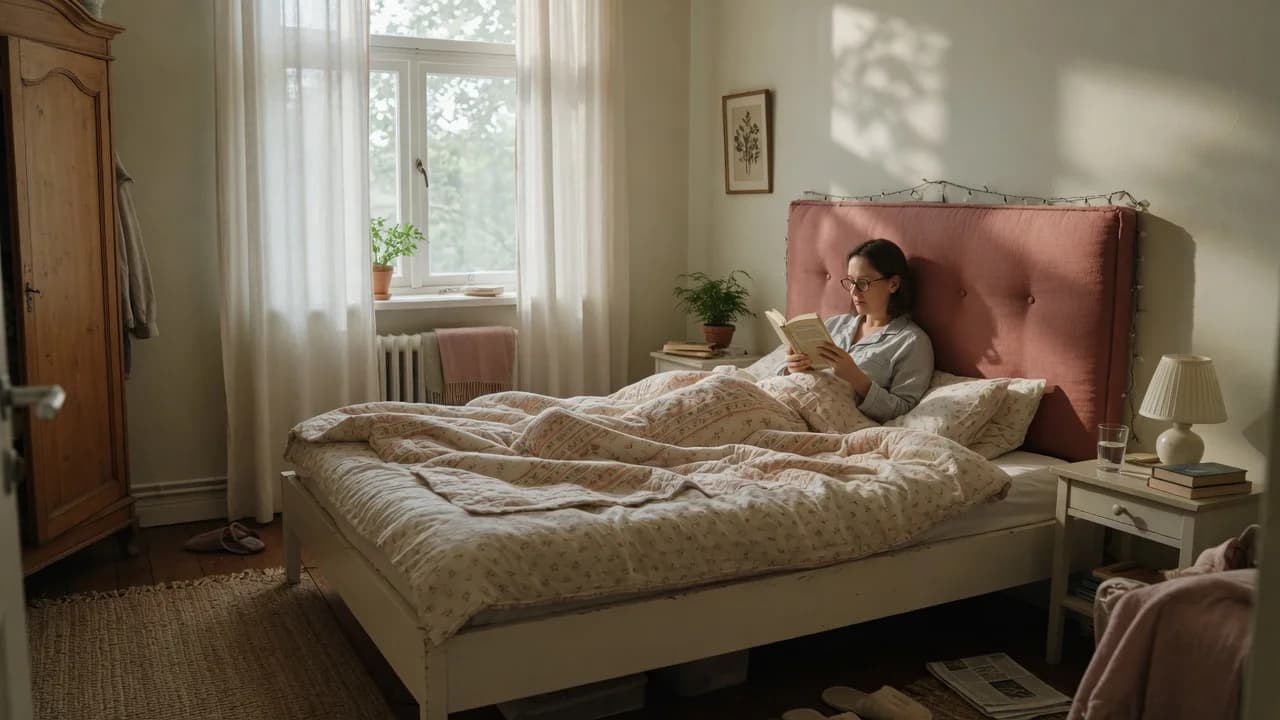
A fabric panel is simpler. Plywood wrapped in foam and fabric, mounted flush to the wall behind the bed. It adds softness for sitting up, absorbs some sound, and weighs about 8 pounds for a queen-size panel. It stores nothing. It doesn't need to hit a stud. Two picture hangers into drywall do the job. This isn't about which looks better. Both can look polished or sloppy depending on execution. The question is structural.
Your Wall Decides More Than You Think
A friend mounts a 60-inch floating shelf into drywall with toggle bolts, loads it with books and a lamp, and it holds fine for eight months. Then one night the bracket pulls a half-inch gap from the wall. The shelf didn't fail under weight. It failed under leverage. And drywall doesn't forgive.
Here's the principle. A floating shelf acts as a lever. The wall fasteners are the fulcrum. Place 10 pounds of books on the front edge of a 10-inch-deep shelf, and the pull-out force on the top fasteners multiplies far beyond the shelf's static weight. Anchored into studs with 3-inch construction screws, the shelf can handle this indefinitely. Anchored into drywall alone, even with toggle bolts rated at 100 pounds,[2] the repeated lever action works the fasteners loose over months.
The better question is whether your fasteners can handle leverage, not whether they're rated for the weight. A fabric panel pulls straight down on its mounting hardware. Two 50-pound picture hangers into drywall are overkill for 8 pounds of foam and fabric. The wall barely knows it's there.
You're not choosing between storage and softness; you're choosing what your wall can carry.
How They Stack Up
The wall drives the decision. Here's how the two options compare across the criteria that matter in a room where square footage is scarce.
| Factor | Floating Shelf Headboard | Fabric Panel Headboard |
|---|---|---|
| Storage | 6-10" deep shelf across bed width | None |
| Installation difficulty | High: requires hitting 2+ studs | Low: two D-rings into drywall |
| Weight on wall | 15-40 lbs empty + contents | 5-12 lbs total |
| Floor space saved | Zero footprint | Zero footprint |
| Comfort sitting up | None (hard edge) | Soft, padded surface |
| Rental-friendly | No: large holes, stud mounting | Yes: small screw holes |
| Cost (DIY materials) | $40-$100 | $30-$80 |
| Cost (buy ready-made) | $120-$400 | $50-$200 |
If your wall can take the shelf, you get storage at no floor-space cost. If it can't, the fabric panel gives you comfort without fighting your building. There's no universal winner.
When the Shelf Is the Wrong Call
A floating shelf headboard becomes the wrong choice under three specific conditions. First, when your bed placement doesn't align with studs and you're unwilling to open the wall. Adding horizontal blocking between studs means cutting drywall, installing 2x4 bracing, patching, and repainting. That's a weekend project if you know what you're doing. It's a $300 to $500 contractor call if you don't.
Second, when you rent. Most leases prohibit structural modifications. Even if your landlord allows wall-mounted shelves, the holes required for stud-grade mounting exceed what a standard security deposit tolerates. Spackle doesn't hide a 3/8-inch hole the way it hides a picture-hanger pinhole. So check your lease.
Third, when you actually want a headboard to lean against. A floating shelf edge hits you between the shoulder blades. It's uncomfortable by design. If reading in bed is part of your nightly routine, the shelf offers nothing but a hard line across your back.
Fabric panels have their own failure conditions. In high-humidity bedrooms, common along the Gulf Coast and Southeast US, fabric can absorb moisture and develop mildew against the wall if the panel isn't spaced off the drywall with felt pads or standoffs. And if you need nightstand-level storage, a fabric panel solves exactly zero of that problem.
Building vs. Buying: What the Price Tags Hide
Both options have DIY paths that cut cost significantly. But they cut into different things.
For a floating shelf, you need 3/4-inch plywood or a 1x10 board, a French cleat or heavy-duty bracket system, construction screws long enough to penetrate studs by at least 1.5 inches, and a weekend. The material list runs $40 to $80 at a Home Depot or Lowe's. The skill floor is higher than most "easy weekend project" lists admit. Getting a 60-inch shelf perfectly level across two or three stud brackets is fussy work. If the shelf tilts forward even slightly, every round object rolls off.
For a fabric panel, you need a half-sheet of 1/2-inch plywood cut to bed width, 1-inch foam, upholstery fabric (2 yards for a queen), spray adhesive, and a staple gun. Total: $30 to $60. The hardest part is pulling fabric taut at the corners. It's the kind of project you finish before lunch.
Here's a quick checklist if you're going the DIY route:
- Can you locate and mark at least two studs behind your bed? If no, stop. Build the fabric panel.
- Do you own a stud finder and a 24-inch level? If no, buy them before starting either project.
- Is your bed placement permanent, or do you rearrange furniture seasonally? Floating shelves commit you to a layout.
- Will you actually keep the shelf clear enough to look good, or will it become a clutter catch? Be honest.
If you ignore the stud check and mount a loaded shelf into drywall alone, what happens isn't dramatic. The shelf doesn't crash down during a dinner party. It slowly pulls away from the wall over weeks, leaving a widening gap at the top and eventually tearing out the anchors. You'll notice the lean before the fall. But you'll still have to patch, repaint, and start over.
Find your studs. That answer picks the headboard for you. Two studs behind the bed means you can build a floating shelf that holds real weight. No accessible studs means a fabric panel goes up in an afternoon and doesn't fight your wall. Either way, you skip the floor-standing headboard that eats 3 inches of room depth you don't have.