By 2023, the standard US apartment lease had hardened its language around wall alterations. A "no holes in walls" clause is generally enforceable under contract law, and violating it can cost you part or all of your security deposit.[1] You already know this if you've rented anywhere built after 2010. The practical question is simpler: how do you put a headboard behind your bed when you can't drive so much as a finishing nail into the drywall?
You're not hunting for decor inspiration. You want something that stays in place when you lean back against it at 11 PM with a book. That narrows the field fast.
The options that actually work fall into three categories: floor-standing headboards that use the bed's own weight for stability, adhesive-mounted panels with measurable weight ratings, and freestanding furniture that creates the headboard effect without touching the wall. Each category has a failure mode, and which one applies to you depends on variables most buying guides skip.
The tension is this: the methods that demand zero installation are also the ones most likely to shift, wobble, or tip. And the methods that stay put reliably tend to cost more or eat floor space you might not have.
The Three Variables That Decide Which Option Survives
Before you open a product page, check three things. Skip this and you'll join the group of renters who bought a headboard that didn't fit behind the bed — or tipped forward the first time someone leaned on it.
Bed frame clearance. Pull your bed away from the wall and measure the gap between the back of the frame and the wall. Less than 3 inches? Floor-standing headboards with under-bed legs are your only option in that category. Six inches or more? Thicker freestanding panels become possible. That single measurement eliminates roughly half the products labeled "renter-friendly."
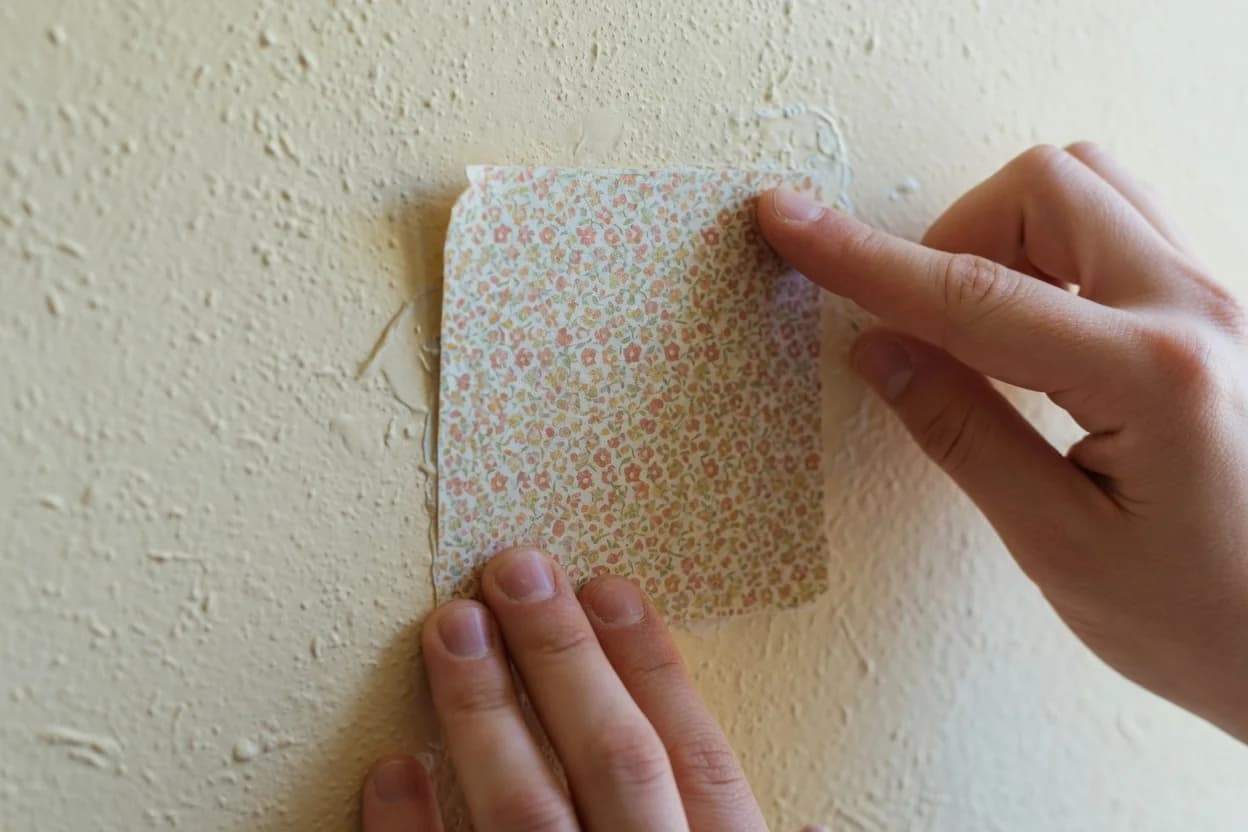
Wall surface. Textured drywall, orange peel, and knockdown finishes describe the walls in nearly every US apartment built since 1980. These textures reduce adhesive contact area by an estimated 30 to 50 percent compared to smooth drywall. Put more precisely: Command strips and similar adhesives depend on full surface contact, and texture interrupts that contact at the microscopic level. On heavily textured walls, even the strongest picture hanging strips will eventually fail under the constant low-level shear force of someone leaning against a panel every night.
Floor type. Hardwood or laminate means low friction. Low friction means a leaning headboard wants to slide. Carpet, especially medium- to high-pile, creates the opposite problem: the headboard legs sink in, and the panel tilts forward over weeks or months.
Floor-Standing Headboards and Adhesive Panels
Getting a headboard to stay put without drilling is not a decorating challenge. It's a friction and weight problem.
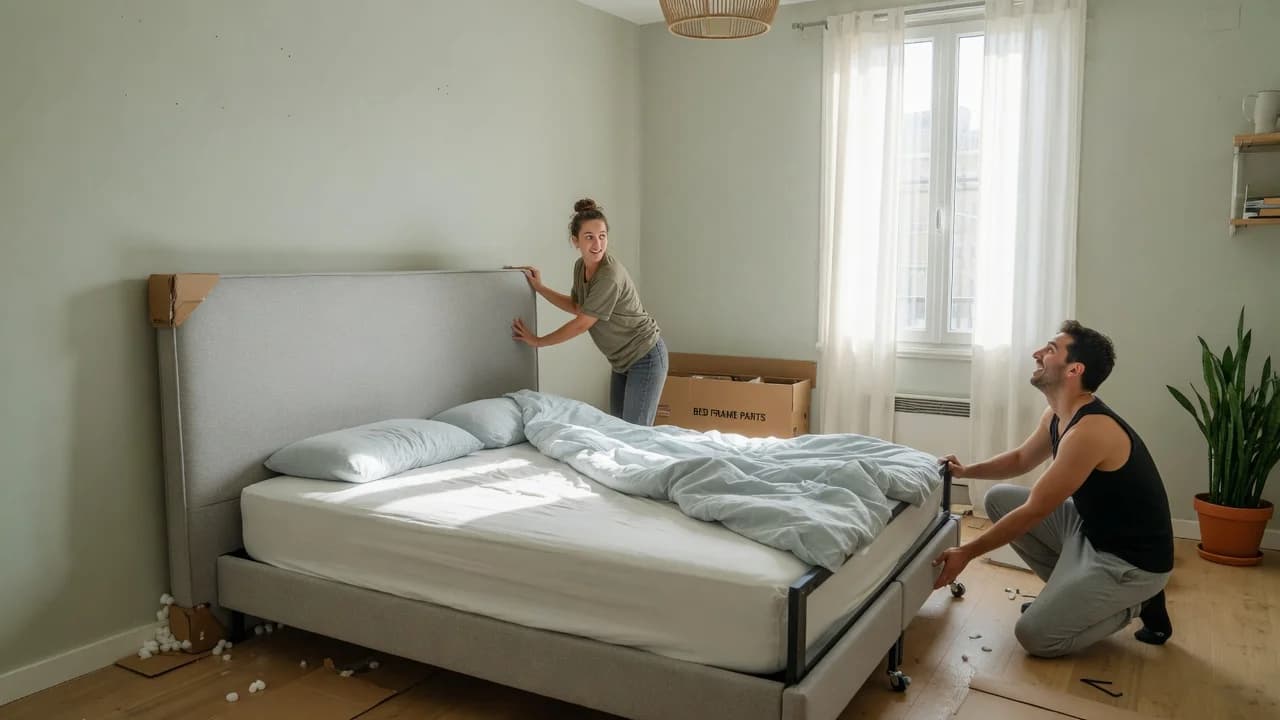
Floor-standing headboards are the closest you'll get to a traditional headboard without mounting hardware. The design: two floor-level legs extend forward under the bed frame, and the mattress and frame weight pin them down. The panel rests against the wall, stabilized by bed mass and wall contact. You slide it into position, push the bed back, and gravity handles the rest.
Prices run from about $80 for basic metal-and-fabric models at Target and Amazon to $400 and up for upholstered units from brands like SoftFrame and Baxton Studio. The height adjustment matters more than the price. Look for telescoping legs if your mattress sits higher than 14 inches off the floor. A fixed-leg headboard behind an elevated platform bed leaves a gap that looks wrong and reduces stability.
The failure mode is insufficient bed weight. A lightweight metal platform frame with a foam mattress may not provide enough downward force to prevent shifting on a slick floor. Rubber furniture grippers under the headboard legs fix this for under $10.
Adhesive-mounted panels cover lightweight upholstered boards, foam-core headboards, rattan screens, and pole-wrap sections attached with Command Picture Hanging Strips or equivalent. According to 3M, Command X-Large strips hold 20 pounds across four pairs, and that rating assumes smooth, clean, properly prepped surfaces.[2] On textured walls, derate by at least a third.
A lightweight foam headboard under 10 pounds, mounted on smooth drywall with eight X-Large strips, will probably hold. A 15-pound rattan panel on orange-peel texture with four strips will fail — maybe not in week one, but by month six, after humidity and temperature cycles have stressed the adhesive bond.
An Apartment Therapy product roundup from early 2024 included a Pottery Barn headboard that ships with 3M double-sided velcro strips as its primary mounting method.[3] When a major retailer ships an $800 product with adhesive as the sole hardware, the method is viable — but only inside its weight and surface constraints.
Here's how the two approaches compare:
| Factor | Floor-Standing | Adhesive-Mounted |
|---|---|---|
| Installation time | Under 5 minutes, no prep | 30+ minutes including wall prep and curing |
| Weight limit | No practical limit (bed weight dependent) | 20 lb max with 4 X-Large strip pairs[2] |
| Wall texture tolerance | Works on any surface | Smooth walls only; textured surfaces reduce hold |
| Price range | $80–$400+ | $30–$800+ |
| Fails when | Bed too light, floor too slick | Panel too heavy, wall too textured, prep skipped |
The floor-standing headboard wins on reliability for most US rental bedrooms. The adhesive route works in a narrower window but costs less at the entry level and preserves more floor space.
Freestanding Furniture and Frame-Integrated Solutions
If your bed frame sits flush against the wall with zero rear clearance, neither floor-standing headboards nor adhesive panels will work cleanly. You need a different category entirely.
Room dividers and folding screens are the simplest answer. A 3-panel bamboo or rattan divider folded flat behind a queen bed creates the visual anchor of a headboard without touching anything but the floor. Cost runs $60 to $200 at retailers like World Market and Wayfair.
The trade is floor space. A folded divider adds 2 to 4 inches of depth behind the bed. In a 10-by-12-foot bedroom that's already tight, that pushes the bed farther into the room than you might like. And most dividers flex or shift if you sit up against them — they're not built for load-bearing contact.
Bed frames with integrated headboards are the most stable option in the entire no-drill category and also the most expensive. The headboard is part of the frame. Nothing to attach, nothing to lean, nothing to stick. Prices start around $150 for basic metal models from Zinus and Amazon Basics and climb past $1,000 for solid wood or upholstered designs.
For renters who've been in the same apartment for two years or more and plan to stay, this route often pencils out cheaper than buying a standalone floor-standing headboard now plus replacing adhesive strips every year or two. It also survives moves — the whole unit comes with you.
The downside is obvious: you're buying a bed frame, not a headboard accessory. If you already own a frame you like, this is overkill. And if you move frequently, disassembling and reassembling a platform bed every 12 months gets old.
How to Pick
If your bed frame has 3 inches or more of rear clearance and you're on carpet, get a floor-standing headboard with telescoping legs. Add rubber grippers under the feet.
If your walls are smooth — unlikely in newer construction, but worth checking — and you want something lightweight and minimal, an adhesive-mounted panel under 10 pounds can work. Use eight Command X-Large strips, not four. Clean the wall with isopropyl alcohol, let it dry completely, press each strip for 30 seconds, and wait a full hour before hanging. Nobody actually waits the full hour. It matters more than you think.
If your bed frame is flush against the wall with zero clearance, skip straight to a frame with a built-in headboard or a room divider. Floor-standing headboards need that under-bed gap. Without it, the legs won't clear.
If you sit up in bed to read every night and lean hard against the wall, do not use adhesive-mounted anything. The constant shear load defeats even properly installed strips within months. Floor-standing or frame-integrated only.
And here's what this article is not: a list of decorative wall treatments. Painted arches, washi tape outlines, and gallery walls behind the bed are creative solutions for visual headboards, but they're not headboards. They provide zero back support and will look wrong the first time you lean against them.
If your bed frame has rear clearance and your floor is carpeted, buy a floor-standing headboard. If your walls are smooth and your panel is lightweight, adhesive mounting might work — test one strip on a hidden patch of wall first. If clearance is zero, replace the frame or use a room divider and accept the floor-space trade.
If none of these conditions describe your situation cleanly, the room divider is the option that can't fail in a way that costs you money. It doesn't touch the wall. It won't tip. It's not the most elegant solution, but it's the one that guarantees your security deposit stays intact.
Drill into the wall anyway and hope the landlord doesn't notice? A single drywall patch and paint touch-up can run $50 to $200 if the property manager hires it out, and most lease agreements authorize deducting that full amount from your security deposit.[1] For that same money, you could buy a floor-standing headboard and a good set of sheets and still come out ahead.