Leasing agents will tell you the same thing before you even ask about decorating: don't lose your deposit over wall damage. They're not wrong. A single patched hole the size of a door knob can cost you $50 or more out of your security deposit, and most renters don't know where the line sits between normal wear and a chargeable repair.
You want the bed to feel finished. A bare wall behind a mattress reads as temporary, no matter how nice the bedding is. You've got two realistic options in a rental: a real headboard you attach to the wall or frame, or a tapestry hung with removable hardware. They solve the same visual problem. They carry very different financial risks.
The gap most advice skips is that headboard installation can cross from "normal use" into "damage" in under an inch of hole size. And if you're wrong about which side you're on, the deposit math flips fast.
What You Risk with a Real Headboard in a Rental
A headboard attaches one of two ways: to the bed frame with bolts, or to the wall with brackets. Frame-mounted headboards keep the wall untouched. Wall-mounted ones need anchors or screws that leave holes behind. What you'll notice when you browse headboard listings is that none of them mention the deposit risk. The average headboard costs between $150 and $1,000 depending on size and material.[4] That's the price of entry. The real cost is what happens when you move out.
Small nail holes from hanging pictures count as normal wear and tear in almost every state.[1] A landlord can't legally deduct for them. But wall anchors for a headboard bracket leave holes between 1/4 inch and 1/2 inch. Those sit in a gray zone. Enough of them, four to six per bracket, can push your wall past "normal" and into "chargeable damage" territory. At that point your landlord can withhold repair costs from your deposit, typically $5 to $15 per hole patched and primed.[2]
Put another way: a $200 headboard could cost you an extra $300 in deposit deductions if the installation leaves too many anchor holes. That math rarely shows up in the product listing.
A tapestry isn't a budget headboard substitute; it's a deposit-preserving tool that buys design time without locking you into one wall. That framing changes which option looks cheaper in the full-cost picture. That's the real comparison.
The Tapestry Option: What It Costs and How to Hang It
A large tapestry, roughly 60 by 80 inches, costs between $15 and $60 on sites like Amazon or Etsy. At the high end you can spend $200 for a woven piece, but the $25 polyester option works fine if you're after pattern, not heirloom quality. Skip the $200 unless it's a forever piece.
The table below stacks the two choices side by side so the numbers do the talking.
| Tapestry (Command Strips) | Real Headboard (Wall-Mounted) | |
|---|---|---|
| Typical Cost | $15 - $60 | $150 - $1,000 |
| Deposit Risk | None (removable strips) | Medium to high (anchor holes) |
| Installation Time | 15 minutes | 1 - 2 hours |
| Style Flexibility | Swap seasonally | Semi-permanent |
| Back Support | None | Yes |
The cost gap is real, but the deposit column is where the decision lives. A tapestry hung with removable strips leaves zero trace. A wall-mounted headboard leaves anchor holes your landlord can charge you for. That's the column most renters miss until move-out day.
Hanging is where most people mess up. Pushpins leave tiny holes that count as normal wear, but they can't hold much weight. For anything over a pound, use 3M Command strips. Four pairs of the large picture-hanging strips hold up to 15 pounds.[3] That's more than enough for a standard cotton or polyester tapestry. Clean the wall with rubbing alcohol first, press firmly for 30 seconds per strip, and wait an hour before hanging anything. Skip that prep step and the strip fails. Every time.
Not every wall surface works. Command strips don't stick to brick or textured wallpaper. In those cases, a tension rod inside a doorway or a floor-based room divider gives you the same visual anchor with zero wall contact. You lose the "headboard" illusion but keep the deposit intact.
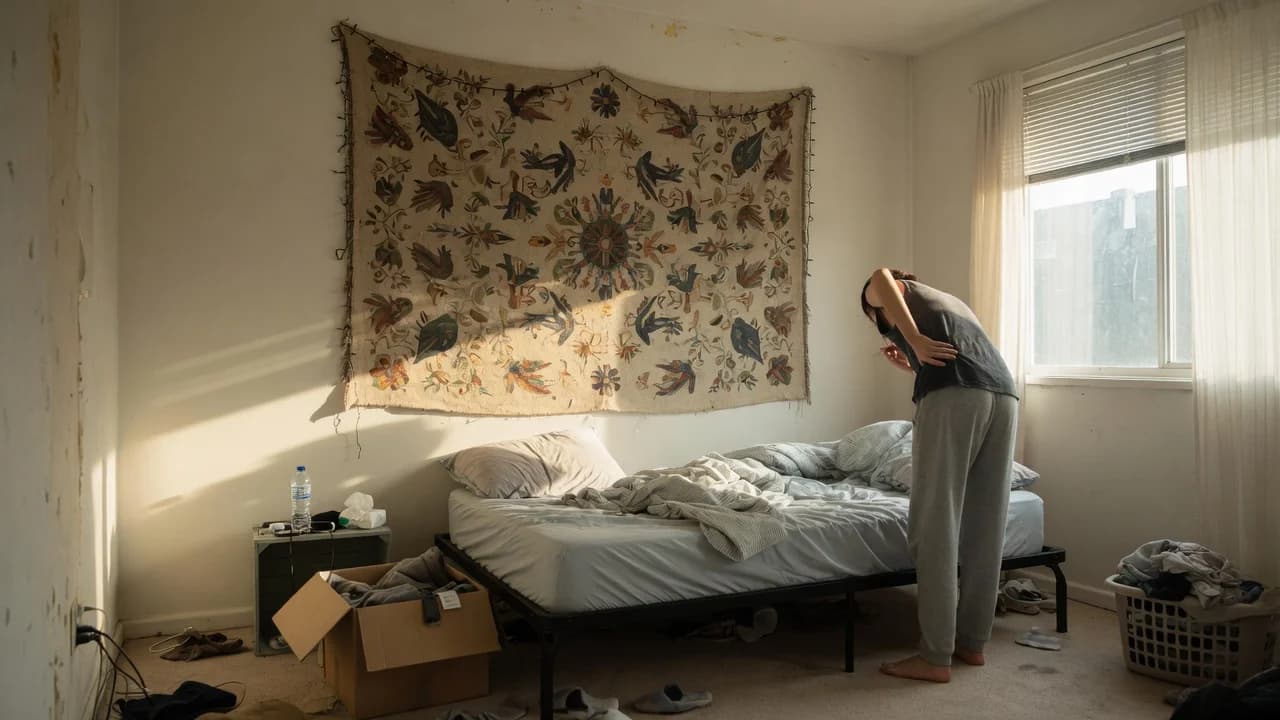
What about the look? A tapestry covers the same wall real estate a headboard would, but it adds texture instead of structure. If your bed frame is simple, or missing, the fabric softens the space. If your style changes in six months, you roll it up and switch. No patching. No repainting.
When a Headboard Still Makes Sense
This isn't an argument that tapestries are always better. A tapestry fails in one specific condition: when you actually need a hard surface behind the bed. If you sit up in bed to read or work every night, fabric against the wall won't give you back support. You'll mark the wall. Then you'll pay for it.
The other case is humidity. Bathrooms and poorly ventilated bedrooms can cause fabric tapestries to trap moisture, leading to mildew smells. Cotton absorbs it. Polyester resists better but still holds odor over time. If your bedroom runs damp in summer, a metal or upholstered headboard cleans easier.
That understates it. The better question is whether you plan to stay in this rental longer than two years. If the answer is yes, and you want a headboard, buy a frame-mounted model, like the simple metal ones from Zinus or the upholstered brackets from Casper, that attaches to the bed base, not the wall. You'll spend $100 to $300 and you won't lose a cent of deposit. That's the clean trade: floor-mounted headboard for permanence, tapestry for flexibility.
If you ignore the deposit calculus entirely and bolt a headboard to the wall without checking your lease, you're betting a $1,000 deposit against a piece of furniture you can't take with you in a meaningful way. The consequence isn't just a deduction; it's that you'll argue with your landlord over a subjective line while your money sits in their account.
Use a tapestry if your primary goal is deposit protection, low cost, and the freedom to change your mind next season. Buy the largest size that fits the wall behind your mattress. Use four pairs of Command large picture-hanging strips. Check that your wall surface is clean and not textured or wallpapered. Stay under the 15-pound total weight the strips are rated for. Remove them by pulling the tab straight down, not away from the wall, to avoid peeling paint. You'll spend under $50 all-in and leave nothing behind when you move out.