Since Facebook Marketplace turned garage sales into a 24/7 auction, the secondhand furniture pipeline has changed. Tables that once sat in basements for decades now move through living rooms in months. And a lot of them wobble.
The advice most people find online treats every wobble the same: tighten something, glue something, stick a coaster under the short leg. That approach works about a third of the time. The rest of the time, it masks the real problem long enough for the buyer to notice—right when you're trying to close the sale.
Diagnosing a wobble isn't complicated. But it demands you distinguish between three distinct failure modes, and the economics of each fix shift depending on what you paid for the piece. Loose fasteners, failed glue joints, and uneven leg contact each require a different repair. Get the diagnosis wrong and you'll waste materials on a fix that doesn't hold—while eating into the margin on a table that was supposed to be a quick turnaround.
The Three Things That Make a Table Wobble
Before you touch a tool, flip the table onto its back on a folded towel. Now diagnose.
Three wobble types, three fixes:
Uneven leg contact. Press down on opposite corners. If the table rocks diagonal-to-diagonal but the legs feel rigid in their joints, one or more feet aren't hitting the floor. This is the cheapest fix and the most common cause of a wobble that disappears on carpet but returns on hardwood.
Failed glue joints. Grab each leg where it meets the apron and try to wiggle it. If a leg moves but the hardware looks intact, the glue inside the mortise has crystallized. Wood glue degrades over decades. Humidity cycles, temperature swings, and dragging the table across the floor all contribute. The joint looks fine from the outside.
Loose fasteners. If tightening a bolt, nut, or corner bracket stops the movement instantly, you got lucky. This costs nothing to fix and takes five minutes. But don't celebrate yet.
Put more precisely: most wobbles aren't pure. A table with loose fasteners often has weakened glue too. Over-tightening hardware to compensate for a dying glue joint is how you strip threads or crack the apron. Treat the cause, not the symptom.
Fix 1: Tighten What's Loose
Start with the obvious. Corner brackets, leg bolts, any visible screws under the tabletop—check every one. Use an adjustable wrench on the nut and pliers on the bolt head. One to hold, one to turn. The goal is snug, not tourniquet-tight. Over-tightening a bolt into hardwood compresses the fibers and creates a new wobble six months down the line.
For tables where the leg threads directly into a metal insert or T-nut, check that the insert itself hasn't loosened. If the threaded insert spins in its hole, back the leg out, dab a small amount of wood glue on the outside of the insert, thread it back in, and let it cure before reattaching the leg.
This fix takes five minutes and costs zero dollars. It's the one you hope for when flipping a piece. But if tightening hardware doesn't eliminate the movement—or if the wobble returns within a week—the joint itself is the problem. Move to Fix 2.
Fix 2: Reglue the Joint
Failed glue joints account for most persistent wobbles in furniture more than ten years old. They're also the fix that separates a flipped table that lasts from one that gets returned.
Wood glue works by penetrating fibers and hardening into a bond stronger than the wood itself. Titebond Original, the standard yellow PVA used in most furniture shops, develops around 3,600 psi of shear strength on hard maple at room temperature.[1] That's stronger than the lignin holding the wood fibers together. But old glue crystallizes into a brittle filler with zero adhesive properties, especially in furniture that's lived in attics, basements, or garages.
You cannot paint new glue over old glue and expect it to hold. The step most DIY guides skip is the one that determines whether your repair survives the first move: removing every trace of the old bond. Disassemble the joint. If the leg won't come free with firm hand pressure, a few taps with a rubber mallet usually breaks the remaining crystallized glue. Scrape the mortise and tenon clean with a chisel or 100-grit sandpaper until you see bare wood on both surfaces.[2]
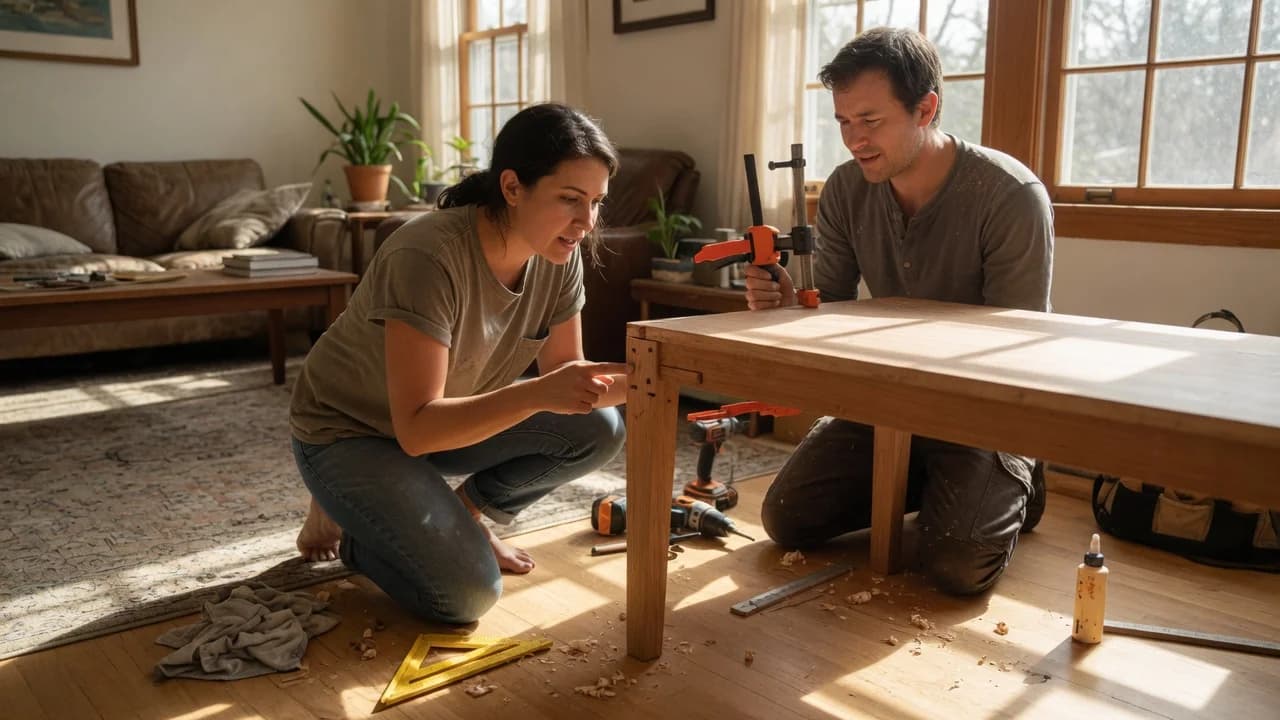
For indoor tables—which covers every living room flip—standard PVA wood glue is the correct choice. Apply an even coat to both surfaces, reassemble, and clamp. A bar clamp across the apron, padded with scrap wood to avoid marring, is ideal. Wipe the squeeze-out with a damp rag before it skins over.
Let it cure for 24 hours. Not 12. Not "until it feels dry." This is the single most common failure point: a flipper rushing the cure to get the piece listed, only to have the wobble return when the buyer leans on it a week later.
If the tenon is loose in the mortise—common in older furniture where wood has worn down—standard PVA won't fill the gap well. That's when epoxy earns its place. Unlike PVA, epoxy is the only genuinely gap-filling glue on the market and retains strength even when mating surfaces aren't perfectly tight.[3] But epoxy costs more, takes longer to cure, and adds $8-12 to your materials cost. Use it only when the joint is too sloppy for PVA.
Fix 3: Level the Feet
Sometimes the wobble isn't in the joint at all. The table was built square, the glue is solid, the hardware is tight—and it still rocks because one leg is shorter than the other three, or because your floor has a slope every table hates.
The quick diagnostic: place the table on a surface you know is flat—a kitchen counter or a level floor in a different room. If the wobble disappears, the problem was the floor, not the table. If it persists, one leg is genuinely short.
For a flip, the cleanest fix is threaded leveling feet. Drill a hole sized for the T-nut's barrel, tap it in with a hammer, thread in the leveler, and adjust until all four legs make contact. A set of four costs $6-10 at any hardware store. And here's the thing: fixing a wobble isn't about the table. It's about what happens when the buyer gets it home. Leveling feet future-proof the table against whatever floor it lands on—and that's a detail you can put in the listing. Buyers notice.
Felt pads or furniture glides work for a personal table but signal "I did the minimum" on a flipped piece. Someone checking the underside will see the difference between a permanent fix and a shim job.
When the Fix Isn't Worth It
Every repair has a cost ceiling, and for a flip, that ceiling is unforgiving. If the table is destined for Marketplace at $60-120, a fix that costs more than $15-20 in materials wipes out the margin. You need to know when to walk.
If the wobble comes from a cracked apron, a split leg tenon, or a mortise wallowed out beyond what epoxy can fill, the repair moves from "simple glue-and-clamp" to "woodworking project." Cutting a new tenon or sistering a cracked rail takes skills and time most flippers don't budget for. The math changes from a $12 glue bottle to a half-day repair with diminishing returns.
Before you commit, ask yourself three things:
Does structural repair cost exceed 25% of what the table will sell for? If yes, pass or price it honestly as-is.
Can you complete the repair without buying a tool you don't own? A clamp is one thing. A doweling jig or a router is another.
Will the repair hold through a move? If you wouldn't trust it in your own living room for a year, don't sell it.
A wobbly table sold with full disclosure at $25 still makes someone a project. A table fixed badly and sold at $80 creates a problem that follows your name on Marketplace. And the quiet math of return requests—messages, refunds, the time you can't get back—never shows up in the profit column.
Right now, flip the table and diagnose. Five minutes with your hands tells you whether you're tightening hardware, regluing joints, or leveling feet. Skip this step and you'll buy the wrong materials before you've started.
Same day: if it's loose fasteners, tighten everything and test. If it's a glue joint, disassemble, clean the old glue off both surfaces, apply fresh PVA, and clamp. Mark the clamp-removal time on your phone. You will forget otherwise.
Before you list: install leveling feet on any table where leg length varies by more than a credit card's thickness. Wipe down every joint, photograph the underside repairs, and test the table on a hard surface before the first message comes in.
A wobble is the cheapest problem a secondhand table can have—provided you diagnose it before you fix it. The table that sits dead-flat on the buyer's floor was never the one that got lucky. It's the one where someone took twenty minutes to figure out which of three things was wrong.