"Measure the width of your room" is the first thing every furniture guide tells you, and for narrow rooms it's the wrong place to start. You can have a room that's 10 feet wide (plenty of width for most sofas) and still end up with a piece that chokes the entire layout. The dimension that sinks most narrow-room furniture plans isn't width. It's depth.
Most people never calculate their depth budget, and that single omission is why living rooms end up looking like bowling alleys: sofa jammed against one wall, crooked walkway past the coffee table, and a room that feels cramped no matter how carefully you chose the paint color. This isn't about decorating tricks to make a narrow room look wider. It's about the arithmetic that determines whether your furniture fits at all.
A standard three-seat sofa measures 38 to 40 inches deep.[2] Add the recommended 16 inches between sofa and coffee table, then the required 36-inch walkway behind it,[1] and you've eaten 90 inches of room depth before you've placed anything on the opposite wall. If your room is 11 feet deep (132 inches), that leaves 42 inches for a media console and breathing room. Tight but workable. If it's 9 feet deep, you're already underwater. And most people don't run this math until the delivery truck is parked outside.
That understates it. The real issue isn't just that people skip the arithmetic. The furniture industry has spent the last decade pushing sofa depths from 36 inches toward 42 and 48 inches. The "standard" sofa in most showrooms today runs deeper than the standard of ten years ago.[2] Modern designs chase the sectional-aesthetic lounger who wants to curl up with a throw blanket. That trend is actively working against anyone furnishing a narrow room.
Two configurations actually work when space is tight: a shallow-depth sofa, or a loveseat paired with an accent chair. The right answer depends on your room's depth, how many people you need to seat, and whether you're willing to sacrifice the deep-cushion sprawl that modern sofas promise. This article gives you the numbers to check before you buy.
The Depth Budget: Stop Measuring Width First
A room that's 10 feet wide can hold nearly any sofa on the market. The longest standard three-seater tops out around 96 inches, and even that leaves 12 inches of clearance on each side. Width is rarely the binding constraint. Depth is where the trouble hides.
Here's the calculation every narrow-room buyer should run before opening a browser tab. Take your room's depth: the distance from the wall behind the sofa to the wall or furniture opposite it. Subtract 36 inches for the primary walkway. The ADA standard for accessible routes is 36 inches of clear width,[1] and interior designers treat that as the floor for comfortable movement through a living room. In a pinch you can drop to 30 inches in a secondary path, but your main circulation route needs the full 36. Subtract another 16 inches for the gap between the sofa front and the coffee table. That's the guideline most furniture planners use: 14 to 18 inches, with 16 being the sweet spot for legroom without making your drink unreachable. Now subtract the sofa depth.
What's left is your usable opposite-side space. If that number is below about 16 inches, you can't fit a media console or even a shallow bookcase across from the sofa without blocking the path. You're in loveseat-and-chair territory.
The dimension that matters isn't the one you're measuring. Most people walk into a furniture store with their room's width memorized and its depth a vague guess. Flip that priority. Depth decides whether a sofa works at all. Width only determines which sofas are in the running once depth gives the green light.
But depth isn't the whole story. The other variable is which sofa you're measuring against. And that's where the real comparison starts.
Sofa vs. Loveseat-and-Chair: Running the Numbers
An apartment-size or shallow-depth sofa is the only sofa worth considering for a narrow room. These run 32 to 35 inches deep instead of the 38 to 42 inches common in full-size three-seaters.[2] La-Z-Boy's Kennedy apartment sofa measures 38 inches deep and 69 inches wide. It's compact but still seats three adults under about 6'2". Lee Industries makes one at 36 inches deep and 76 inches wide. Shallow-depth options in the 32-to-35-inch range exist across most major US retailers, but you have to filter for them deliberately. Most showroom floors are stocked with deeper models because that's what sells to people with average-size living rooms.
The loveseat-and-chair alternative splits your seating into two pieces. A standard loveseat runs 52 to 72 inches wide and about 34 to 38 inches deep.[3] The chair adds roughly 30 to 34 inches of depth and 28 to 34 inches of width. The trick that makes this work in a narrow room isn't the dimensions of the individual pieces. It's that you can place the chair on a different wall. Put the loveseat along one long wall and the chair angled near a corner or opposite it, and the room's depth no longer has to absorb both pieces stacked in a straight line.
The table below compares the two options against the criteria that matter most when every inch counts.
| Criterion | Shallow-Depth Sofa | Loveseat + Accent Chair |
|---|---|---|
| Total depth footprint | 32–38 inches (single piece) | 34–38 inches (loveseat); chair on adjacent or opposite wall |
| Seating capacity | 3 adults | 3 adults (2 on loveseat, 1 on chair) |
| Typical cost, mid-market | $800–$1,800 | $900–$2,200 (two separate pieces) |
| Minimum room depth (with 36" walkway + 16" coffee table gap) | 96–102 inches (8'–8'6") | 90–96 inches (7'6"–8'); chair placed on opposite wall |
| Layout flexibility | Low — single fixed footprint | High — chair can be repositioned or moved to another room |
| Walkway integrity | Sensitive to sofa depth; 2 extra inches can break the layout | Preserved by splitting seating across two walls |
The depth numbers tell a clear story. In a room that's 8 feet deep (96 inches), the sofa path requires a piece roughly 30 inches deep or shallower to keep the walkway functional. Thirty-inch-deep sofas that seat three adults are hard to find. The loveseat-and-chair route, with the chair placed on the opposite wall, fits comfortably. In a room that's 10 feet deep (120 inches), a 34-inch sofa works. At 11 feet or more, even a 40-inch standard sofa clears the depth budget with room to spare.
But here's what the table doesn't capture: the loveseat-and-chair config costs more for roughly the same number of seats. You're buying two upholstered pieces instead of one. That second piece needs its own delivery, its own fabric selection, its own footprint in the room. If your depth budget clears the sofa threshold, the single-piece solution is cheaper and simpler. If it doesn't, the two-piece solution isn't a compromise. It's the only math that works.
So the real question is: what's your room's depth? Open your tape measure right now and find out.
When Neither Option Works Well
Rooms narrower than about 9 feet wide and shallower than about 8 feet deep hit a wall. In a space that tight, even the loveseat-and-chair configuration with the chair on the opposite wall leaves you with a walkway under 30 inches. You'll be turning sideways to pass the coffee table. That's not a living room. It's a corridor with cushions.
The furniture industry's answer to this problem is the "apartment sectional." You'll see these marketed aggressively for small spaces: an L-shaped piece with a chaise on one end. Ignore it. A typical apartment sectional has a seating depth of 38 to 42 inches and a chaise extension that protrudes another 50 to 60 inches into the room. In a room that's 9 feet wide (108 inches), that chaise cuts the space nearly in half. You get a walkway of maybe 20 inches. The math doesn't work, and no amount of clever angling fixes it.
If your room is below the 90-inch depth mark and below 108 inches wide, your realistic options are a pair of armless slipper chairs with a small side table, or a compact settee under 60 inches wide with no coffee table at all. Skip the coffee table. Use a narrow console behind the seating or C-tables that slide over the arm. And accept that this room won't seat four for movie night. That's not a furniture failure. It's a square-footage reality.
Here's what happens if you ignore the numbers and order the deep sofa anyway. You'll pay $100 to $300 in return shipping and restocking fees. You'll lose two to four weeks waiting for a replacement. And you'll still be shopping for seating while your living room sits half-furnished and fully frustrating. The tape measure costs nothing and takes five minutes.
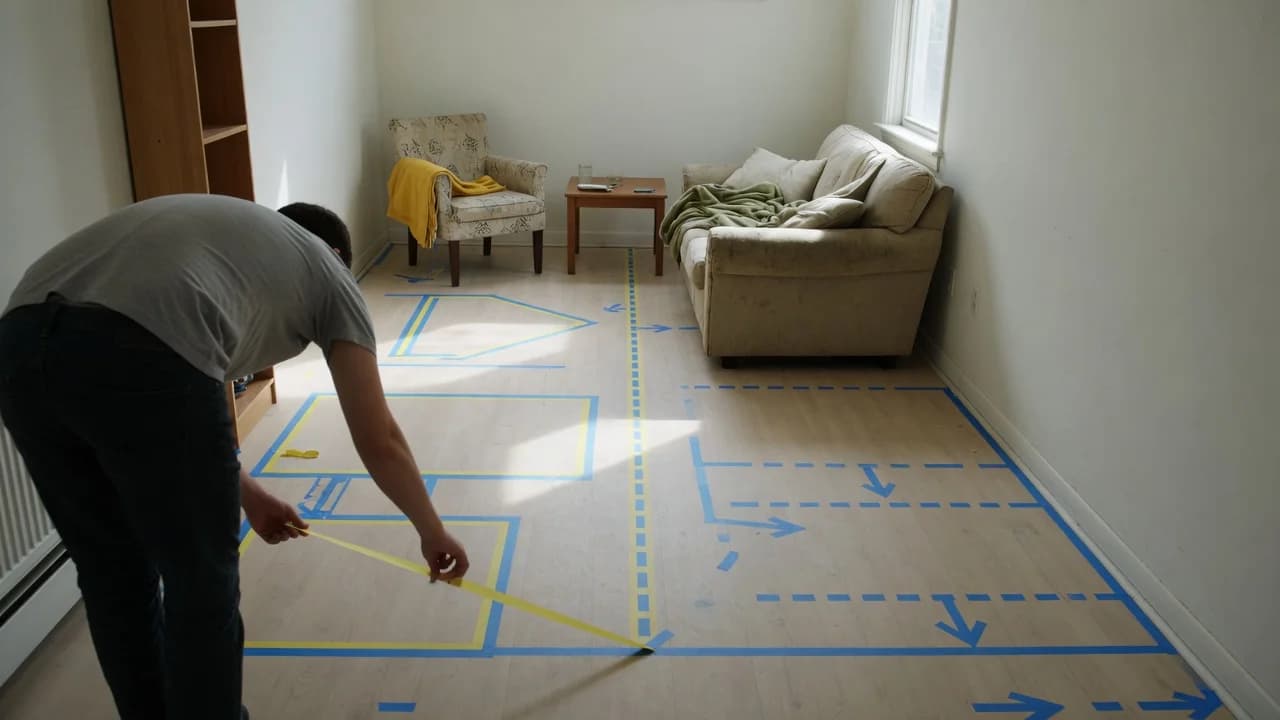
Start today: measure your room's depth from the wall behind the sofa to the wall opposite it. Not the width, not the diagonal—the depth. Write it down. Before you order anything, set a hard depth filter at 35 inches if your room is under 10 feet deep. If no sofa under 35 inches works for you, switch to a loveseat-and-chair configuration now, and measure the chair's footprint against the opposite wall to confirm at least 30 inches of clearance. Within the week, mark the furniture footprint on your floor with painter's tape and walk the path for two days. If you're sidestepping, adjust before delivery, not after. A narrow room isn't a design problem. It's a math problem. And the math either clears or it doesn't.