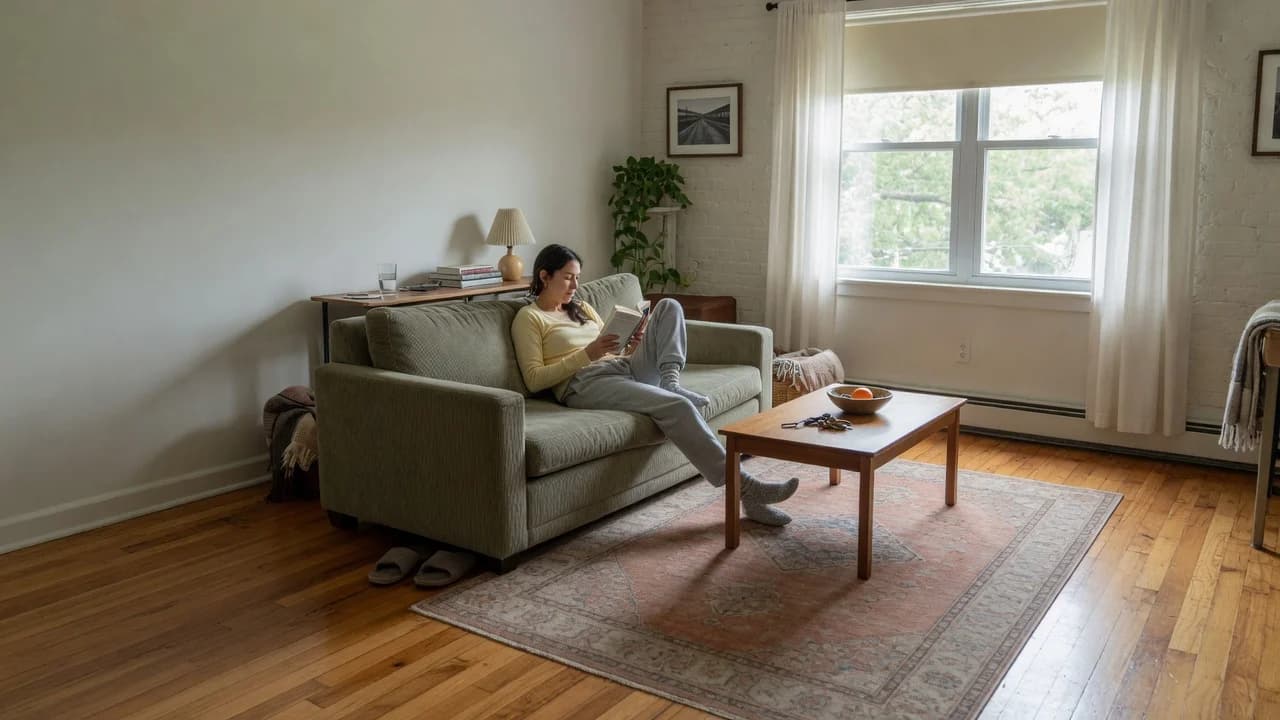
A 5x7 rug runs about $80 to $300 at most US retailers. A 6x9 costs $120 to $500. The gap between those two sizes is where most small-apartment decorating money gets wasted. Not on the wrong pattern. On the wrong dimensions for how the sofa actually sits in the room.
The standard rule says leave 12 to 18 inches of bare floor between the rug edge and every wall. That rule assumes a rectangular room with four clean walls. Small apartments rarely cooperate. You've got radiators jutting out, door swings, open kitchen transitions, maybe a column where nobody wanted one. The rule breaks fast when the room isn't a neat box.
So the real question isn't what size rug fits the room. It's what size rug anchors your sofa without choking the only walkway. Two factors decide the answer. Neither appears on a rug tag.
The Only Two Rug Placements That Matter
Your sofa-to-rug relationship has exactly two configurations. Pick one before you pick a size.
Front-legs-on means the front two legs of the sofa rest on the rug and the back legs sit on bare floor. This is the apartment default for good reason. It anchors the seating group visually without demanding a rug that eats the whole room. A 6x9 can pull this off with a standard three-seat sofa in most layouts. Even a 5x7 works under a loveseat if the room is genuinely tight.[1]
All-legs-on means every leg of every seating piece sits fully on the rug. It looks intentional and pulled-together. It also needs a much bigger rug. For a standard 72-to-84-inch sofa with a chair or two, you're usually looking at an 8x10 minimum. In a 10x12 apartment living room, that leaves almost no visible floor.[2]
Front-legs-on is the safer starting point for apartments. It's forgiving on budget and dimension. Measure your sofa. Add 12 to 18 inches total to its width. That's your minimum rug width. If your sofa is 72 inches wide, a 6x9 rug gives you 72 inches of width with the front legs landing inside the edge by several inches on each side. The math works.
Which Size for Which Sofa
Here's the counter-example first. A 5x7 under a full three-seat sofa looks like someone dropped a bath mat in the middle of the room. The sofa legs sit on bare floor. The coffee table hovers over the rug edge. Nothing visually connects. The room reads smaller than it is because the furniture looks adrift.
Now the principle: the rug has to catch at least the front legs of every major seating piece and extend past the sofa arms by enough margin that the placement reads as intentional, not accidental. Six inches of rug beyond each armrest is the floor. More is better.
A 6x9 is the workhorse size for most small-apartment living rooms. A 5x7 only works under loveseats and in studios under 10x10. An 8x10 gives you the polished all-legs-on look but can overwhelm rooms under 11x14.
| Rug Size | Sofa Type | Placement | Works When Room Is | Skip If |
|---|---|---|---|---|
| 5x7 | Loveseat (under 60" wide) | Front legs only | Under 10x10 ft | You have a 3-seat sofa |
| 6x9 | Standard 3-seat (72–84") | Front legs on | 10x10 to 12x14 ft | You want all legs on the rug |
| 8x10 | 3-seat + chairs, compact sectional | Front legs or all legs | 11x14 ft or larger | Room is under 10x12 ft |
| 9x12 | Sectional or sofa + 2 chairs | All legs on | 13x15 ft or larger | You live in a true small apartment |
Or rather: the 6x9 doesn't just work for most apartments. It's the size that most apartment-grade three-seaters were implicitly built around. A typical apartment sofa runs 68 to 82 inches wide. A 6x9 is 72 inches on its short side. That puts the sofa's front legs roughly 6 to 12 inches inside each rug edge. Exactly where they should be. Not barely touching. Not adrift in the middle. Anchored.
If you do nothing else, measure your sofa width and make sure the rug is at least that wide. Then check that the rug extends at least 6 inches past each armrest. That combination eliminates about 80% of the sizing mistakes people make in small apartments.
When a Bigger Rug Creates Bigger Problems
The advice you'll hear everywhere is "size up when in doubt." For suburban living rooms with 200 square feet to work with, that's fine. In a small apartment, a rug that's too big creates its own category of misery.[2]
A rug that runs within 6 inches of every wall reads as wall-to-wall carpet that failed. It traps dust and crumbs along edges the vacuum can't reach. It makes the room feel like the rug is wearing the apartment, not the other way around.
And here's the problem nobody mentions: an oversized rug can turn a walkway into an obstacle. If you have to step over the corner of the rug to get from the sofa to the kitchen, the rug is too big. Full stop. In a tight layout, every extra inch of rug past the seating zone is an inch you'd rather have as clear floor.
The 12-to-18-inch floor border rule exists for a reason, and it's not just visual. That gap gives the eye a place to rest and the vacuum a lane to run. In rooms under 10x10, 8 inches of border still works. Drop below 6 inches, and the room starts to feel like it's wearing a rug that's one size too large, which is almost as bad as one size too small.
The right rug size isn't about filling the floor. It's about defining where the seating ends and the walking begins.
Before you buy, check three things: the rug leaves at least 8 inches of bare floor on every visible side, no corner crosses a walkway or doorway threshold, and you can vacuum the edges without moving furniture. Miss any of those and the rug is too big for the space, regardless of what the sizing chart says.
If your apartment living room is under 10x10, an 8x10 rug may actually make the space feel worse than a 6x9, even though it's technically more rug. The extra square footage crosses from anchor to intruder.
If your sofa is a standard three-seater in a 10x12 or larger apartment living room, get a 6x9. Front legs on. Coffee table centered. You're done.
If you've got a loveseat in a studio or a room under 10x10, a 5x7 can work. Front-legs-only placement. The rug must extend at least 6 inches past each armrest. If it doesn't, go 6x9.
If your living area is 11x14 or larger and you want the pulled-together all-legs-on look, go 8x10. That extra width lets the whole sofa sit inside the rug boundary while the room still breathes.
Stuck between two sizes? Tape the dimensions on your floor with painter's tape. Live with the outline for a day. Walk around it. Sit on your sofa and look at it from the kitchen. Thirty minutes of tape work beats hauling a 40-pound rug back to the store.
And don't skip the rug pad. A pad stops the rug from sliding underfoot. In a small apartment where you're navigating tight corners every day, a sliding rug isn't an annoyance. It's a hazard.