The standard advice on small-space Christmas trees is to measure your ceiling height and buy a slim profile. For someone renting a 400-square-foot studio with a radiator hugging one wall and a bed taking most of the floor, that advice mistakes the wrong constraint.
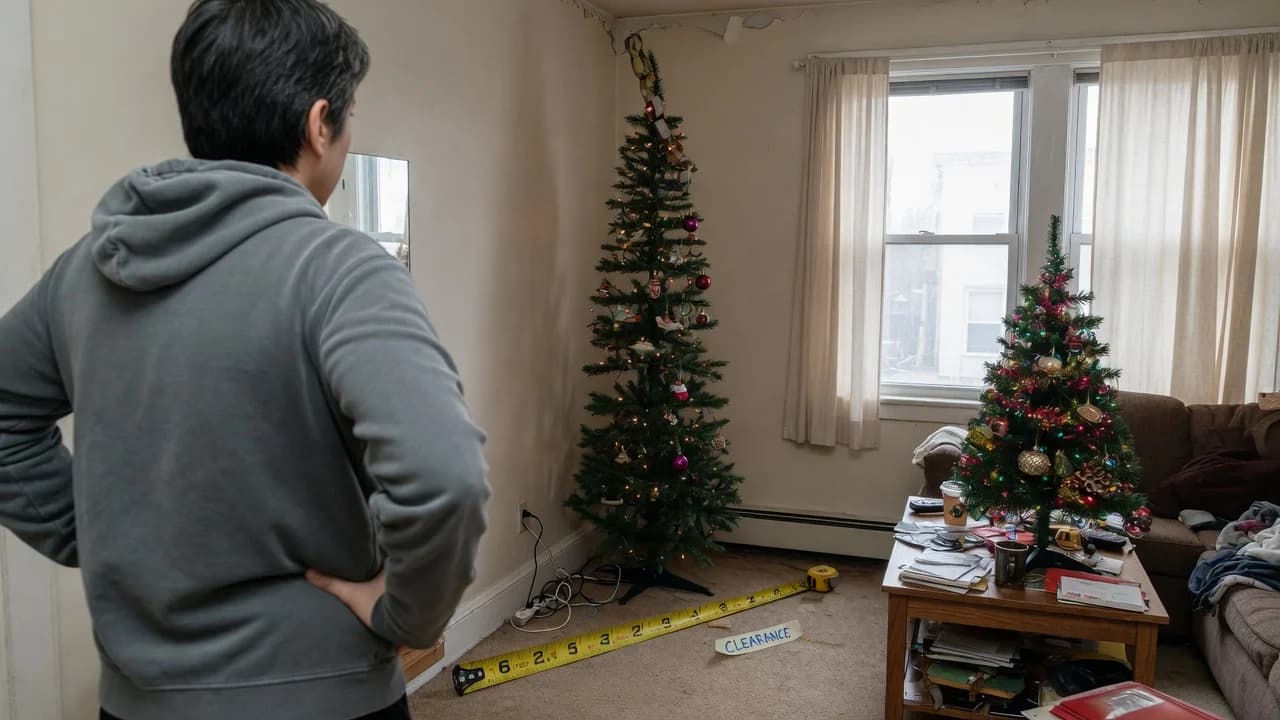
Height is the easy variable. You have 8-foot ceilings, maybe 7.5 in an older building. The math is subtract a foot for a topper, done. What trips people up isn't height. It's width. A slim tree listed at 7 feet tall and 36 inches wide at the base doesn't sound like much until you tape those dimensions on your floor and realize the walking path between your bed and the kitchen is gone.
Most buyers pick a tree by height and the word "slim" on the box, then discover at home that the diameter consumes their only walking path or the tabletop base commandeers their only work surface. That frustration is avoidable if you measure the right thing before you open a retailer tab.
This isn't about height at all. It's about whether your apartment has floor to lose or surface to lose. And the answer determines which category of tree you should even be looking at before you compare brands, tip counts, or pre-lit options.
Measure First, Browse Second
Before you open a shopping tab, you need three numbers. Not two. Most guides send you off with ceiling height and a vague instruction to "not go too wide." You need ceiling height, floor clearance width, and available surface depth. Each one changes what you buy.
Ceiling height sets the maximum. Standard US apartments run 8 feet; pre-war buildings often sit at 7.5. Your tree, including its stand and any topper, needs at least 6 inches of breathing room below the ceiling. A 7.5-foot tree in a 7.5-foot room doesn't fit. That puts most apartment floor trees in the 6 to 7-foot range. Tabletop trees run 2 to 4 feet, so ceiling height rarely constrains them.
Floor clearance width is where things go wrong. This isn't the width of your room. It's the usable floor diameter in the exact spot where the tree will stand. Measure from the wall to the nearest obstruction: a radiator, the arm of your sofa, a doorway swing path. Subtract 12 inches for walking clearance on at least one side. The number left is your maximum tree diameter.
The question isn't how tall your tree should be. It's whether you have floor to lose or surface to lose.
Surface depth matters if floor clearance pushes you toward tabletop. A 3-foot tabletop tree typically sits on a base 12 to 18 inches wide, and it needs a stable, level surface. If your console table is 10 inches deep and the tree's base is 14, the tree overhangs. That's a tipping hazard.
These three numbers determine which product category you shop in. Floor clearance at 24 inches or above puts a slim floor tree on the table. Below 20 inches, you're in tabletop territory or you need an alternative entirely. Between 18 and 24 inches, you have a decision to make, and the tiebreaker isn't preference. It's whether you can live without the walking clearance.
Slim Floor Trees: Diameter Decides Everything
The label "slim" covers more variation than most buyers expect. Retailers use it as an umbrella for anything narrower than a full-profile tree, but the difference between a pencil tree and a half-slim is the difference between fitting your apartment and your tree becoming the only thing in it.
Pencil trees are the narrowest option: 18 to 24 inches in diameter at the base, with a columnar shape that barely tapers toward the top. A 7-foot pencil tree uses about as much floor as a bar stool. The trade-off is branch density. Pencil trees carry fewer tips per branch. Consumer Reports notes that a quality 7.5-foot tree should aim for 4,000 to 5,000 branch tips, but on a pencil silhouette you may see half that count, which means trunk visibility and gaps become real concerns.[1]
Slim trees, sometimes labeled half-profile or apartment slim, run 30 to 42 inches at the base. They keep the conical silhouette of a full tree, just compressed horizontally. A 7-foot slim tree at 36 inches wide demands a corner with three feet of clearance in both directions. In a studio apartment, that's often the entire space between your bed and the wall. It fits on paper. In practice, you step around it all month.
Or rather, the constraint isn't the tree's labeled width but the clearance radius around it. A 30-inch tree in a 36-inch corner technically fits, but you can't reach the back branches to hang ornaments without dragging the whole thing forward each time. That gets old by day three.
One spec buried in product listings: the stand diameter. Some pencil trees use a tripod stand that adds 4 to 6 inches beyond the branch diameter at floor level. Check stand specs, not just tree width. If the stand pushes your total footprint past your measured clearance, the tree doesn't fit regardless of what the branch diameter says.
For most tiny apartments, the sweet spot is a 6.5 to 7-foot pencil tree with a diameter under 22 inches, placed in a corner where you measured at least 28 inches of clearance on the visible side. That gives you height and presence without surrendering your walking path. If your floor clearance can't clear 28 inches, skip to the next section.
Tabletop Trees: The Surface Trade-Off
If your floor clearance lands under 20 inches, a tabletop tree isn't a fallback. It's the correct category.
Tabletop trees run 2 to 4 feet tall with base diameters between 12 and 18 inches. At 3 feet, you get enough height to read as a tree rather than a centerpiece. The category has improved sharply: you can now find tabletop trees with PE branch tips and realistic trunk detailing that don't look like a craft-store afterthought. They take mini ornaments and a short string of lights, and at eye level on a console or sideboard, they carry more presence than you'd expect.
The constraint nobody mentions is surface stability. A tree with a 15-inch base sitting on a console that's 12 inches deep overhangs by 3 inches. Cats, elbows, and vacuum cords will find that overhang. The tree needs a surface with at least 2 inches of margin beyond the base in every direction, and the surface itself has to be level and weight-bearing. A flimsy TV tray isn't enough.
Height proportion matters. A 4-foot tabletop tree on a 30-inch console puts the top at 6.5 feet. That's taller than a full-height slim tree in the same room, and the visual effect can feel oddly top-heavy. A 2.5 to 3-foot tree on a 24 to 30-inch surface lands the top around 4.5 to 5.5 feet, which reads as proportional.
Storage is the quiet win. A 3-foot tabletop tree fits in a closet shelf box. A 7-foot slim tree, even disassembled into sections, needs a storage bag roughly 4 feet long and a foot wide. If your apartment has exactly one closet, that math matters.[1]
Making the Call: Floor vs. Surface
If your floor clearance is 24 inches or more: buy a pencil or slim floor tree. You have the space for height, and the visual impact of a 6.5 to 7-foot tree in a small apartment is worth the floor it occupies.
If your floor clearance is 18 to 23 inches: you're in the gray zone. A pencil tree at 18 to 20 inches in diameter technically fits, but you'll have near-zero walking clearance on the non-visible side. This can work if the tree goes in a corner behind a piece of furniture where nobody walks. It'll be a pain to decorate and you'll knock into it reaching for things on nearby shelves. In this zone, a tabletop tree on a secure surface often ends up being the choice you won't regret by week two.
If your floor clearance is under 18 inches: tabletop tree. Don't overthink it.
Here's how the two categories compare on the dimensions that actually matter in a tiny apartment:
| What Matters | Slim Floor Tree (6.5-7 ft) | Tabletop Tree (2-3 ft) |
|---|---|---|
| Floor footprint | 18-42 inch diameter | Surface only, ~15-inch base |
| Height with placement | 6.5-7 feet from floor | 4-5.5 feet on 24-30" surface |
| Walking clearance needed | 12+ inches on visible side | None on floor |
| Surface commitment | None | Permanent surface, 2" margin |
| Storage space | ~48" × 12" bag | Fits in closet shelf box |
| Ornament capacity | Full-size ornaments | Mini ornaments only |
One constraint overrides everything above: your lease. Many US apartment leases explicitly prohibit live Christmas trees due to fire risk. The National Fire Protection Association reports that US fire departments responded to an average of 160 home structure fires per year that began with Christmas trees between 2016 and 2020, causing an annual average of two deaths and $12 million in direct property damage.[2] Even with an artificial tree, keep it at least 5 feet from any heat source, including radiators and space heaters.[3] In a 400-square-foot studio, that 5-foot radius often eliminates the only viable corner you measured.
If both categories feel like they're demanding space you genuinely don't have, there's a third path most guides skip. Wall-mounted fabric trees, string-light tree outlines on the wall, or a small potted Norfolk pine used as year-round greenery all deliver holiday presence without claiming floor or surface. Apartment Therapy found the Grandin Road wall-hanging tree to be a genuinely pleasing option for spaces where floor space doesn't exist at all.[3] Zero footprint. It hangs on a nail.
The Number That Actually Decides
Buy the tree that matches your apartment's abundant resource. If you have floor, get a pencil tree at 6.5 to 7 feet with a diameter under 22 inches, placed where you measured 24+ inches of clearance. If you have surface, get a 2.5 to 3-foot tabletop tree with a secure base on furniture you already own. If you have neither, get a wall-hanging tree and skip the floor game entirely.
Don't estimate the numbers. Tape the footprint on your floor tonight and walk around it for an evening. The tree you don't trip over is the right diameter. Order the one that clears your tape by at least 2 inches.
Everything else — brand, pre-lit vs. unlit, PE vs. PVC — matters only after the dimensions work. Get the dimensions wrong and none of the features will save you from a tree that makes your apartment feel smaller than it already is. Get them right and you'll set it up, step back, and realize the space works better than you thought it could.