The label says "removable," and for most surfaces that's true—until it isn't. Contact paper has become the go-to rental upgrade for kitchen cabinets that haven't seen an update since the Clinton administration. The risk nobody mentions is what happens when adhesive meets substrate: the glue that makes contact paper stick is also what makes it a liability on the wrong cabinet surface.
Most cabinet doors in US rentals fall into three categories: solid wood—rare in apartments built after 1990—painted MDF, and thermofoil-wrapped particle board. That third category is the problem. Thermofoil is a thin PVC skin heat-vacuumed onto an MDF core, and the bond between the foil and the core degrades with age and heat exposure. When you peel contact paper off a thermofoil door two years later, the foil can come with it. That damage exceeds what state security deposit laws classify as normal wear and tear.[1]
The question isn't whether contact paper works as a cosmetic upgrade. It does. The question is whether your specific cabinets can survive the removal, and that depends on three things most guides skip: the surface material, the age of the finish, and how close the cabinets sit to a heat source. Get those wrong and you're not just removing contact paper—you're paying to replace cabinet doors.
Know Your Cabinet Surface
Before you order a single roll, open a cabinet door and look at the edges. The construction tells you everything you need to know about whether this project will end with a full deposit refund or a deduction letter.
Solid wood doors show end grain on the top and bottom edges—visible growth rings where the face meets the edge. Contact paper removes cleanly from sealed wood in nearly every documented case because the adhesive sits on top of the finish rather than bonding into the surface itself. Painted MDF is the middle-risk category, identifiable by its smooth, grain-free face and slightly soft unsealed edges. The paint layer acts as a buffer, but builder-grade paint jobs in apartments—often a single coat sprayed over primer—can lift under sustained adhesive contact.
Then there's thermofoil, and this is where the deposit risk lives. These cabinets have a uniform plastic sheen with no visible wood grain, and their edges appear wrapped in a continuous skin with faint seam lines at the corners. The safety of contact paper depends almost entirely on what your cabinet doors are made of, not the "removable" label on the roll. The bond between thermofoil and its MDF core weakens predictably over time, which means removing adhesive from the surface can delaminate the foil from the door entirely. That damage extends beyond what security deposit law classifies as normal wear and tear—it becomes tenant-caused damage, and replacing cabinet fronts can consume a full deposit.[1]
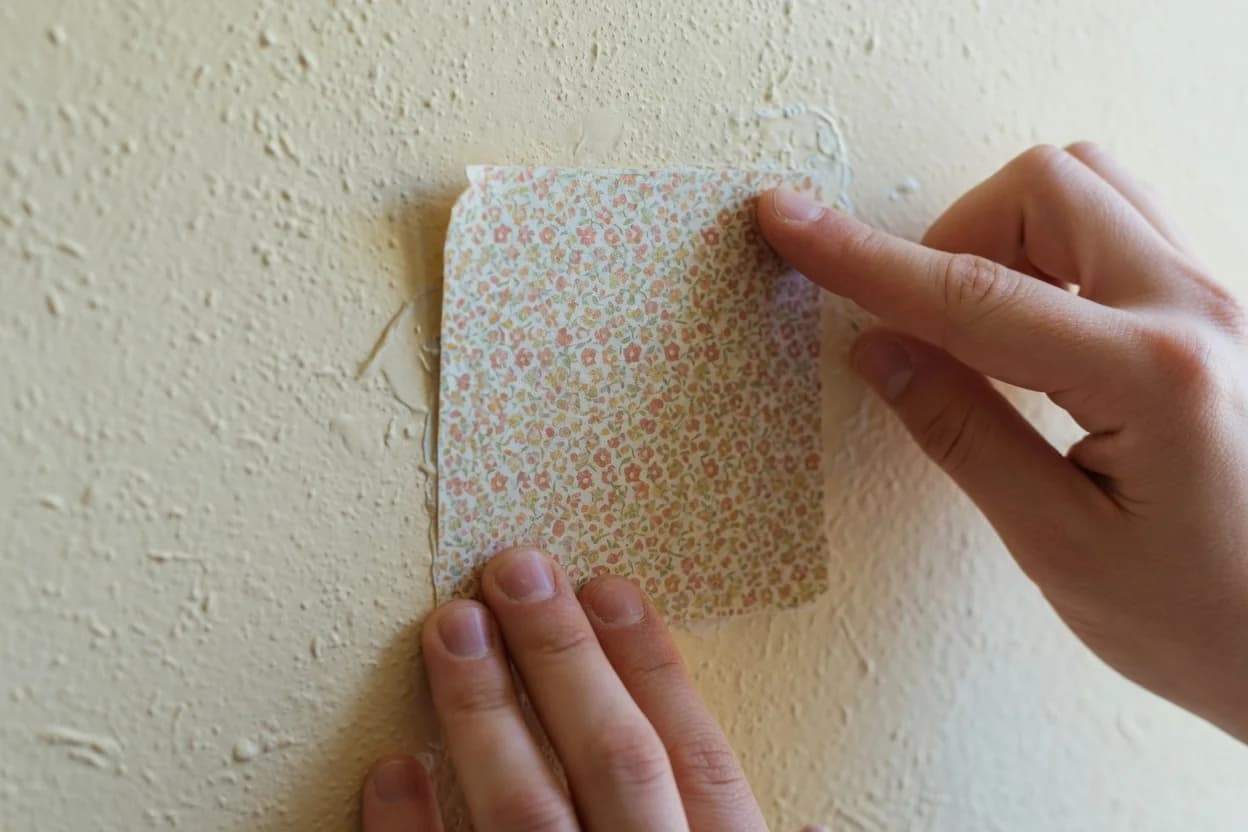
The test you can run right now: press a piece of standard clear packing tape onto an inconspicuous area—the inside edge of a door near a hinge. Leave it for twenty-four hours, then peel. If any finish comes with the tape, contact paper will do the same thing across a larger surface with a stronger adhesive that has had months to cure.
What Makes Contact Paper Safe or Dangerous
Not all contact paper is the same product, and the differences determine whether removal is a ten-minute job or an afternoon of damage control. The critical variable is the adhesive formulation.
Traditional contact paper uses a rubber-based or acrylic pressure-sensitive adhesive that increases bond strength over time through a process called cold flow. The adhesive literally flows into microscopic pores in the cabinet surface, creating a mechanical bond that heat alone cannot always fully reverse. Premium vinyl films, particularly those marketed as removable or repositionable by manufacturers like d-c-fix, use water-based or low-tack acrylic adhesives designed to release cleanly when warmed.[2] The price difference between these categories runs roughly ten to fifteen dollars per roll. That spread is negligible compared to the cost of replacing even one damaged thermofoil door.
A third category has emerged recently: static-cling films that use no adhesive at all, relying instead on electrostatic attraction. These products solve the adhesive problem entirely but introduce their own limitation—they don't grip textured or curved surfaces reliably and tend to lift at edges within months near cooking heat.
| Product Type | Adhesive Risk | Best Surface | Approx. Cost per Roll |
|---|---|---|---|
| Traditional contact paper | High: bond strengthens over time | Sealed solid wood only | $8–15 |
| Premium removable vinyl | Low: heat-releasable adhesive | Sealed wood, painted MDF | $18–30 |
| Static-cling film | None: no adhesive | Smooth, flat, non-textured | $15–25 |
The table makes the trade-off clear: you're choosing between lower upfront cost and lower removal risk. For cabinets within three feet of a stove or dishwasher, the premium removable vinyl is the only paper-based option worth considering. Heat cycling from appliances accelerates adhesive curing, which means the same roll of traditional contact paper that peels off harmlessly from a hallway closet after two years may strip finish from a cabinet next to the oven in six months.
The Application-Removal Lifecycle
How you apply contact paper is how you will eventually remove it. The technique at installation determines whether removal takes an hour with a hair dryer or an entire weekend with a plastic scraper and a bottle of Goo Gone.
Start with a degreased surface. Kitchen cabinets accumulate a film of polymerized cooking oil that's nearly invisible—you can feel it as a slight tackiness when you run your fingers across the surface above the stove. That film prevents adhesive from bonding evenly. Use TSP or a dedicated degreaser, not dish soap, which leaves its own residue. Wipe the surface with isopropyl alcohol after cleaning and let it dry completely.
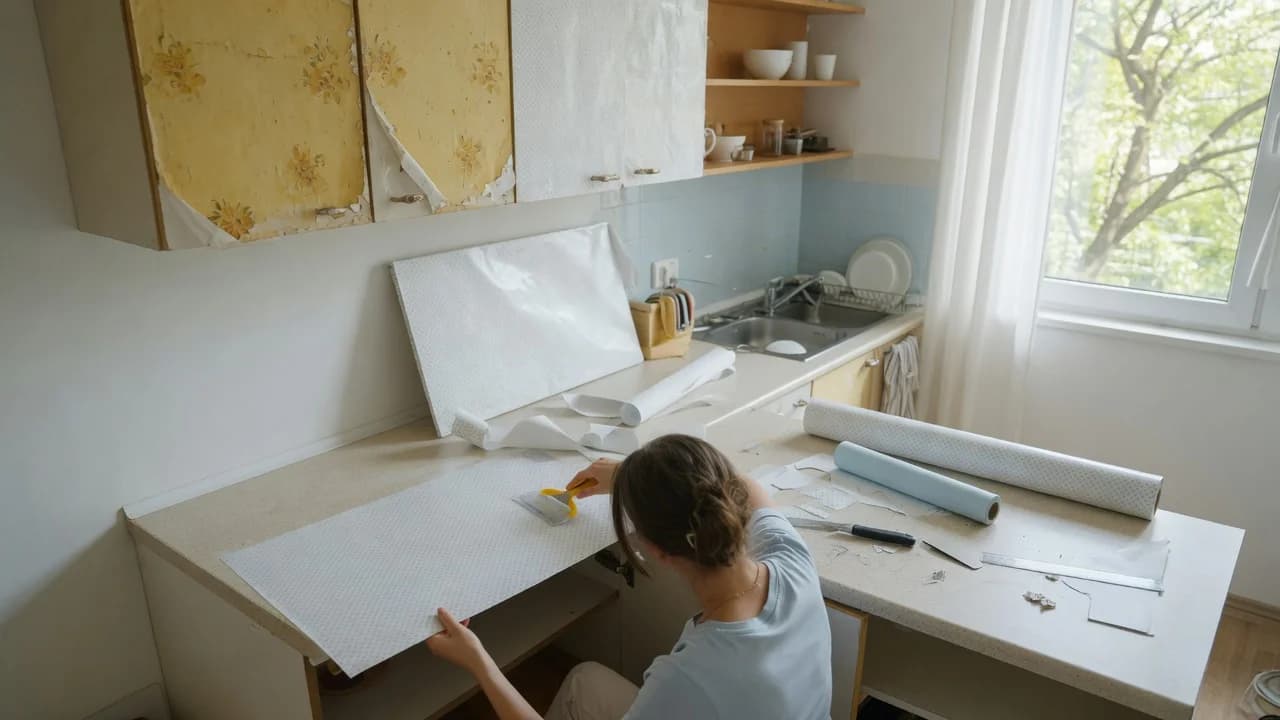
Apply the contact paper so it wraps around the back of the cabinet door by at least half an inch on all sides. This prevents the paper from catching and lifting every time you open the door, and it gives you a clean edge to grip when removal time comes. The most common application error—and the one that turns removal into a headache—is trimming the paper flush with the door edge. Flush-cut paper has no grab point. You end up digging at the adhesive with a scraper, which is exactly how cabinet finishes get gouged.[3]
Removal follows the same principle in reverse: heat, patience, and the right angle. A standard hair dryer set to medium-high, held six to eight inches from the surface and moved continuously, softens most removable vinyl adhesives within thirty seconds. Peel at a forty-five-degree angle relative to the door surface, not straight up. Straight-up peeling concentrates force on a narrow strip of finish; a shallow angle distributes the stress across a wider area and reduces the chance of lifting the underlying surface. If the paper tears mid-pull—and it probably will on doors larger than a breadbox—reheat the area before attempting to lift the new edge.
That framing misses something. The hair-dryer-and-peel method assumes the adhesive is the weakest bond in the stack. On aged thermofoil, the factory bond between the foil and the MDF core can be weaker than the contact paper's grip on the foil surface. You're not removing the paper from the cabinet—you're separating the cabinet from itself. If your cabinets are thermofoil and the paper has been in place for more than eighteen months, even careful heat-assisted removal can pull the foil away from the core, particularly in kitchens where the cabinets face a south-facing window or sit adjacent to the oven. In that scenario, the question stops being "can I get my deposit back" and becomes "how much of it will I lose."
For adhesive residue that remains after the paper comes off—and some residue is normal even with premium products—start with the gentlest solvent: warm water with a few drops of dish soap. If that fails, move to mineral oil or a citrus-based adhesive remover. Goo Gone works for most residues but contains petroleum distillates that can haze certain lacquered finishes. Test it on the inside of a door before touching a visible surface. Rubbing alcohol is the next step up, but it dissolves shellac and can dull some varnishes on contact. Acetone should never go near a cabinet door; it strips paint and melts thermofoil.
When Contact Paper Is the Wrong Call
You might be reading this because you've already seen a Pinterest transformation and the roll is sitting in your cart. That enthusiasm is the moment to pause and run the numbers on what reversible actually means for your specific apartment.
If your cabinets are thermofoil, more than a decade old, or showing any existing peeling at the edges, contact paper is not your upgrade. It's a liability. The cost of replacing a single thermofoil cabinet door runs between sixty and two hundred dollars depending on size and whether the landlord can match the existing style—and landlords are entitled to charge for the full replacement cost of tenant-caused damage beyond normal wear and tear.[1] Multiply that by ten or fifteen doors in a typical kitchen, and a forty-dollar contact paper project can generate a deduction letter for two thousand dollars.
The alternative that actually works for high-risk surfaces is a hardware swap. New knobs and pulls cost three to eight dollars each at any home center, install with a screwdriver, and reverse in under an hour when you move out. The visual impact is smaller, but the financial risk is zero. If you want the full color change and you're determined to get it, removable magnetic cabinet fronts or static-cling films designed specifically for cabinetry are the only adhesive-free paths. They cost more upfront—typically sixty to one hundred twenty dollars for a full kitchen—but that premium buys you a removal process that involves pulling gently, not praying.
If you do nothing and keep the cabinets as they are, you get your full deposit back on move-out assuming the rest of the unit is clean and undamaged. That's the baseline against which every cosmetic risk should be measured. The consequence of ignoring this warning isn't just a lost deposit—it's potentially owing money beyond the deposit if the damage exceeds what you put down. Landlords can pursue tenants in small claims court for repair costs that exceed the security deposit.[1]
If your cabinets are solid wood or painted MDF in good condition, premium removable vinyl contact paper applied with a wrap-around edge is a safe, reversible upgrade. Budget for one weekend of work and the higher per-roll cost of a manufacturer that publishes removal guidance. Take dated photos of every cabinet surface before you start.[2]
If your cabinets are thermofoil, older than ten years, or already peeling anywhere along the edges, skip the contact paper entirely. The deposit risk exceeds the cosmetic reward. Change the hardware instead, or invest in static-cling or magnetic panels that don't use adhesive at all.
If you're not sure what your cabinets are made of, run the packing-tape test in an inconspicuous spot and wait thirty days. Not twenty-four hours—adhesive behavior changes over weeks, not days. If the tape removes cleanly after a month, your surface can handle the real thing. If any finish lifts, even a speck, you've just saved yourself a deposit.