Open shelving took over American kitchen design somewhere around 2015, when the modern farmhouse look made upper cabinets feel heavy and dated. Ten years later, the shelves are still everywhere. What's less everywhere is advice that actually helps you style them so they don't look like storage units with the doors ripped off.
The gap between the styled shelves in photos and the ones in your actual kitchen comes down to something that gets skipped constantly: editing. Not rearranging. Not buying more stuff. Removing it.
That sounds obvious until you're standing in front of your shelves at 8 PM on a Tuesday, staring at mismatched mugs and a cookbook stack you haven't touched since 2019, wondering why none of it reads as intentional.
Three variables decide whether open shelving looks curated or chaotic: how much you remove before you start, whether you commit to negative space, and whether you mix heights and textures on purpose. None of these require spending money.
The Storage Trap
Open shelves fail the moment you treat them as storage first and display second.
Storage is about capacity. Fitting as much as possible into the available footprint. Display is about selection: choosing what earns a spot and letting everything else live behind a closed door. These are not adjacent mindsets. They are opposites.
You can spot storage-thinking shelves from across the room. Every inch is occupied. Items touch. There is no single place for the eye to land. The effect reads as inventory, not intention.
What makes this harder is that most American kitchens built before 2010 were designed around closed cabinets. When you remove the doors or install open shelving in a retrofit, the default behavior is to load the shelves the same way you loaded the cabinets. That's the root problem. The system changed but the habit didn't.
Pull Everything Off Before You Style Anything
Skip this step and you'll rearrange clutter instead of eliminating it.
Take everything off every shelf. Set it on the counter. Sort into three piles: items you use daily that look good on display, useful items that are visually messy (plastic lids, foil boxes, mismatched food containers), and things you haven't touched in months or that are chipped, cracked, or redundant.
Pile two goes into closed cabinets or drawers. Pile three goes in the trash or donation box. What's left is your shelf-worthy inventory. You will almost certainly have less of it than you expected.
Open shelves don't reward better arrangement. They reward fewer objects.
That framing misses something. The edit isn't only about reducing quantity. It's about forcing each object to justify its place on a permanent display surface that every guest in your kitchen will see. A shelf isn't neutral. It elevates whatever sits on it. If you wouldn't set that item on your dining table as a centerpiece when guests arrive, it probably doesn't belong at eye level in your kitchen. This is not about buying matching canister sets or replacing your dinnerware. It's about what stays and what goes.
Once you've edited, then you style. Never the other way around.
Three Rules That Do the Heavy Lifting
The principles that make open shelves work are not mysterious. They're just specific. (That's also why styled shelves in photos tend to look better than real ones: they haven't survived a Tuesday dinner yet.)
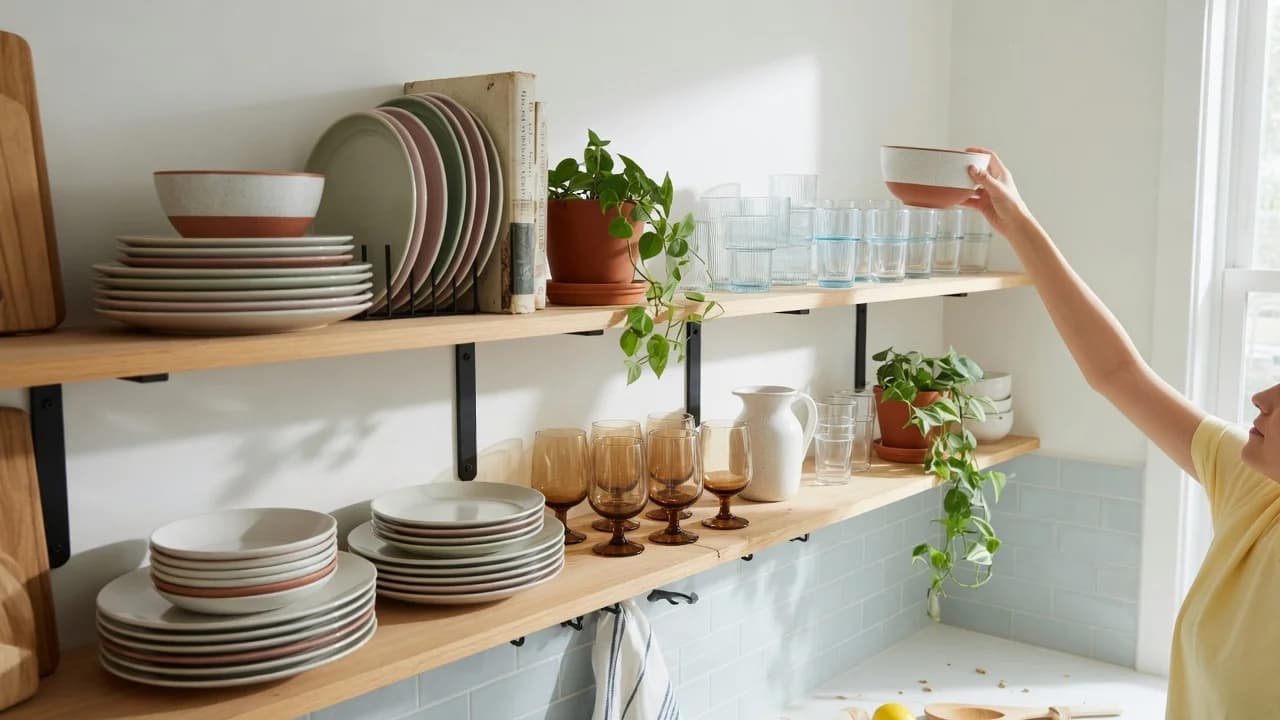
Rule 1: Leave breathing room. A practical guideline: roughly one-third of each shelf should stay visibly empty. Not a hairline gap between two stacks. Real negative space that lets individual objects stand apart.[1] Empty space is not wasted. It's what gives the objects that remain their weight. If a standard 36-inch shelf holds roughly 12 items when packed, the one-third rule means removing 4 of them. Suddenly the shelf reads as styled rather than stored.
Rule 2: Vary height and texture. If everything sits at the same elevation, the shelf flattens. Stack some items. Let others stand solo. Place a tall vessel beside a low stack of bowls. Designer Leslie Kramer explains the problem directly: "If everything on it is the same shape or sitting at the same height, it all begins to blend."[2] Texture does parallel work. A matte ceramic mug next to glossy glass next to raw wood creates depth that matching materials cannot produce. Contrast delivers what uniformity can't. And it costs nothing.
Rule 3: Anchor each shelf. Every shelf needs at least one larger object holding the composition together: a stack of dinner plates, a wide cutting board leaning against the back, a substantial cookbook laid flat, a large ceramic pitcher. Smaller items look scattered without something ground-level anchoring the arrangement. One anchor per shelf. Two if the shelf runs longer than three feet.
These three rules work as a system. Remove negative space and the shelf suffocates. Remove height contrast and it goes flat. Remove the anchor and it scatters. Apply all three together and even ordinary dishware reads as intentional.
When the Rules Work Against You
These principles assume a few things about your kitchen that may not hold.
Open shelving in a small, dark kitchen magnifies visual weight. If your kitchen gets limited natural light, open shelves can feel oppressive regardless of how well you style them. In that case, restrict yourself to two colors at most: one neutral base and one accent. Fewer colors mean less visual information, which helps a dark kitchen breathe.
Dust is the variable nobody mentions until month three. Open shelves collect it faster than closed cabinets. If you're not willing to do a quick weekly wipe-down, limit open shelving to items you use daily. Those get handled and washed often enough that dust never settles long.
And if your dishware is genuinely mismatched, not charmingly eclectic but actually clashing in color and style, open shelving may never deliver the look you want. Matching or near-matching dinnerware in a single color family does the bulk of the work before you style a single object. Without that foundation, you're fighting the material itself.
Ignore the edit-first rule and here's what happens. You'll spend an afternoon rearranging clutter into slightly different clutter. And the shelves will look the same by Thursday. The consequence is not just visual. A cluttered kitchen creates background stress that makes the room feel less functional, even when everything is technically accessible.
Take everything off your shelves right now. Put back only what passes one test: would you set this item on your dining table as a centerpiece for guests? If the answer is no, it stays in a closed cabinet. Do this before you worry about arrangement, before you buy anything, before you try a single styling technique. The edit is the whole thing.