Ask a kitchen designer what they measure first in a tight space, and they'll say aisle clearance. Not cabinet depth, not counter overhang. Aisle clearance. That number decides whether a freestanding kitchen cart makes your galley functional or turns it into an obstacle course.
But the clearance rule that guides a permanent remodel doesn't translate cleanly to a rental. You're not just solving for workflow. You're solving for a lease, a security deposit, and a move-out inspection that treats anything beyond ordinary wear and tear as your problem.
It comes down to three things: how much floor you can actually spare, what kind of storage you're missing, and whether your landlord will notice. The answer isn't always yes. Sometimes it's a hard no, and spending $200 on a cart you'll end up selling on Facebook Marketplace two months later is a waste of money.
The Space Math: What Actually Fits
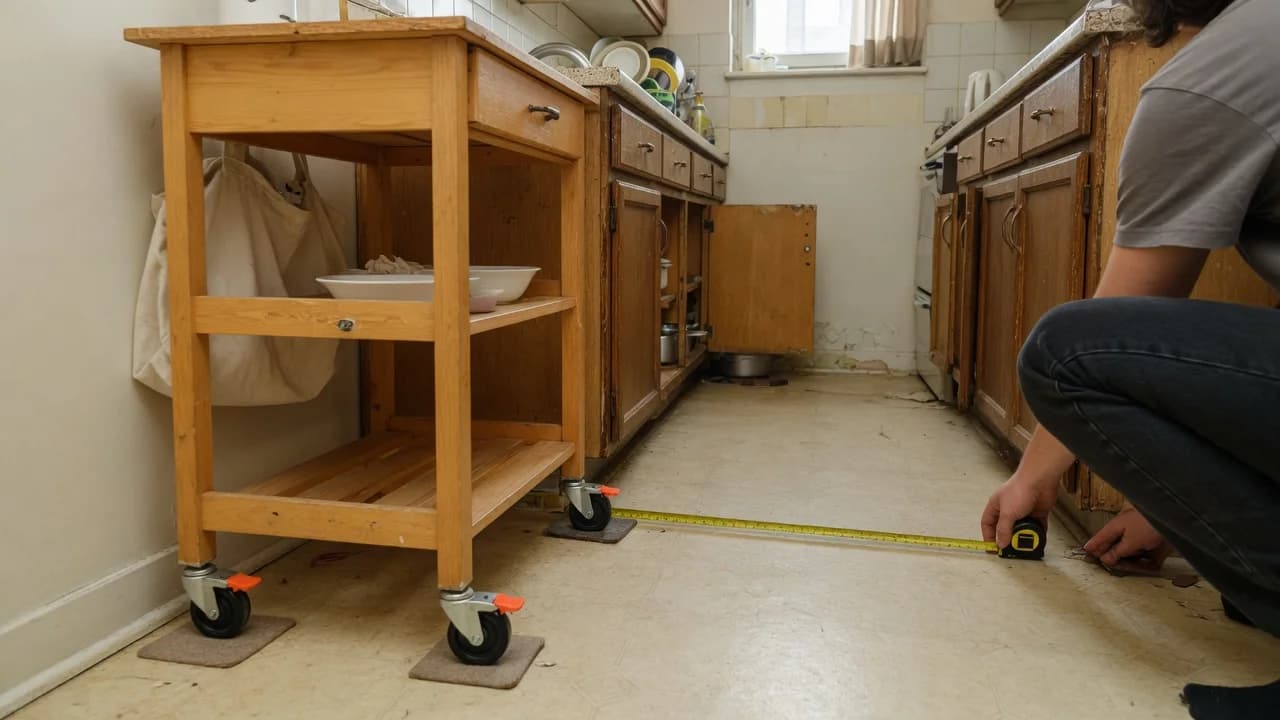
Here's the number that matters: 42 inches. That's the minimum work aisle width the National Kitchen and Bath Association recommends for a single cook.[1] Measure between your existing counter edge and the opposite wall or appliance. That's your aisle. Subtract 42. Whatever's left is the maximum depth you can give a cart.
Most narrow kitchen carts run 16 to 18 inches deep. Compact models like the IKEA Stenstorp hit about 17 inches deep when folded.[2] So if your aisle measures 60 inches between counters, you can fit an 18-inch cart and still have 42 inches of walking space. If the aisle is 48 inches, you're down to 6 inches of clearance after the cart. That's not enough to open an oven door.
Depth matters more than width here. A cart that's too deep narrows the walkway. A cart that's too wide just sticks out further along the wall, which is often manageable. But depth is the number that breaks the layout.
Also check the floor. Hard surfaces like tile, laminate, and sealed wood handle casters fine if you put felt pads under the wheels. Vinyl sheet flooring and soft pine will dent. If your rental has either, a cart isn't worth the deposit fight.
Carts vs. The Alternatives
A cart isn't storage you're adding. It's square footage you're borrowing from the floor. And borrowing floor space in a cramped kitchen means you're giving something up. Before you buy, compare what you get against what you lose.
| Option | Floor Space Used | Storage Gain | Prep Surface | Deposit Risk | Typical Cost |
|---|---|---|---|---|---|
| Rolling kitchen cart | 4-6 sq ft | 2-3 shelves + drawer | Yes (30-36" wide) | Moderate (caster damage) | $100-$900[3] |
| Wall-mounted shelf | 0 sq ft | 1 shelf | No | Low (wall anchors) | $30-$80 |
| Over-sink cutting board | 0 sq ft | None | Yes (temporary) | None | $25-$60 |
| Do nothing | 0 sq ft | None | Existing counters only | None | $0 |
The cart is the only option here that gives you both storage and a work surface. But it's also the only one that costs you floor space and puts your deposit at risk. If your main problem is prep space, an over-sink board solves it cheaper with zero landlord exposure. If you need storage, a wall-mounted shelf often gets the job done without eating a single square foot.
When a Cart Wins
Under the right conditions, a cart is the best $150 you'll spend on your rental kitchen. Here's when it works.
Your aisle measures 56 inches or more between counters. That gives you room for an 18-inch-deep cart and still leaves 38 inches of walkway, which is tight but workable if you're the only one cooking. At 60 inches or above, you're in the clear.
Your kitchen has a dead zone: a stretch of wall where a cart can live without blocking a doorway, the fridge swing, or the dishwasher drop-down. These spots exist in L-shaped kitchens and open-plan layouts. Galley kitchens rarely have one.
You need both storage and a work surface. The cart's value proposition collapses if you only need one. For storage alone, a slim rolling shelf unit costs half as much and fits in narrower gaps. For prep surface alone, the over-sink board wins. The cart justifies itself when you genuinely need both.
Your lease is silent on furniture and your floor is hard. No clause about "water-bearing furniture" or "tenant-installed fixtures." Tile, laminate, or sealed hardwood. And you're willing to spend $10 on adhesive felt pads for the casters.
When a Cart Is a Mistake
Skip the cart entirely if any of these apply.
Your aisle is under 54 inches. At that width, even a 16-inch cart leaves 38 inches, which sounds fine until you open the oven door and block the only path through the kitchen. One person cooking is manageable. Two people? Someone's getting hip-checked into a counter. This is where the cart goes from helper to hazard.
Your floor is soft vinyl, old pine, or anything that dents under concentrated weight. A loaded cart puts 80 to 120 pounds on four small casters. Over months, those wheels leave divots. California law lets a landlord deduct for damage beyond ordinary wear and tear.[4] Most state laws work the same way. Divots from furniture casters cross that line.
You move every 12 months. A cart is a pain to haul up stairs, wedge through door frames, or fit into a U-Haul already full of boxes. If your rental timeline is short, you'll resent the thing by move-out. Or rather: you'll resent having to figure out whether to leave it behind, sell it for $40, or pay a friend in pizza to carry it down three flights.
Your lease explicitly prohibits "additional furniture that contacts plumbing" or "tenant-installed storage units." Most leases don't. But if yours does, a cart gives your landlord a written reason to withhold the deposit. The cart isn't worth that fight.
Measure your aisle. Subtract 42. If the number is 18 or more, buy the narrowest cart you can find with locking casters, put felt pads on the wheels, and keep the receipt for your move-out documentation. If the number is smaller than 18, don't buy a cart. Mount a shelf above an unused stretch of counter, slide an over-sink cutting board into the drawer, and put the $150 toward your next rent check instead. The cart only wins when the floor can pay for it. And in a cramped rental, that floor is usually spoken for.