A lighting designer will ask two questions before they recommend any lamp with a cantilevered arm: where's the base going, and how far does the light need to travel. Skip either one and you'll own a very expensive decoration that doesn't illuminate anything useful. An arc floor lamp solves a specific problem—you need overhead light but have no ceiling fixture and no room for a side table—and it solves it only if the numbers work.
The problem is that most arc lamp buying advice assumes you have floor space to spare. You don't. You're working with a sofa against a wall, a narrow walkway, or a rental where you can't drill into the ceiling. The lamp's base has to sit somewhere, and that somewhere needs to be far enough from the seating that the arc clears the furniture while close enough that the shade lands where you want light. That geometry is tighter than most guides admit.
The three numbers that actually matter are arm reach, base footprint, and base weight. Arm reach determines whether the shade can physically reach your seating. Base footprint determines whether the lamp fits in the space you have. Base weight determines whether the whole thing stays upright once you position it. Get any of them wrong and the lamp doesn't work. Get all three right and you have a room that lights like it has a ceiling fixture, with no wiring required.
Why Side Tables Matter (and Why You Don't Need One)
The standard living room layout puts a table lamp on an end table next to the sofa. That setup needs roughly 18 to 24 inches of clearance between the sofa arm and the wall or next piece of furniture. When you're short on square footage—a narrow city apartment, a condo with an open-plan layout that pushes furniture against walls, a converted bedroom—that 18 inches simply doesn't exist.
The arc floor lamp bypasses the side table entirely. Its curved arm cantilevers the light source over the seating from a base that can sit against a wall, behind the sofa, or tucked into a corner 4 to 6 feet away. The base needs its own footprint—typically 12 to 16 inches in diameter for a stable model—but that footprint can sit in dead space that a side table could never occupy. Behind a sectional where nobody walks. In the corner between two windows. Flush against a wall behind a recliner.
What you lose is the table surface itself. No place for a drink, a book, a phone. That's the trade-off, and it's worth naming explicitly because the arc lamp doesn't solve it. If you need a surface, a slim floor lamp with a built-in shelf—sometimes called a lamp table—might be the better compromise. But if you have a coffee table, a window ledge, or a console behind the sofa, the arc lamp's overhead light is the more elegant solution.
Arm Reach: The Number That Decides Whether It Works
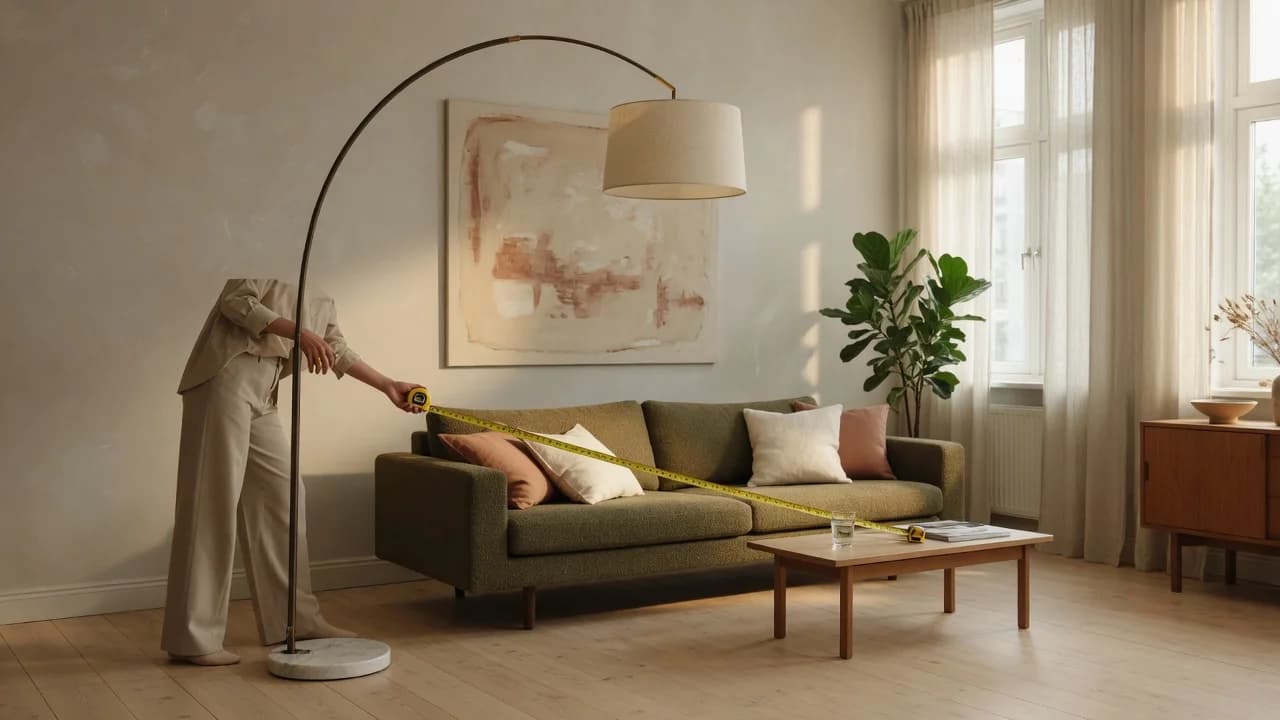
Put more precisely: arm reach isn't the same as lamp height, and conflating the two is the most common mistake buyers make. Arm reach is the horizontal distance from the center of the base to the center of the shade when the lamp is assembled. Lamp height is the vertical measurement from floor to the top of the arc. A lamp can be 80 inches tall and still only reach 36 inches horizontally—which won't clear a standard 38-inch-deep sofa.
Standard arc floor lamps sold in the US typically offer arm reaches between 48 and 72 inches. The shorter end works for a reading chair or a loveseat. The longer end is what you need for a full-size sofa, especially if the base has to sit behind or beside the furniture rather than in front of it. Measure from your planned base position to where you want the light to land—usually the center of the seating area—and add 6 inches for margin. If the lamp's spec sheet lists maximum reach but doesn't clarify whether that's measured from base center or base edge, assume the shorter number.
Most people think they're choosing a lamp. They're actually choosing a cantilever. The arm is a lever, and every inch of reach multiplies the force trying to tip the lamp forward. That brings us to the spec that makes or breaks the whole setup.
Base Weight and Stability: The Safety Spec Nobody Reads
An arc floor lamp is a physics problem before it's a design object. The weighted arm creates a moment—a rotational force—around the base. The base counters that moment with its own mass. If the base is too light, the lamp tips. If the base is wide enough and heavy enough, the lamp stays put even with the arm fully extended.
For a standard arc lamp with a 50- to 60-inch reach, a base weight of 15 to 25 pounds is the practical minimum. That's typically achieved with a marble disc, a steel plate, or a concrete core wrapped in a finished material. Lamps with reaches beyond 65 inches need 30 pounds or more. These aren't arbitrary numbers. UL 153, the US safety standard for portable luminaires, includes stability testing for articulated-arm lamps, and manufacturers who certify to that standard have engineered their bases to pass a tilt test on a 10-degree inclined surface.[1]
Carpet changes the equation. A 20-pound base that sits solidly on hardwood can feel wobbly on medium-pile carpet because the weight distributes less evenly. On carpet, favor bases with a wider diameter—at least 14 inches—and non-slip pads on the underside. If you're placing the lamp on a rug over hardwood, the rug itself can slide. A rubber rug pad underneath solves that.
What happens if you ignore base weight? The lamp stands fine for a week, maybe a month. Then someone bumps it while vacuuming. A dog's tail catches the cord. A kid grabs the pole. The lamp tips, the bulb shatters, and if it's an incandescent bulb running hot, the shade can scorch whatever it lands on. The CPSC has documented floor lamp tip-over incidents involving halogen lamps that ignited bedding and upholstery.[2] That's worst case, but it's avoidable with a base that's heavy enough for the job.
When an Arc Lamp Is the Wrong Choice
This article isn't about lamps with built-in tables or USB ports. It's about the specific scenario where floor space is so tight that a side table is off the table entirely. And in that scenario, an arc floor lamp is still sometimes the wrong tool.
If your base placement zone sits directly over a floor vent, the heat from forced air will warp a wood or composite base over time and can cause a marble base to develop hairline cracks from thermal cycling. If you have a large dog that runs through the room—not walks, runs—even a 40-pound base can get knocked askew by a 70-pound animal at speed. If your only viable base position is in a main walkway, the trip hazard from the cord and the base edge outweighs the lighting benefit.
In those cases, the better alternative is a wall-mounted swing-arm lamp. It gives you the same overhead reach with zero floor footprint, and models with a plug-in cord don't require hardwiring—you just need a wall outlet and two drywall anchors rated for 25 pounds or more. The trade-off is that you lose the sculptural presence of an arc lamp. But in a room where every square foot counts, that's a trade worth making.
Buy the lamp with the heaviest base that fits your space. Arm reach gets you the light where you need it. Base weight keeps it there. Every other spec—finish, shade material, dimmer type—is secondary to those two numbers. If the base weighs less than 20 pounds and the arm reaches more than 50 inches, keep looking. The math doesn't work.