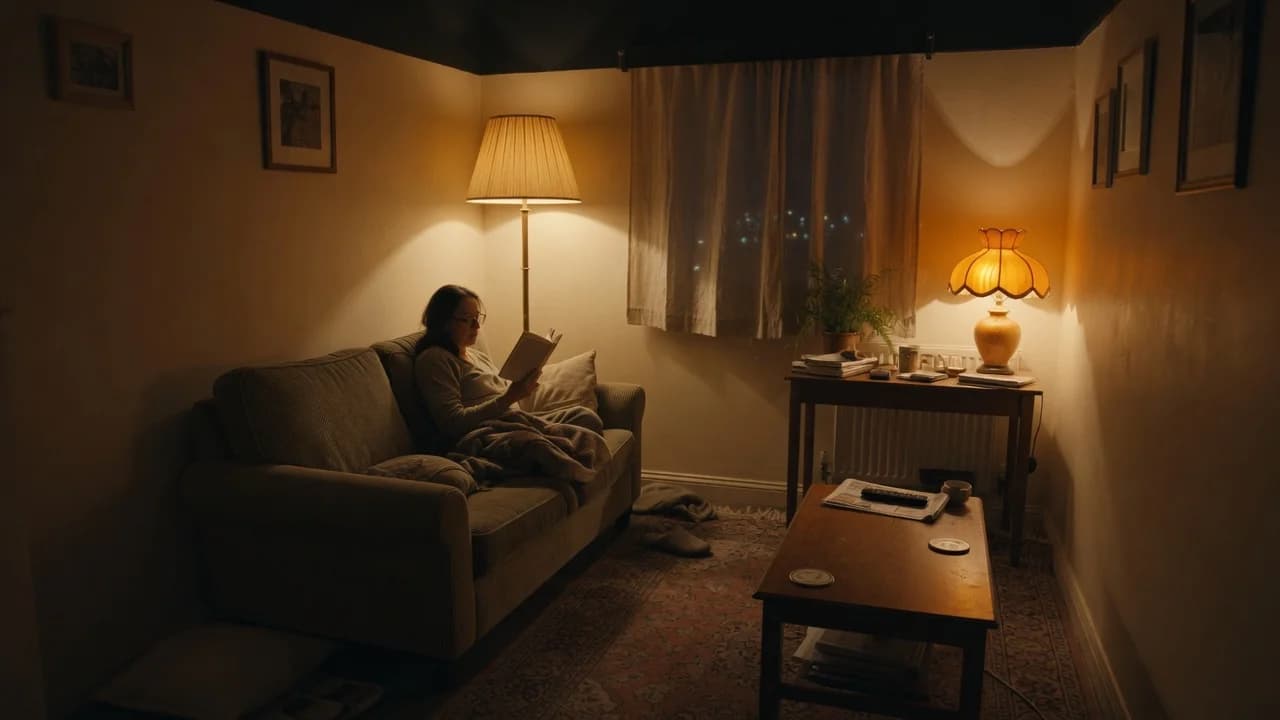
How many lamps does it take to make a small living room feel warm at night, not just lit? The answer isn't a single number, and anyone who gives you one without asking about your room is guessing. A 120-square-foot apartment living room and a 200-square-foot open-plan space need different things. So do rooms with eight-foot ceilings versus ten. The variables that matter right now are square footage, lamp height, and bulb color temperature. Get those three right, and two lamps can do what four can't.
Most people start by asking the wrong question. They ask "how many?" before they ask "what kind?" A floor lamp with a 2700K bulb in the right corner changes how a room feels more than three table lamps with cool bulbs spread around the room's perimeter. Lamp count matters less than layering.
That's the tension right there. Lighting advice online tends to treat warmth as a brightness problem. It isn't. Warmth is a color-temperature and height-distribution problem. A room lit by a single ceiling fixture at 3000K feels flat even at 3,000 lumens. That same room with two 2700K lamps at different heights, using half the lumens, feels warm. The physics of why is straightforward, but almost nobody explains it before telling you to buy another lamp.
What you actually need: the right lamp count for a small room at night, the bulb specs that create warmth, and where each lamp goes so the light lands where it counts. For most small rooms, the answer is two or three. But the number alone is useless without the rest.
Why One Light Source Fails
A single overhead fixture or one lonely floor lamp cannot make a room feel warm. It can only make it feel lit. The reason is contrast. One light source at or near the ceiling produces a bright pool underneath and deep shadows everywhere else. Corners go dark. Walls recede. The room feels smaller than it is, and the light reads as harsh. Lighting designers call this the "interrogation room" effect, and it's why people keep buying lamps without fixing the actual problem.
Your eyes read "warmth" as light arriving from multiple angles at multiple intensities. When light reaches you from above, from the side, and from below — even at low output — your brain interprets the space as comfortable and complete. The American Lighting Association's layered lighting framework identifies three layers: ambient, task, and accent.[1] In a small living room at night, collapse that to two practical layers: a mid-height source (floor lamp, 58 to 68 inches tall) and a low source (table lamp, 24 to 30 inches from floor to shade bottom). Those two heights, with just two lamps, create depth a single fixture never will.
The implication here matters more than the mechanism, so here it is: one light source is a failure waiting to happen. Two sources at different heights is the minimum. The exact number that works for your room depends on square footage.
The Right Lamp Count by Room Size
Warmth isn't about how many bulbs you have — it's about how many heights your light comes from. That's the reframe. Once you think in heights instead of counts, the math gets simpler.
The Illuminating Engineering Society recommends 10 to 20 foot-candles for living room ambient lighting. A foot-candle equals one lumen per square foot.[2] For a small living room — 120 to 180 square feet — that means 1,200 to 3,600 total lumens. But that range covers daytime function. For warmth at night, aim for the low end, or even below it. A room lit for evening relaxation needs roughly 1,000 to 2,000 lumens, spread across multiple sources.
A standard 60-watt-equivalent LED bulb puts out about 800 lumens. Two of those give you 1,600 lumens. That's the sweet spot for a 150-square-foot room at night. Three 800-lumen lamps hit 2,400 lumens, which suits the upper end of "small" — roughly 180 to 200 square feet — or rooms with darker walls that soak up light.
Here's the practical breakdown:
- 100 to 140 sq ft: two lamps, 800 lumens each, 2700K
- 140 to 180 sq ft: two or three lamps, 800 lumens each, 2700K
- 180 to 220 sq ft: three lamps, 800 lumens each, 2700K
These figures assume the lamps are your primary light at night, with the ceiling light off. If you're supplementing existing warm recessed lighting, subtract one lamp. The count matters less than distribution: at least two heights, at least two positions. A floor lamp in one corner and a table lamp across the room at a lower height is the baseline that works.
Bulb Choices That Create Warmth
The lamp count is half the equation. The bulb inside is the other half. The most common mistake is buying bulbs whose color temperature is too cool.
Color temperature is measured in Kelvin. Lower numbers mean warmer, amber-toned light. Higher numbers mean cooler, bluer light. ENERGY STAR classifies 2200K to 3000K as warm light, matching traditional incandescent bulbs.[3] For a living room at night, you want 2700K. Not 3000K. Not "warm white" from a bulk pack that turns out to be 3500K. 2700K.
Or rather: the difference between 2700K and 3000K matters far more at night than during the day. At 9 PM, with the room dim and the TV on, 3000K reads as noticeably cooler and less relaxing. Its blue-spectrum content is measurably higher, suppressing melatonin more aggressively — the same mechanism that makes screens disrupt sleep.[3] If warmth is genuinely what you're after, 2700K is the ceiling, not the starting point.
Brightness matters too, but in the opposite direction most people assume. You don't want more lumens for warmth. You want fewer. A 450-lumen table-lamp bulb at 2700K creates a more intimate glow than an 800-lumen bulb at the same temperature. The eye associates lower brightness with warmth because it mimics firelight and candlelight. Two 450-lumen table lamps at 2700K, plus an 800-lumen floor lamp, feel cozier than three 800-lumen lamps across the board. Total lumens in the 1,200-to-1,800 range, with variation between sources, beats uniform brightness every time.
Where to Put Each Lamp
Placement overrides count more often than people expect. Two lamps in the wrong spots add less warmth than one lamp in the right spot.
The floor lamp goes in a corner, 4 to 6 inches off each wall, shade aimed toward the ceiling. This bounces light off two walls and the ceiling, creating a soft wash that fills the room without glare. A torchiere that directs all light upward is ideal here. For a reading floor lamp with a downward shade, position it beside the sofa with the shade bottom at roughly seated shoulder height — about 42 to 48 inches from the floor. Light at eye level when you're sitting is where warmth registers most strongly.
The table lamp goes across the room from the floor lamp. On a side table, console, or shelf, with the shade bottom 24 to 30 inches from the floor. This lower source creates the height contrast that makes the room feel layered. A third lamp, if needed, belongs behind the sofa on a narrow console. Light from behind, combined with light from the corner and from the side, gives you three distinct angles. Your brain reads that as "warm" before it even processes the color temperature.
What you're avoiding is both lamps on the same wall. Two table lamps flanking a TV on the same wall send light from one direction. The room stays flat. The rule: no two lamps on the same wall. Spread them across at least two walls, ideally three.
Quick placement reference:
- One floor lamp in a corner, 4 to 6 inches off each wall
- One table lamp on the opposite side of the room
- If adding a third: behind the sofa on a console, or on a sideboard against the third wall
When Two Lamps Beat Three
There's a point where adding lamps stops adding warmth and starts adding clutter. In a room under 120 square feet, three lamps can feel like furniture congestion. Two well-placed lamps with warm bulbs do the job without shrinking the room.
The condition is straightforward: if the path between any two lamps is less than four feet, you're crowding the space. In a 10-by-12-foot living room, a floor lamp in one corner and a table lamp in the opposite corner sit roughly 12 feet apart. That spacing works. Add a third lamp, and you're choosing between placing it within 4 feet of an existing lamp — too close — or blocking a walkway. The room doesn't get warmer. It gets busier.
This also applies if your living room already has warm-toned recessed lighting. With 2700K dimmable downlights in the ceiling, you may only need one lamp — a floor lamp in the corner — to create the height layering ceiling lights can't provide. Two lamps in that scenario is fine. Three is almost certainly overkill. The ceiling lights handle the ambient layer. The floor lamp adds the mid-height layer. A table lamp finishes the low layer. That's three layers from two lamps plus existing fixtures, and it avoids the most common over-lighting mistake.
What's the alternative? Doing nothing. Keeping the overhead on and calling it done. The consequence isn't darkness — it's flatness. The ceiling-light-only room is the one where you eventually stop sitting in the living room after dinner because it doesn't feel good to be there. Two lamps with warm bulbs fix that. It's not about seeing better. It's about feeling better in the room you already have.
Tonight, turn off the ceiling light and put one lamp in a corner with a 2700K bulb. That's the immediate step. It costs nothing if you already have a lamp and a warm bulb. If you don't, a floor lamp with a warm LED runs $40 to $80 and takes five minutes. This one change shows you whether the room needs more before you buy anything else.
This week, add a second lamp at a different height on the opposite side of the room. A table lamp if you started with a floor lamp. A floor lamp if you started with a table lamp. Match the bulb temperature — both at 2700K — and keep total lumens under 2,000. Most small rooms are done at this point. Two heights, two positions, warm color. You'll notice it the first evening both are on.
If a dark corner or dead zone persists, add a third lamp behind the seating area — but only if the room is above 140 square feet and the spacing allows. The third lamp is the finishing move, not the starting point. Most small rooms never need it. Two at the right heights, in the right corners, with the right bulbs, is the configuration that delivers warmth. More than that is usually about wanting to buy lamps, not about needing more light.