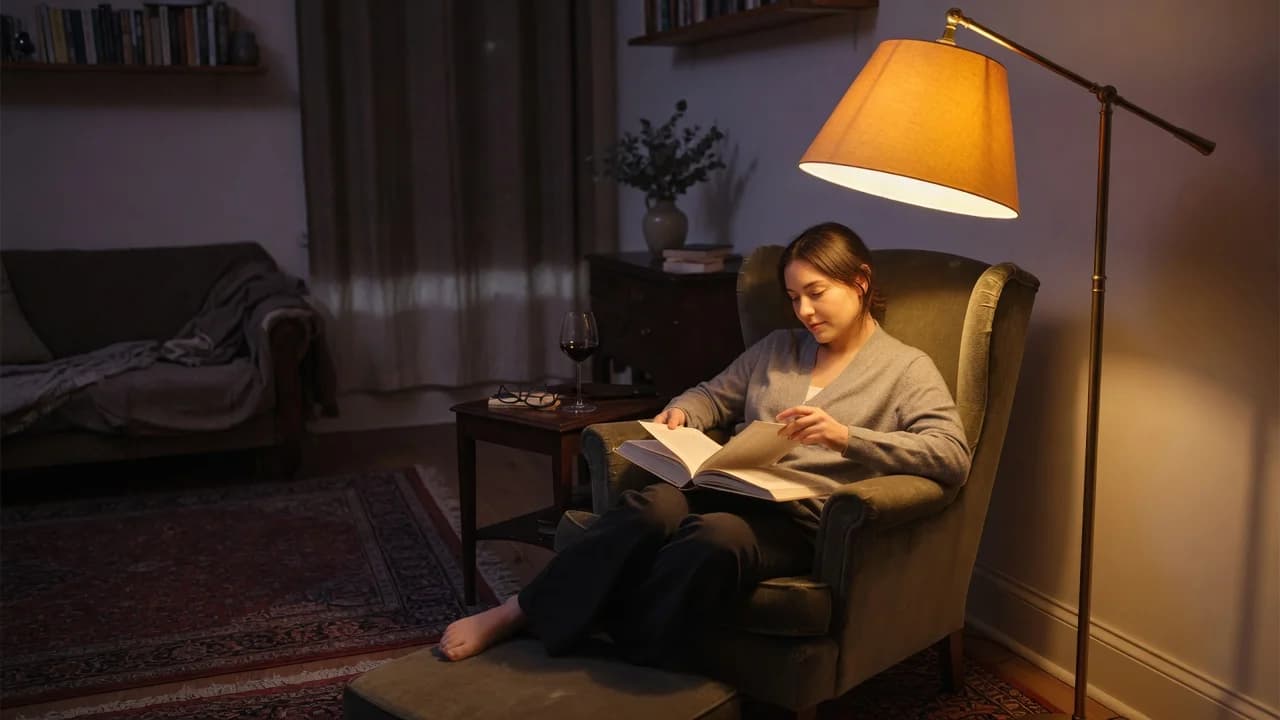
The floor lamp you're about to buy will disappoint you. Not because it's cheap or ugly — because the lighting industry tells you to shop by style, and style doesn't light a dark corner.
A corner absorbs light from two walls instead of one, and if your ceiling climbs past 9 feet, a torchiere's upward beam dissipates before it ever reaches your seating area. That's the tension most lamp-buying guides skip: the same lamp that works beautifully in a catalog photo can leave your actual room dimmer than before, because corners cheat light in ways open rooms don't.
The right lamp turns on three numbers — lumens, beam angle, and ceiling height — and almost nobody shopping online checks any of them. What follows isn't a style guide. It's a measuring-tape-and-math approach to the one fixture that might finally kill the cave in the corner of your living room.
Why That Corner Stays Dark
Corners eat light. It's not your imagination.
In an open room, a lamp's output scatters in all directions, and some of it bounces back to you. In a corner, two walls meet and absorb or reflect depending on paint color and surface texture. A white wall might reflect 80% of the light hitting it. A dark navy wall? Maybe 15%. Two dark walls in a corner compound the loss geometrically — the light hits wall one, loses most of its energy, then what's left hits wall two and loses most of what remains.
Add a floor lamp to the wrong corner and you don't fill the darkness. You create a hot spot on one wall and the shadows deepen everywhere else. The fix isn't more watts. It's understanding that corner lighting is directional lighting, whether you want it to be or not. Every bulb you place in a corner becomes a beam, because the corner itself acts like half a spotlight housing.
That's also why the spec that matters most — beyond raw brightness — is one most lamp listings bury or omit entirely.
Lumens: Stop Guessing, Start Measuring
Forget watts. Watts tell you how much electricity a bulb uses, not how much light it produces. Lumens are the only number that predicts whether your corner brightens or stays murky.
The Illuminating Engineering Society (IES) recommends 10 to 20 foot-candles for living rooms — foot-candles being the amount of light that actually lands on a surface, not what leaves the bulb.[1] To translate that into lumens for your specific room: multiply your living room's square footage by 20 (the upper end for a darker space). A 200-square-foot living room needs roughly 4,000 lumens total — from all sources combined. A single floor lamp in a dark corner should deliver at least 1,500 to 2,000 of those lumens to make a visible difference.
That understates it. If your corner has dark walls or your lamp sits behind furniture, you need closer to 2,500 lumens from that single fixture, because wall absorption and furniture shadowing can cut effective brightness by 30% or more. Most floor lamps sold at big-box retailers ship with a single 800-lumen bulb. That's why they don't work.
A quick field test: stand where you'd sit, hold your phone's light meter app toward the corner at night, and check the reading. Under 5 foot-candles? You need a dedicated high-output lamp, not a style piece.
Quick-Reference: Lumen Targets for Dark Corners
- Room size under 150 sq ft: 1,200–1,800 lumens from corner lamp
- Room size 150–250 sq ft: 1,800–2,500 lumens from corner lamp
- Room size over 250 sq ft: 2,500+ lumens, or two lamps
- Dark walls (navy, charcoal, burgundy): add 30% to any target above
- White or light walls: targets above are sufficient
Beam Angle: The Spec Nobody Talks About
Lumens tell you how much light. Beam angle tells you where it goes. In a corner, that's everything.
A standard omnidirectional bulb throws light in a near-sphere. Place it in a corner and maybe a third of its output heads toward the room — the rest fires into the walls or ceiling. A narrow-beam bulb (under 40 degrees) creates a harsh spotlight on one patch of wall and leaves the rest of the corner in shadow. The usable range for corner placement sits between 60 and 120 degrees. Wider than 120 and you're back to wasting lumens on the walls behind the lamp.
Torchiere lamps, which fire all their light upward, depend on ceiling bounce. At an 8-foot ceiling, that bounce covers a roughly 10-foot circle on the floor below. At 10 feet, the circle widens to about 14 feet but the light density at seating height drops by nearly half. Past 12 feet, a torchiere becomes decorative — the light's spread is so diffuse you can't read by it. That's why ceiling height is the first thing you measure before choosing lamp type.
Directional lamps — arc lamps, pharmacy lamps, adjustable-head floor lamps — give you control. Point the head at the wall 18 to 24 inches above eye level in your seating position, angled at roughly 30 degrees from vertical toward the room center. The light washes the wall, bounces into the room, and avoids direct glare into your eyes. This is the setup that makes a single floor lamp work harder than two poorly placed ones. But most lamp listings never mention it.
Lamp Types That Actually Work in Corners
A corner lamp isn't filling darkness; it's sculpting light against two walls. That changes which lamp types make sense and which ones don't.
Torchieres: Best for rooms with ceilings under 9 feet and light-colored walls. The upward light bounces off the ceiling and washes down evenly. In tall rooms or dark-walled rooms, torchieres fail — the bounce is too weak and the corner stays shadowed. Look for models with a bowl reflector, not just a bare bulb pointing up. The reflector directs more light downward and outward instead of wasting it straight into the ceiling drywall.
Arc lamps: The curved-arm design places the bulb away from the wall, which solves the corner-absorption problem entirely. The head hangs 6 to 7 feet above the floor and aims downward at an angle. This is the most effective single-fixture solution for a dark corner with high ceilings, because you control exactly where the light lands. The downside: arc lamps need floor space — the base sits 3 to 4 feet from where the light falls, so a tight corner behind a sofa won't fit one.
Directional floor lamps (pharmacy, task, adjustable-head): These are the workhorses. A slim pole with an articulating head that pivots and tilts. Place the base in the corner, angle the head toward the seating area, and you get task-quality light without the arc lamp's footprint. The trade-off: they light where you point them and nothing else. You'll want a second light source elsewhere in the room for ambient fill.
Tree lamps and multi-head: Multiple adjustable heads on a single pole. One head washes the wall, another points toward the seating area, a third aims at the ceiling for ambient bounce. They're versatile but visually busy, and cheap models wobble. Good ones start around $120 and use standard E26 sockets so you can swap bulbs.
Lamp Types Compared
| Type | Best Ceiling Height | Light Direction | Corner Fit | Price Range (USD) |
|---|---|---|---|---|
| Torchiere | Under 9 ft | Up (ceiling bounce) | Tight corners | $40–$150 |
| Arc | 9 ft+ | Down and angled | Needs 3+ ft clearance | $100–$400 |
| Directional (pharmacy) | Any | Adjustable | Excellent | $50–$200 |
| Tree / Multi-head | Any | Multiple directions | Good | $80–$250 |
None of these solve every problem. High-ceiling rooms with dark corners and limited floor space — think a narrow living room in a modern apartment building — may need a different approach entirely. So measure first, shop second.
When a Floor Lamp Isn't Enough
Some corners defeat even the best floor lamp. The math is straightforward: if your living room exceeds 300 square feet, has ceilings above 12 feet, and the corner walls are dark, no single plug-in fixture will fill that space. You're asking a lamp to do the work of recessed lighting.
The failure mode isn't subtle. You'll buy a 2,500-lumen arc lamp, position it perfectly, and the corner still feels like dusk at noon. Why? Because at 12 feet, even a focused beam spreads to a circle roughly 5 to 6 feet wide by the time it reaches seating height, and the light density per square foot drops below what the IES considers adequate for casual reading — around 10 foot-candles.[1] You'd need roughly 5,000 lumens from a single source to compensate, and most residential floor lamps top out around 3,000 before heat and glare become problems.
What to do instead: add a wall-mounted plug-in sconce to the adjacent wall (no electrician needed for plug-in models) or place a second floor lamp on the opposite side of the room firing toward the corner. Two 1,500-lumen lamps on opposite walls do more for a dark room than one 3,000-lumen lamp in the corner, because you're lighting the room from two angles instead of fighting absorption from one.
Also: if the corner you're trying to light sits behind a large piece of furniture — a sectional sofa, a tall bookshelf — reconsider the floor lamp entirely. Furniture blocks floor-level light output. A plug-in wall sconce mounted 5 to 6 feet up the wall, or a clamp-on reading light attached to a shelf, bypasses the obstruction and puts light exactly where you need it.
How to Buy Without Regretting It
Open the lamp listing. Scroll past the lifestyle photos of sun-drenched living rooms that look nothing like yours at 9 PM. Find three numbers.
First: total lumens. If the listing doesn't state them, assume the lamp ships with a single 800-lumen bulb and budget another $15 to $25 for a brighter replacement. Look for lamps with standard E26 sockets — proprietary or integrated LED panels can't be swapped, and when they fail (and they do), you're buying a whole new lamp instead of a $10 bulb.
Second: the UL listing mark. Portable floor lamps sold in the United States must meet UL 153, the safety standard for portable electric luminaires.[2] A UL mark on the base or cord label means the lamp passed testing for electrical fire risk and stability. No UL mark? Return it. Counterfeit marks exist — UL publishes warnings about specific models[2] — so buy from retailers with actual return policies, not marketplace sellers with three product photos and no address.
Third: bulb compatibility. If the lamp uses a specialized base — GU10, G9, candelabra — factor bulb replacement cost and availability into your decision. E26 (standard medium base) gives you access to every LED bulb on the market, including high-CRI options in the 90+ range that make skin tones and fabric colors look right, and dimmable bulbs that let you adjust output without changing lamps.
And the fourth thing most buyers skip: measure your corner. Width, depth, and ceiling height. Write them down. If the lamp's product dimensions show a base wider than your corner or a height that puts the bulb below eye level when you're seated, keep scrolling. A floor lamp whose bulb sits at 48 inches when your eyes are at 42 inches from a sofa will glare into your face every single evening.
Buy the directional floor lamp with an E26 socket, a 2,000-lumen dimmable LED bulb in 2700K to 3000K, and a beam angle between 60 and 120 degrees. Place it 12 to 18 inches from the corner walls, angled toward your seating area. That single setup solves more dark-corner problems than any style-first purchase ever will.
If your ceiling is under 9 feet and your walls are light, a torchiere with a bowl reflector works instead. If your ceiling is over 12 feet, skip the floor lamp entirely and mount a plug-in sconce.
But for the vast middle — the 8-to-10-foot ceiling, the 150-to-250-square-foot room, the corner that swallows every lamp you've tried — the directional lamp with the right bulb and the right angle is the answer. Everything else is decoration masquerading as a solution.