The standard advice on string lights is to ditch them the second your dorm days are over. That advice is lazy.
The real problem isn't the string lights. It's that nothing else in the room is doing any work. You wanted warm and cozy. What you got reads like someone who hasn't discovered floor lamps yet. It stings to spend time and money on a space and have it read "temporary" to anyone who walks in.
Professional lighting designers build rooms in three layers. The U.S. Department of Energy's residential lighting guidelines name them explicitly: ambient, task, and accent.[1] String lights are accent at best. When they're your primary source, the room never gets past the decorative layer. This isn't about smart bulbs or automation. It's about the fundamentals, and the fix costs less than a decent area rug.
It's Not the String Lights. It's the Missing Layers.
Picture a restaurant patio at dusk. Globe string lights crisscross overhead. Nobody calls that dorm-like. Same product, completely different reaction.
The difference is everything those patio lights are paired with: candlelight on tables, sconces washing the walls, uplighting in the landscaping. The string lights are the accent. The heavy lifting is happening elsewhere.
That's the insight most "ditch your string lights" advice skips. In a typical living room, string lights are being asked to illuminate the entire space. A strand of 25 micro-LEDs produces maybe 200 to 300 lumens total. Spread across 200 square feet, that's roughly 1 to 1.5 lumens per square foot. A common guideline among lighting designers puts the target for living room ambient light at 5 to 10 lumens per square foot. The math doesn't add up.
Put more precisely: string lights don't fail because they look juvenile. They fail because they're dim, unidirectional, and undiffused. Visible LED dots create harsh points of light instead of a smooth wash. Exposed wires draw attention to the fixture, not what it illuminates. And cheap LEDs from a discount multipack often land in the 4000K to 5000K range: clinical blue-white, not warm. A room that reads grown-up solves all three problems across multiple light sources.
The Three Layers That Do the Real Work
Lighting designers think in layers. The framework, formalized by the Illuminating Engineering Society and referenced in U.S. Department of Energy guidelines, divides any well-lit room into ambient, task, and accent light.[1]
Ambient light is the baseline. It eliminates dark corners so you can move through the space comfortably. Overhead fixtures typically provide it: recessed lights, a flush mount, or a semi-flush ceiling fixture. But floor lamps that bounce light off the ceiling work too. (Overhead lighting alone creates the same problem as string lights alone, just from the opposite direction: harsh and flat instead of dim and flat.) Without ambient light, every other layer looks harsh by contrast.
Task light supports specific activities. Reading, knitting, folding laundry on the couch. A floor lamp behind a reading chair. A table lamp on an end table. The test: can you read a book in your usual seat without adjusting your position? If not, the task layer is missing.
Accent light is where string lights belong. This layer highlights features: artwork, textured walls, bookshelves, architectural details. It creates depth by drawing the eye to specific points. Picture lights, directional sconces, and LED strips in shelving all serve this function.
The reason a room with only string lights feels off isn't that you picked the wrong fixture. It's that you've only got the decorative layer. No ambient foundation, no task support. Everything looks flat because there's no contrast anywhere. And adding more strands doesn't fix it.
What to Actually Buy, By Layer
You don't need to replace everything. I'd start with whichever layer is missing, and the ambient layer almost always makes the biggest difference fastest.
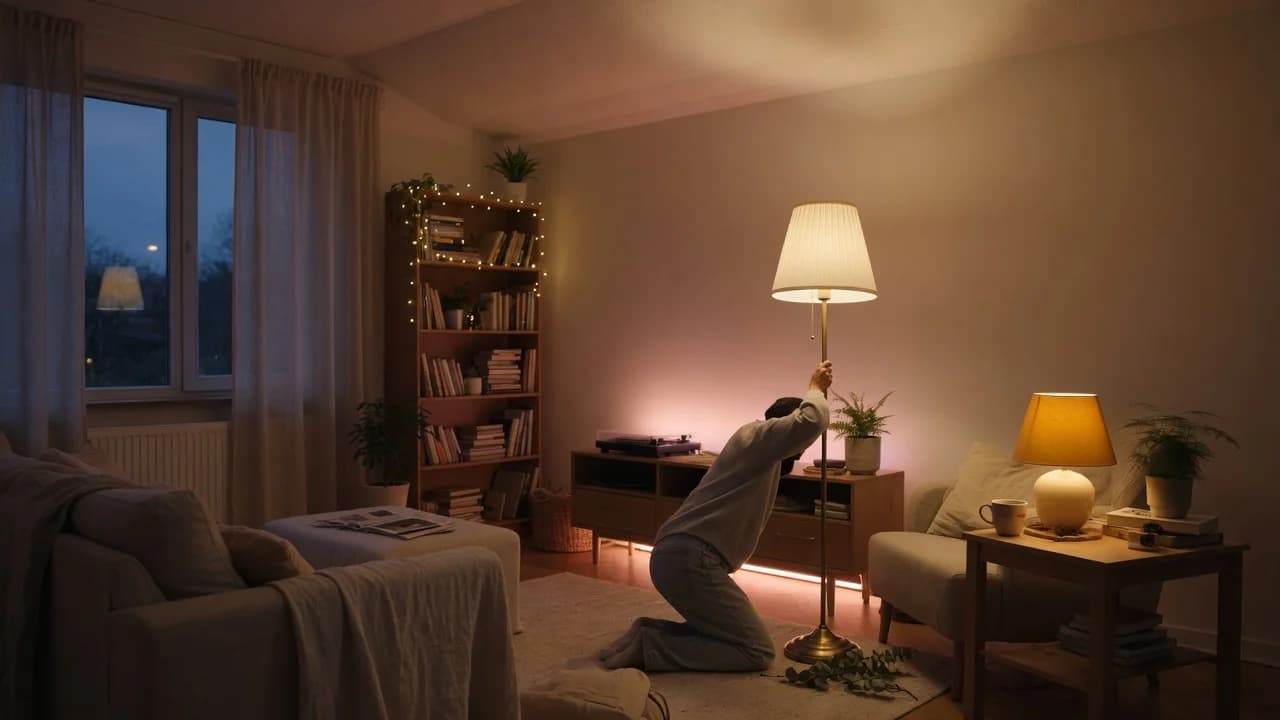
Ambient first. No overhead light? A plug-in floor lamp that directs light upward is the fastest fix. Look for a torchiere or a lamp with an uplight shade. Position it in a corner. If you do have overhead lighting, check the bulb. Anything above 3000K in a living room feels clinical. The ideal range is 2700K to 3000K, the warm amber-toned light people associate with cozy.[2] Swap the bulb before you swap the fixture.
Task next. One table lamp on a side table, or a floor lamp with a downward shade next to where you sit. That's often all it takes.
Accent last. String lights can stay, but with conditions. Upgrade to globe-style bulbs on a black or cloth-wrapped cord. Mount with proper anchor points, not thumbtacks. Designers recommend dedicated hardware: small cup hooks or adhesive clips at even intervals.[3] The problem isn't the string lights. It's that nothing else is doing the real work.
Better yet: LED strip lights inside an aluminum channel with a frosted diffuser. The channel hides the circuit board, the diffuser turns LED dots into a continuous line of light, and the whole thing reads architectural instead of temporary. Tuck it behind a media console or along bookshelves.
Entry-level cost for a basic rebuild: one uplight floor lamp ($40 to $80), one table lamp with a warm bulb ($30 to $50), one accent element like a picture light or diffused LED strip ($25 to $50). Total: $95 to $180. About what you'd spend on two or three throw pillows, and the impact is an order of magnitude larger.
When the Layering Advice Doesn't Apply
There are living rooms where adding lamps isn't the answer.
If your space is under 100 square feet, every lamp eats floor area you can't spare. Make the string lights work harder: globe bulbs at 2700K, ceiling perimeter mounting with adhesive hooks, plus one table lamp for task light. Two sources, not one, and the room already reads more intentional.
If you're in a rental with zero overhead fixtures and exactly two outlets, skip the floor lamp and look at plug-in wall sconces. Several retailers now sell sconces with fabric-covered cords and in-line switches that mount with drywall anchors and plug into a standard outlet.[4] No electrician, no patching when you leave.
And if you genuinely love your string lights? Don't get rid of them. Just stop asking them to be your only light source. Keep the strings. Add a floor lamp and a table lamp. Suddenly the strings read as a choice, not a crutch.
Ignore this advice, keep using string lights as your primary source, and the room will keep reading like temporary housing no matter how much you spend on furniture. The lighting sets the ceiling on how grown-up the space can feel.
The Short Version: What to Do This Weekend
If your living room has no lamps beyond string lights, buy a floor lamp this weekend. Something that bounces light off the ceiling. That one change does more than replacing the string lights ever would.
If you already have ambient and task light but the room still feels unfinished, check your color temperatures. Mismatched bulbs fight each other. Standardize everything at 2700K or 3000K.
If you want the decorative glow without the dorm association, put the strings on a dimmer, mount them with real hardware, and make sure they're the third-brightest thing in the room. They should highlight, not illuminate.
You don't need to throw everything out. You just need to stop asking one $15 strand to do the work of three separate light sources.