Since pandemic-era nesting turned every rental bedroom into a design project, the layered bed has become the default ambition of apartment styling. You've seen it: crisp sheets folded back to reveal a quilt underneath, a duvet that looks plump rather than pancaked, pillows stacked with intention instead of obligation. What most of those photos don't tell you is how little of that look depends on spending real money.
The real obstacle isn't your budget. It's that nobody explains which layers actually create depth and which ones just pile on laundry. Walk into any big-box bedding aisle and you'll find "bed in a bag" sets promising a finished look for $60. What you get is six pieces of matching microfiber that somehow all read as one flat surface. That's the gap: matching isn't layering, and more pieces isn't more depth.
Or rather: the problem isn't that you're buying cheap bedding. It's that you're buying bedding designed to match instead of bedding designed to contrast. Layering depends on visible difference between each piece. Texture, weight, finish. Two identical-weight cotton blankets stacked on top of each other don't layer. They just double the laundry. This isn't about finding the right filter or coordinating with your wall color. It's about the physical stack of fabric on your mattress and which pieces earn their place.
If you're staring at a queen bed with nothing on it but a mattress and a single comforter you grabbed at Target during move-in week, and you've got maybe $200 total to fix it, here's what actually works.
Why Your Bed Looks Flat: The Layer Deficit
A flat-looking bed almost always has the same root cause: there aren't enough distinct textile planes for light to hit differently. When every piece on the bed is the same material, same weight, and same color family with no texture break, your eye reads it as one surface. A comforter pulled up to the pillows with nothing underneath showing. That's one plane. You need at least three.
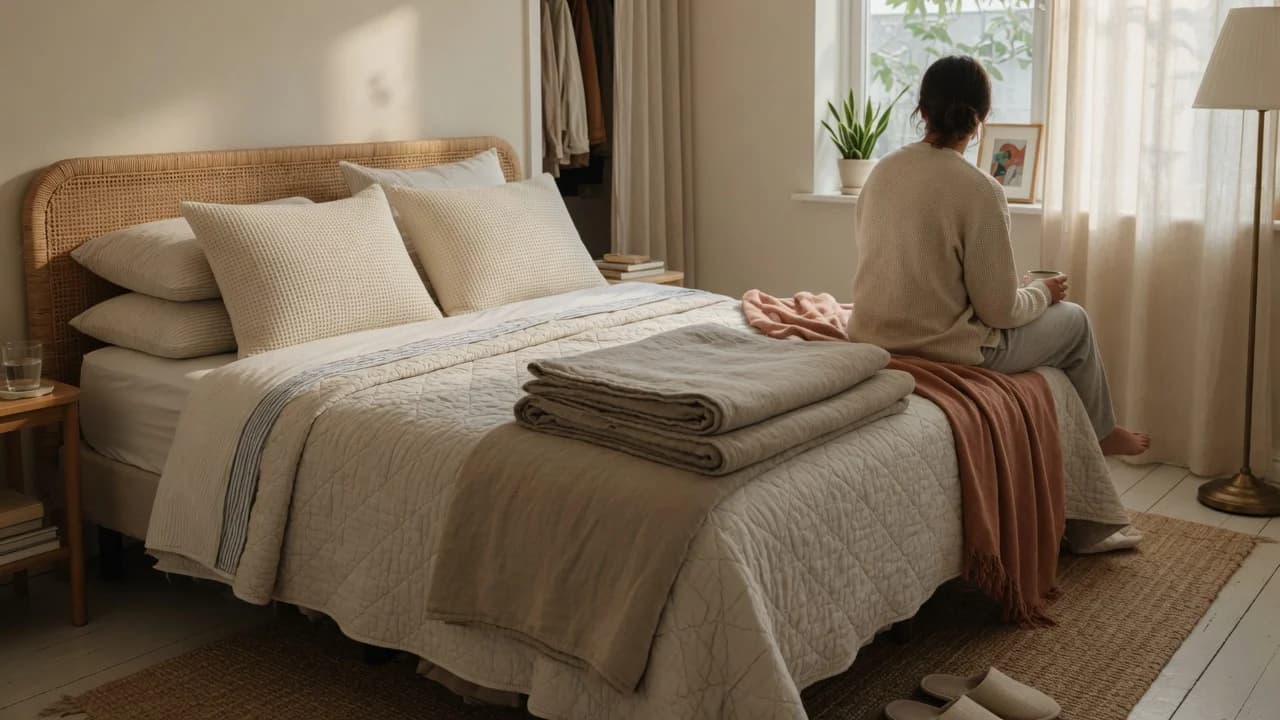
What creates depth isn't more blankets. It's the folded edges, the color shifts, and the shadow lines where one fabric ends and another begins. This is why designers obsess over the "turn-back": folding the duvet down roughly 18 inches from the head of the bed so the layers underneath are visible. Without that fold, even a bed with four layers reads as one.
The mistake most first-apartment shoppers make is buying a complete set of matching pieces and calling it done. You've seen the packaging: comforter, two shams, a bed skirt, maybe a decorative pillow, all in the same printed microfiber. Every piece has the same sheen. Nothing breaks the visual plane. From six feet away, it might as well be one blanket.
This is where the budget argument usually collapses into "just buy nicer stuff." That's wrong. A $200 all-cotton duvet with nothing underneath it still looks flat. A $40 quilt folded back over a $30 cotton sheet set creates real depth. The order and contrast matter more than the price of any individual piece. Ignore the sequence and you'll spend money replacing pieces that were never the problem.
The Four Layers That Actually Build Depth
You need four visible textile planes, not counting the fitted sheet (nobody sees it) or the mattress pad (nobody cares about it). Here's the stack, bottom to top.
Layer 1: The flat sheet, folded back. This should show as a 3- to 4-inch band at the head of the bed, just above where the coverlet hits. Cotton percale works best here because its crisp finish contrasts with whatever sits above it. The Good Housekeeping Institute's Textiles Lab notes that percale's "breathable and crisp" weave gives it a matte look that reads as intentional against shinier or heavier layers.[1]
Layer 2: A coverlet or lightweight quilt, folded at roughly mid-bed. This is the layer most first-apartment beds skip entirely. It sits between the flat sheet and the duvet. Get it in a texture that contrasts with both: if your sheets are smooth cotton percale, go for a quilted or waffle-weave cotton. Fold it back about 18 inches from the pillows so it reveals the sheet above and tucks under the duvet below.
Layer 3: The duvet, folded in thirds at the foot. Use a duvet cover over an insert, not a comforter. The cover is washable, and a duvet insert with real loft (even a budget down-alternative one) creates the plump look a comforter can't. Good Housekeeping's fiber science team recommends a duvet with a removable cover because inserts "are focused on quality construction and offer more choices for fill materials and warmth levels."[1] Fold it back roughly a third of the bed's length to expose the coverlet underneath.
Layer 4: Sleeping pillows, Euro shams, and one decorative pillow. Two standard pillows in cases that match your sheets. Two Euro shams (26x26 inches) directly behind them in a coordinating but not matching fabric. One lumbar or bolster pillow centered in front. Euro inserts can be cheap: the sham fabric is what shows. Pillow arrangement alone gives the bed vertical structure that no flat layer can replicate.
If you look at that stack and think "that's a lot of laundry," you're right. Five pieces visible at any time: flat sheet edge, coverlet, duvet, pillows, shams. But that's the formula. Skip one and you lose a distinct plane.
Where to Spend, Where to Save
Here's the reframe: layering isn't about buying more things; it's about buying the right things in the right sequence.
Spend on sheets. The flat sheet creates the first visible edge and touches your body for eight hours. Cotton percale in the 300-500 thread count range is the sweet spot for durability and price. Target's Threshold 400 Thread Count Performance Sheet Set runs $35-$65 for a queen. Fiber scientists at Good Housekeeping caution that thread count above 500 is often misleading; focus on fiber content and weave instead.[1]
Spend on the duvet insert. A down-alternative insert with baffle-box construction keeps fill from shifting into sad little clumps. A queen insert runs $30-$50 at IKEA or Target. Get one size up from your duvet cover (king insert in a queen cover) for that overstuffed hotel look. Nobody sees the insert. Everyone sees the loft.
Save on the coverlet or quilt. HomeGoods, TJ Maxx, and Marshalls have cotton quilts for $25-$40 that work perfectly as the middle layer. Nobody will examine the stitching. The texture contrast is what registers visually.
Save on Euro shams and decorative pillows. Buy the $10-$15 inserts at IKEA or Walmart. Spend on the sham covers: one linen-blend pair at $20-$25 from Target's Casaluna line or H&M Home gives you the texture contrast that makes the whole bed look deliberate.
Save on the throw blanket. A $15 knit throw from a discount store folded in thirds at the bed's foot adds a fifth texture plane. It doesn't need to be cashmere. It needs to not match the duvet.
Budget Breakdown (Queen Bed):
The Architectural Digest first-apartment guide notes that quality bedding makes "an apartment feel like a home," but its recommended sheet bundle starts at $170 alone.[2] You can build the entire layered stack for roughly what one AD-recommended set costs.
| Item | Price Range |
|---|---|
| Sheets (cotton percale, 300-500 TC) | $35 – $65 |
| Duvet insert (down-alternative, baffle-box) | $30 – $50 |
| Duvet cover | $25 – $40 |
| Coverlet or quilt | $25 – $40 |
| Euro sham inserts (2) | $20 |
| Euro sham covers (2) | $20 – $30 |
| Throw blanket | $10 – $20 |
| Total | $165 – $265 |
Target roughly $200 and you'll hit the sweet spot. Shop end-of-season clearance and that number drops further.
When Layering Doesn't Work
This approach has a real failure condition, and you should know it before you spend anything.
If your bedroom is genuinely small and your bed is pushed against a wall on one or two sides, the layered look loses most of its impact. Layering depends on light hitting the bed from multiple angles, which requires at least two open sides. In a room where the bed occupies most of the floor space (think a queen bed in a 10x10 room with a door and a closet eating two walls), the visual payoff shrinks hard.
In that situation, drop the coverlet and the Euro shams. Go with high-contrast sheets and duvet, two sleeping pillows, one lumbar pillow at center, and the throw at the foot. That's three visible planes instead of four, and it costs about $120-$140 total. Your bed won't photograph like a catalog spread, but it'll still feel finished in a space where nobody can stand back far enough to see the full stack anyway.
The other condition where the four-layer approach struggles: if you're a hot sleeper in a warm climate with no air conditioning. Each layer adds insulation. Cotton percale breathes and linen-blend shams help, but four textile planes in a Florida July with a window unit is pushing it. Swap the coverlet for a single textured top sheet folded back, and skip the throw. You'll still get three distinct planes with less retained heat.
The consequence of ignoring these conditions isn't just a bed that looks wrong. It's $200 spent on pieces you'll strip off nightly because they're in the way or making you sweat. A bed that looks great but you can't actually sleep in is worse than a flat bed you sleep fine in.
If your bed has at least two open sides and you're in a climate where blankets make sense: buy the flat sheet, coverlet, duvet, and pillow stack in that order. Spend on the sheet set and the duvet insert. Skimp on the coverlet and throw. That gets you to four visible planes for roughly $200.
If your bed is against a wall or you sleep hot: skip the coverlet. Three planes with high-contrast textures still beats a matching set that reads as one surface every time.
If you have exactly one afternoon and $100: buy a textured coverlet in a color that contrasts with your existing comforter and two Euro sham covers. Fold the comforter back, drop the coverlet underneath where it'll show, and put the shams behind your sleeping pillows. That single change creates two new planes on a bed that previously had none.
The layered bed isn't about having the most bedding. It's about having visible difference where your eye expects uniformity. Every piece should look like it belongs to a different purchase decision. When someone walks into your apartment and can't immediately name what you changed, but the bed suddenly looks right, that's the stack doing its job.