Housekeepers will tell you to ignore thread count before they tell you anything else, and there's a good reason for that.
Most hotel chains use sheets in the 250 to 400 thread count range[2] — percale cotton, nothing exotic. The numbers that dominate bedding aisle marketing simply aren't what create the look you're chasing.
What you're actually responding to when you walk into a hotel room and think "I want my bed to look like this" isn't fabric quality. It's structure. Tension. Volume. Symmetry. Those four things are technique, not materials.
The tension is this: you can buy the exact sheets a hotel uses and still make a bed that looks flat and forgettable. The look lives in how the layers are assembled, not what they cost. And the assembly method most people use at home — fitted sheet, top sheet yanked up, comforter thrown over — is the opposite of what housekeeping departments train for.
The Real Reason Hotel Beds Look Different
Hotels don't make beds the way you do. That's not a judgment. It's a description of process.
At home, most people treat bed-making as a two-minute task: pull up the sheets, flip the duvet straight, arrange pillows. Hotel housekeepers approach it as a layered system. Fitted sheet first, tight enough that you could bounce a quarter off it. Then a flat sheet, placed face-down so the finished fold reveals the right side. Then the blanket or duvet insert, set six inches below the mattress head. Then a second flat sheet on top, face-up. Then two precise folds at the head — the first tucking both flat sheets together, the second catching the blanket — creating that clean, turned-down band you see in every hotel photo.
That's triple sheeting. It sandwiches the blanket between two flat sheets instead of stuffing it into a duvet cover. It's faster to change between guests, cheaper to launder, and it produces the clean lines that read as luxury to the eye. The American Hotel lodging industry adopted it widely because it cuts bed-making time substantially compared to wrestling with duvet covers.[3]
Put more precisely: the technique itself isn't what saves time. What saves time is eliminating the duvet cover entirely. The visual result — that crisp, layered header — is a side effect of an operational decision made for speed and laundry cost. You get the look for free.
The Triple-Sheet System, With What You Already Own
You already have what you need. Two flat sheets and a blanket — the kind of thin, $20 blanket that sits folded in the linen closet because it's not decorative enough to display. That blanket is now the hero of your bed.
Step one: fitted sheet, pulled taut. If your fitted sheet bunches in the corners, it's either the wrong pocket depth or you're not pulling hard enough. Deep-pocket sheets (16 to 18 inches) accommodate most mattress-plus-topper combinations. If yours don't reach, a set of sheet straps costs about eight dollars and solves the problem in sixty seconds.
Step two: lay the first flat sheet across the bed, finished side facing the mattress so it faces up when folded. Align the top hem with the mattress edge. Smooth it flat. No wrinkles at this stage. Wrinkles telegraph "home bed" instantly.
Step three: place your blanket on top, starting six inches below the mattress head. That six-inch setback is not decorative fussiness. It's what creates the reveal band when you fold.
Step four: lay the second flat sheet on top of the blanket, finished side facing you. Align the top hem with the mattress edge again, covering the blanket completely.
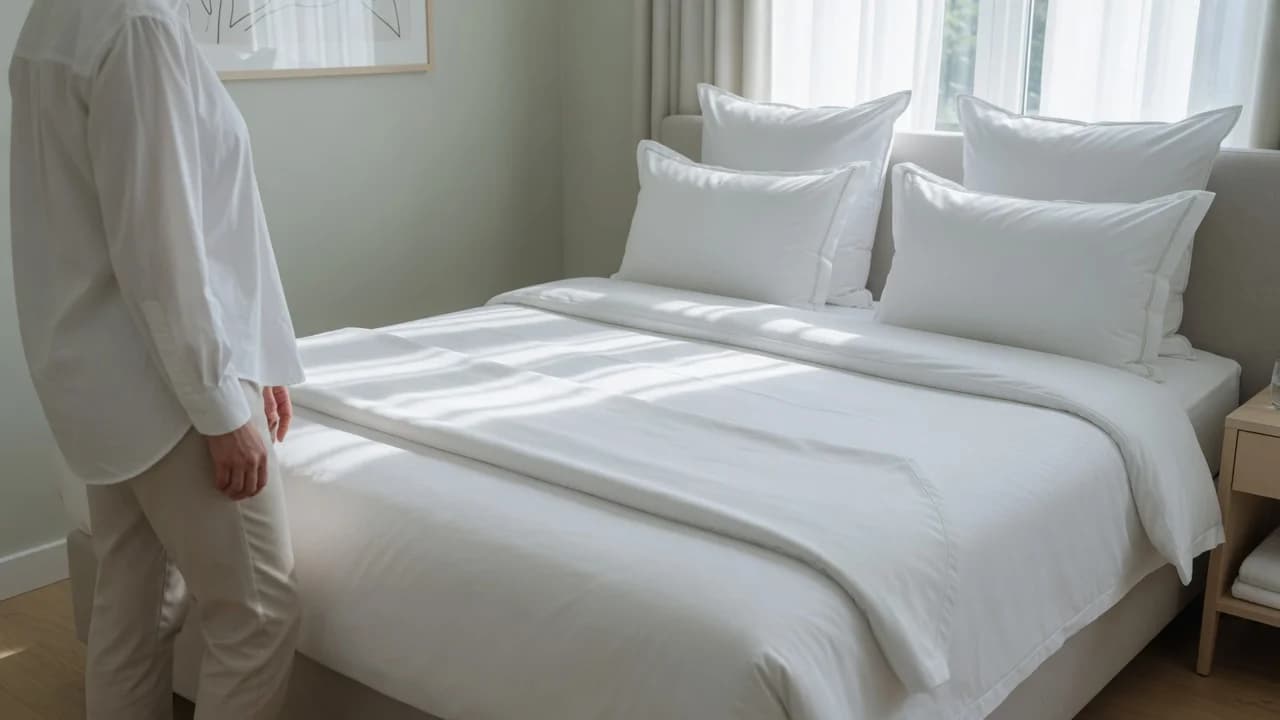
Step five: at the head of the bed, fold both flat sheets down together about six inches — blanket stays put. Then fold both sheets and the blanket together another six inches. You've now created the signature hotel band: two crisp folds, blanket sandwiched invisibly between sheets.
Step six: hospital corners at the foot. Lift the hanging fabric at one bottom corner into a 45-degree triangle resting on top of the mattress. Tuck the fabric hanging below the triangle under the mattress. Fold the triangle down and tuck that too.[1] The result is a diagonal seam that holds the layers under tension. Do both bottom corners. Tuck the sides or leave them loose if you prefer the relaxed drape some boutique hotels use.
If you do nothing else from this article, do those two things: the double fold at the head and the hospital corners at the foot. Those two moves account for maybe 70% of the visual difference between a hotel bed and a standard home bed.
Here's where technique alone stops working: if your flat sheets are visibly worn — thinning in the center, faded along the fold lines, pilled from years of washing — no amount of folding will hide it. There's a floor. Sheets with visible wear need to be replaced before technique can do its work. But you don't need hotel-brand sheets. Target's Threshold 300-thread-count percale runs about $35 for a queen flat sheet and performs close enough that no guest would notice. The key is percale, not sateen. Percale's one-over-one weave stays crisp and actually improves with washing[2] — hotels prefer it because it gets better after dozens of laundry cycles. Sateen drapes smoothly but reads as rumpled faster.
Pillow Math: Four Minimum, No Exceptions
Count the pillows on the next hotel bed photo you see. On a queen or king, you'll see four sleeping pillows minimum, plus Euro shams behind them and sometimes an accent pillow in front. That isn't excess. It's architecture.
Two pillows on a queen bed look sparse. The eye reads the gap between them as incompleteness. Four pillows, arranged in pairs with the openings facing outward away from the center, create a continuous horizontal band across the headboard. That band is what photographs as finished.
Euro shams — those 26-by-26-inch square pillows — sit behind the sleeping pillows and prevent them from sliding apart overnight. Hotels use them as structural backstops disguised as decoration. If you don't own Euro pillows, two additional standard pillows stood vertically behind the sleeping pair achieves roughly the same effect.
Pillow chopping is the thing people don't know they're missing. Take your hand and karate-chop vertically into the center of each pillow, creating a crease. Hotel pillows have that dimpled center line because someone chopped them. It breaks the pillow's natural roundness and creates a tailored, upright shape. Fluff, then chop.
That framing misses something. What matters isn't the chop itself — it's that the chop only works when the pillowcase is pressed smooth first. A wrinkled pillowcase with a chop in it still looks like a wrinkled pillowcase. Iron your pillowcases. Or mist them with water from a spray bottle after putting them on, then smooth with your hands. The water relaxes cotton fibers enough to release creases without heat. Hotel laundry teams press pillowcases flat, and the visual difference between pressed and unpressed pillowcases is larger than the difference between 300 and 600 thread count.
A hotel bed isn't bought. It's built. Every layer, every fold, every tucked corner is a decision someone made. The materials are ordinary. The assembly is what you're paying for when you book the room.
Finishing Moves That Cost Nothing
The top sheet fold at the head — that six-to-twelve-inch band of layered fabric — should be perfectly straight. Hotels use it as a visual anchor. If it's crooked, the whole bed reads as careless regardless of what else you did right. Take ten seconds to sight down the fold line from the foot of the bed. Adjust.
Daily reset takes sixty seconds. Smooth the top layer. Re-chop the pillows. Straighten the head fold. If you do this every morning, the bed stays at 90% of its just-made appearance indefinitely. The beds you see in hotel rooms at 4 PM check-in were made hours earlier and held their shape because tension, not fluffing, does the holding.
One thing this article does not cover: scented linen sprays, decorative throws, bed runners, or turndown rituals. Those are theater. The structural bed — tight sheets, layered header, four pressed pillows, straight fold — looks right without any of them. Add them if you want. But they're garnish, not the meal.
If you ignore all of this and keep making your bed the same way — fitted sheet, top sheet pulled straight, duvet thrown over — you'll keep getting the same result. A bed that's functional but forgettable. The gap between what you have now and what you want isn't locked behind a $300 sheet set. It's about fifteen minutes of learning to fold differently.
Strip your bed tonight and remake it with two flat sheets and a thin blanket. Do the double head fold. Cut hospital corners at the foot. Put four pillows on it, pressed and chopped. That's the whole technique. It works with the linens in your closet right now, and it changes what your bedroom looks like more than any bedding purchase ever will.