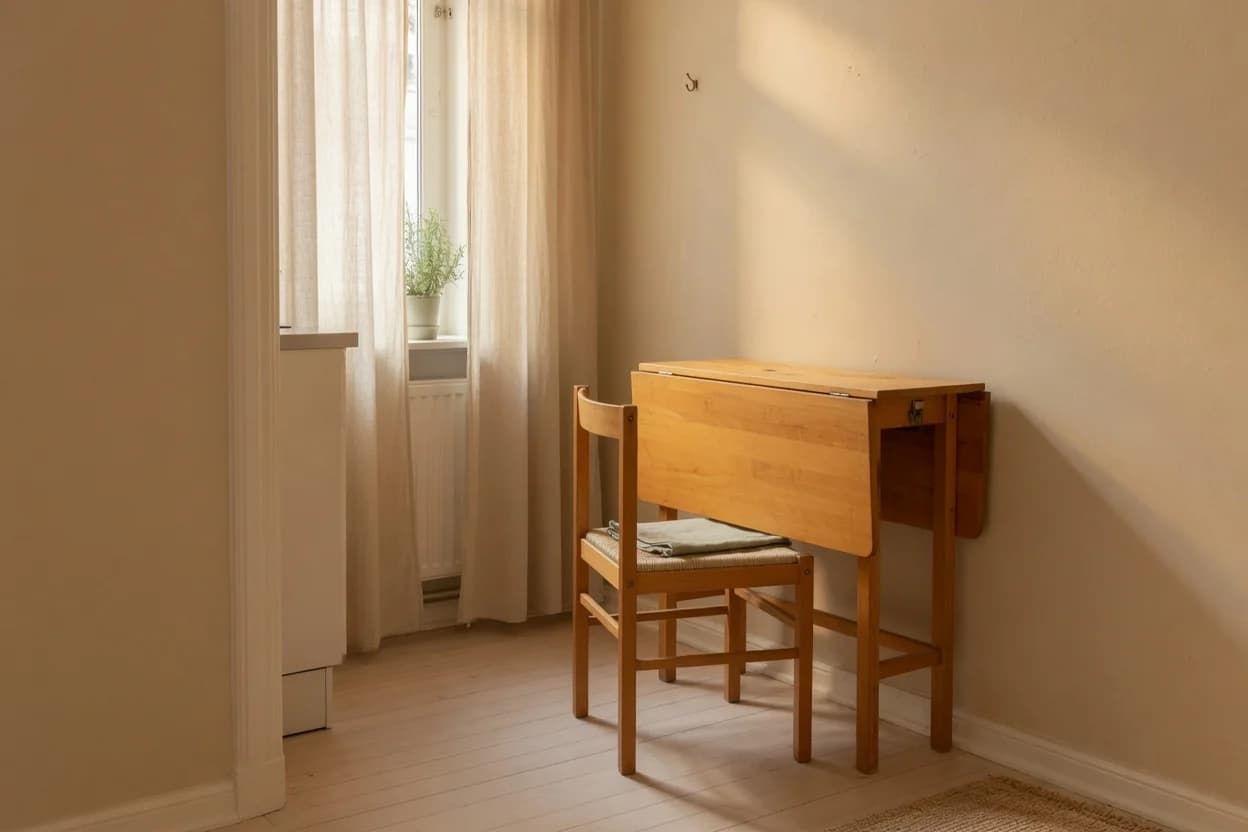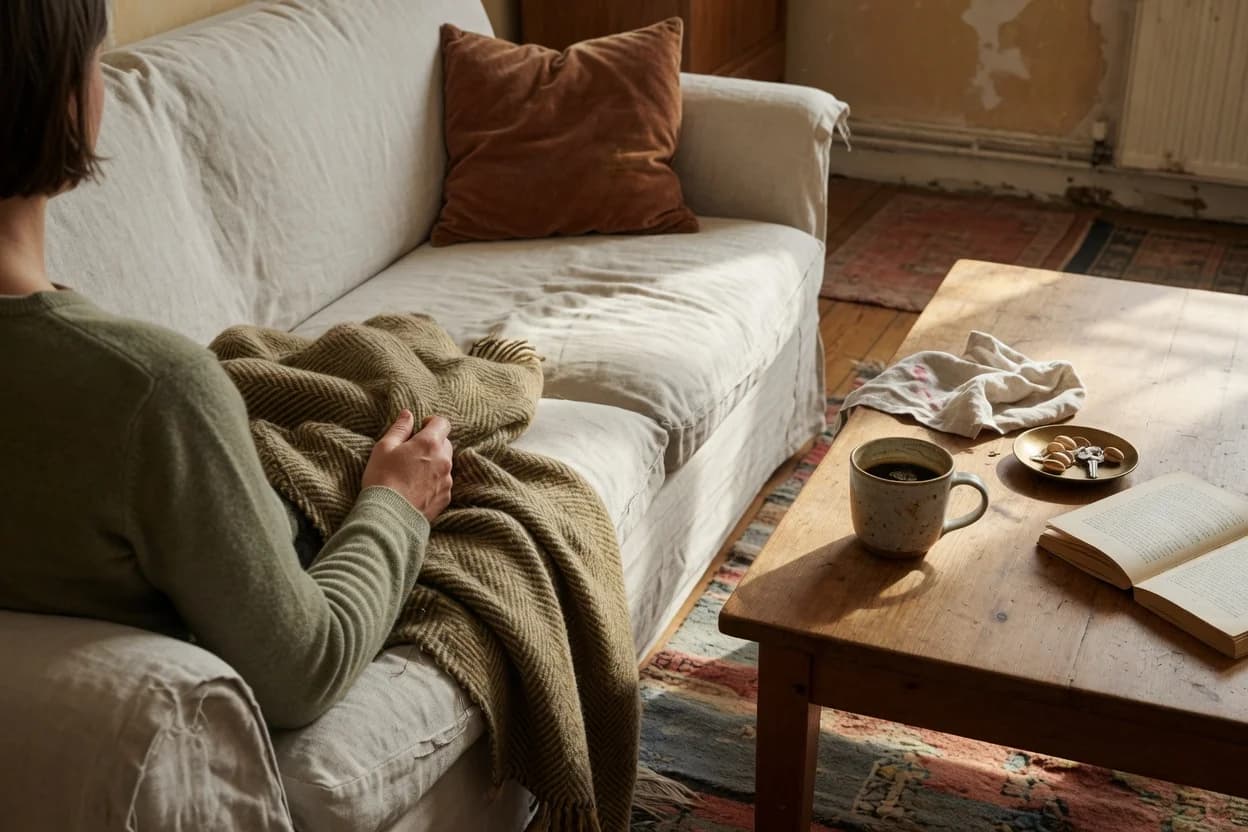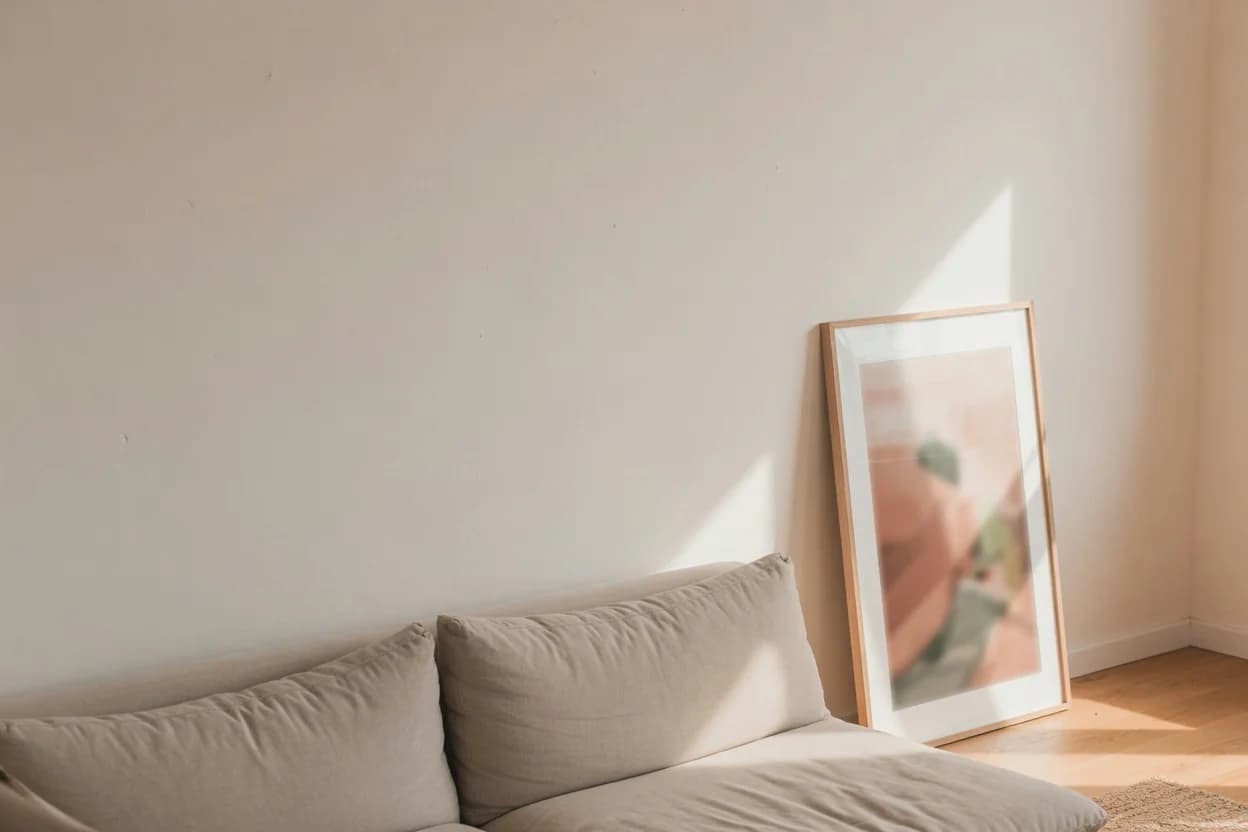
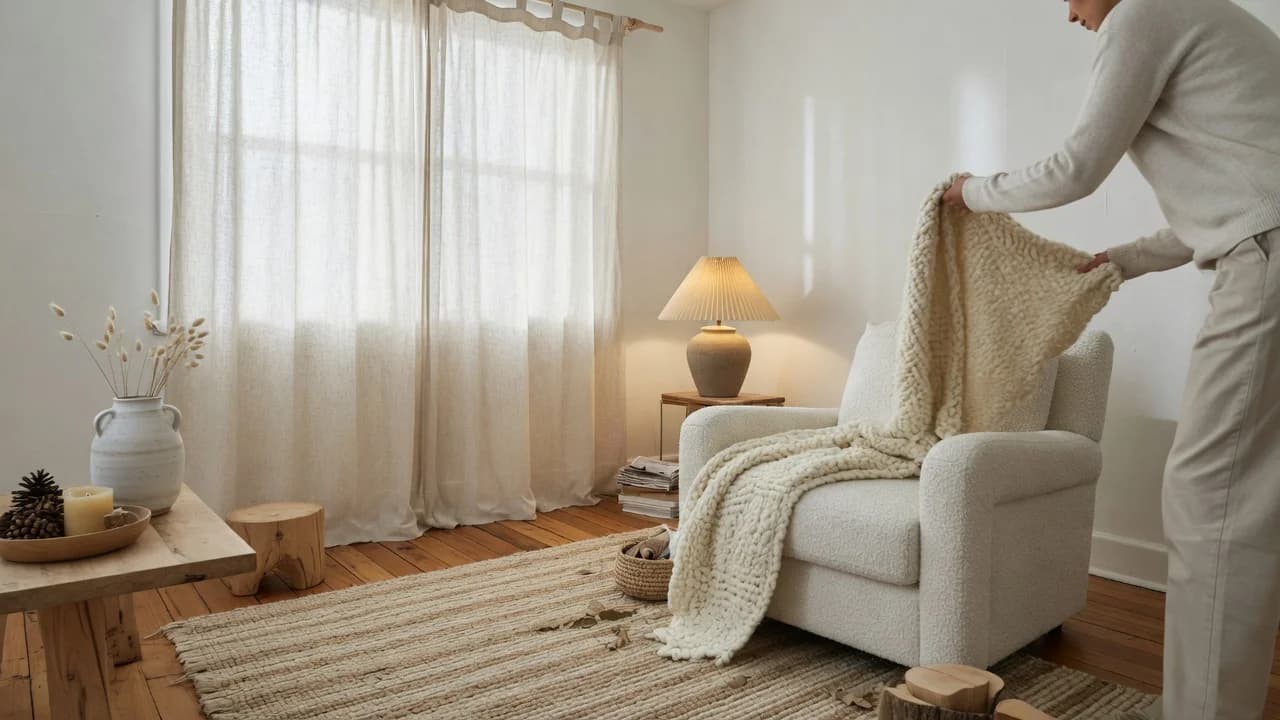
Interior designers will tell you to layer textures before they discuss anything else about a white room, and there's a structural reason for that. You've probably tried the obvious fix already: a throw blanket, a few pillows, maybe a jute rug. The room still feels cold.
Most guides stop at naming what to add. They don't explain that texture layering has an order, and getting the sequence wrong is what turns a potentially warm white room into a cluttered one. A jute rug and a linen sofa and a wool throw all read as the same flat plane if they hit the room in the wrong sequence. This isn't about abandoning white walls for beige. It's about making white work by giving light something to break against.
That ordering problem is the difference between a room that photographs well and one that feels good to sit in at 7 PM with a cup of coffee.
What Goes Wrong When Texture Has No Hierarchy
The problem isn't the objects. It's the order. Walk into most white rooms that feel off, and you'll see the same pattern: accent pillows on a smooth sofa, a ceramic vase on a glossy side table, a basket in the corner. None of it registers as warmth because none of it creates shadow.
Here's why. A white room fails when every surface reflects light at roughly the same intensity. Color creates depth through hue contrast, which the brain reads instantly. A navy sofa against a cream wall registers as a foreground object. In an all-white room, that boundary vanishes. The sofa, the wall, the rug all merge into one perceptual surface.
Objects that should create separation don't, because they were placed before the larger surfaces underneath them were differentiated from the wall. You need the floor to read as distinct from the wall before a rug can read as distinct from the floor. You need the sofa to separate from the wall before a throw pillow can separate from the sofa. Skip those steps and every texture you add just joins the flat field.
The Sequence That Actually Works
If you do nothing else, get the sequence right. The order is: floor first, then large upholstery, then window treatments, then accent pieces. This isn't a style preference. It's a light-management sequence. Each layer creates the shadow structure the next layer needs to register.
Start with the floor. It's the biggest continuous surface in the room. A natural-fiber rug (jute, sisal, or wool with a low pile) absorbs light differently than hardwood or tile. That absorption breaks the reflective field at its largest point. Without it, every object you place above floats in the same visual plane. Designers call this grounding the room, and in a white space that term is literal, not poetic.[1]
Next, address the largest upholstered piece. The sofa or bed. Linen, cotton velvet, and bouclé each catch light at different angles across the same surface. A white linen sofa against a white wall works because the linen has slubs and weave variation the wall doesn't. The contrast is in light behavior, not color. That's the whole trick.
Window treatments come third because they control the light source itself. Unlined linen or cotton drapery filters daylight and introduces soft, shifting shadow across the day. Skip synthetics and blackout fabrics. You want the fabric to work with the light, not fight it. That interaction is what gives a white room its sense of time rather than the static flatness of a room lit only by overhead fixtures.
Only after floor, upholstery, and windows are in place do accent textiles and hard accessories earn their keep. A chunky wool throw, a matte ceramic vase, a raw wood tray. Added too early, they read as clutter. Added in sequence, they punctuate the structure the larger layers built.
The Materials That Carry the Weight
Texture isn't decoration in a white room; it's the architecture the eye uses to navigate the space. That understates it. Texture in a monochrome room is doing the job color normally does: creating foreground, middle ground, and background so the eye knows where to land. Once you see it that way, material selection becomes structural, not aesthetic.
Three families of materials do the real work. Natural plant fibers (jute, sisal, seagrass) go on floors and in storage. They absorb light heavily and produce visible texture at a distance. Jute's nubby surface creates more micro-shadow per square inch than any synthetic at the same price.[2]
Animal-derived and textured plant fabrics (wool, linen, bouclé, cotton velvet) should fill your soft surfaces. Each reads differently under light. Wool is matte and depth-rich. Linen has visible fiber variation. Bouclé loops catch light at dozens of angles. Cotton velvet shifts between sheen and matte depending on nap direction. These differences create the layered effect that makes a white room feel composed, not blank.
Wood and unfired ceramics handle the hard surfaces. Skip gloss finishes entirely. A white oak side table with a low-sheen surface reflects maybe 30% of the light that hits it. A lacquered white table reflects closer to 80%. In a room where walls already bounce most of the light, you need wood to absorb. Same logic for ceramics: unglazed stoneware creates shadow. Glossy porcelain does not.
And swap every bulb to 2700K or 3000K. At 2700K, white walls shift cream-toned and textured surfaces cast deeper shadow. At 4000K, those same textures flatten because cooler light reduces contrast between lit and shadowed zones. Open your phone and look at a photo of your white room shot under overhead lights at night. That washed-out flatness is as much about the bulb as the lack of texture.[1]
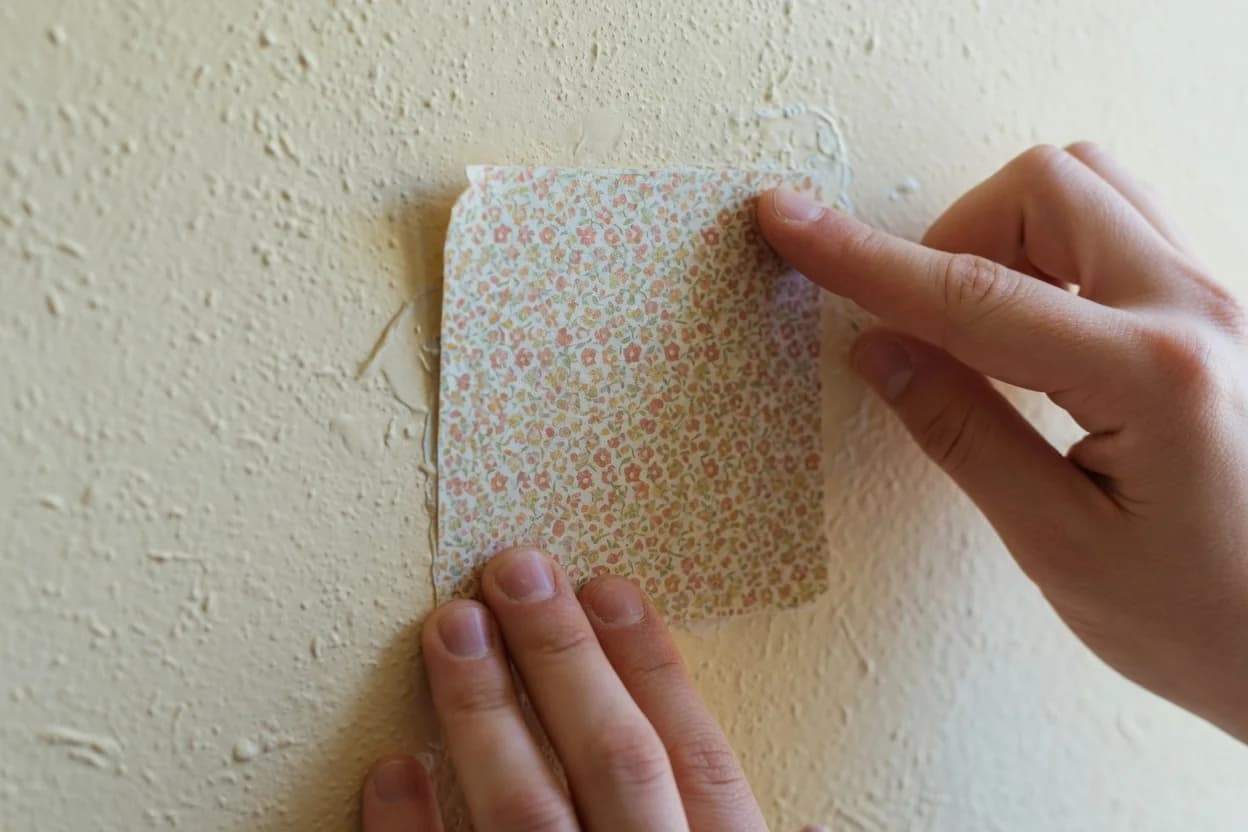
One condition where this approach weakens: if your room already has serious architectural texture (exposed brick, rough beams, heavily textured plaster, board-and-batten walls), the architecture is already doing the shadow work. In that case, pull back. Two accent textures, maximum. Let the walls carry the depth. Adding the full layering stack on top of existing character makes the room feel chaotic, not layered. The system works when the bones are flat. When they're not, subtract.
If your white room has flat walls, smooth ceilings, and uniform flooring:
- Start with a natural-fiber rug on the floor.
- Make your largest upholstered piece linen, bouclé, or cotton velvet.
- Hang unlined linen or cotton drapes.
- Light everything at 2700K.
- Add accent pieces last.
If the room already has architectural texture (brick, beams, plaster, paneling), pull back to two textures and let the structure carry the warmth.
Do nothing and the room stays what it is now: a bright box that makes every object look slightly wrong for reasons you can't quite name. That flatness isn't a design choice. It's a shadow deficit, and the fix is mechanical.