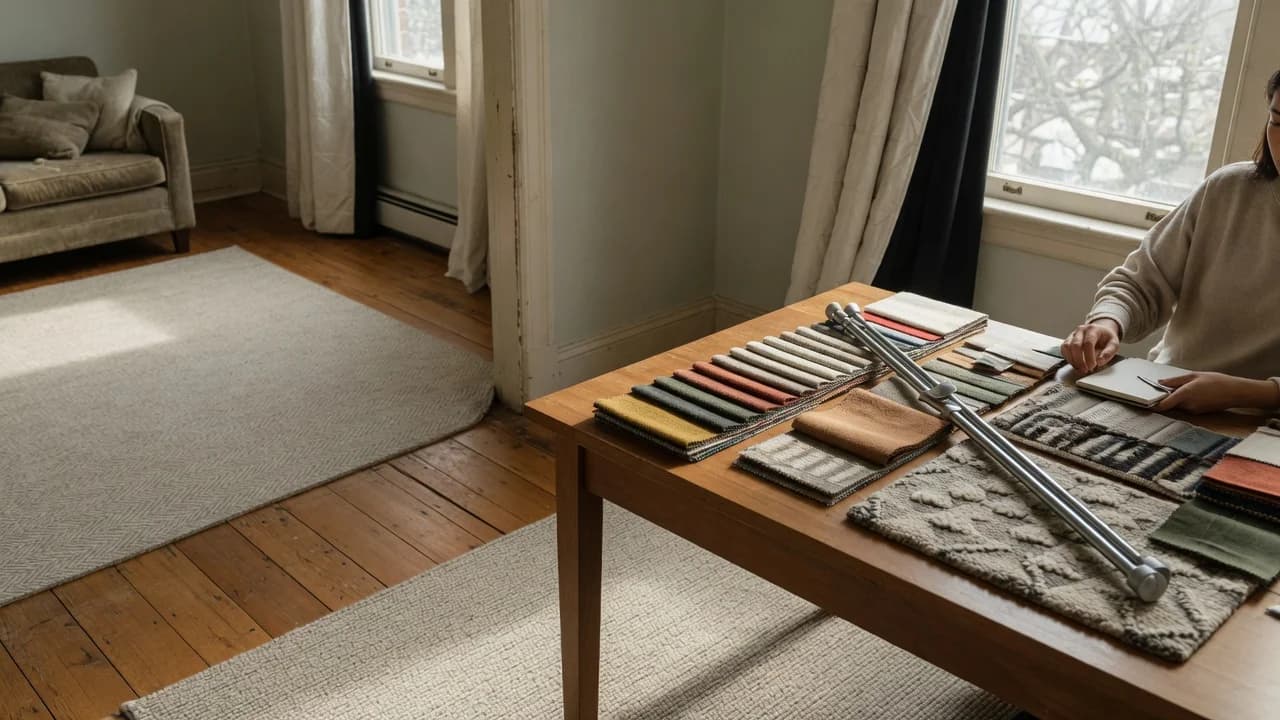
A renter in a prewar Boston apartment with oak flooring and drafty double-hung windows has three options when the temperature drops: push the thermostat past 72 and absorb the utility bill that follows, buy a space heater the lease probably forbids, or warm the place with textiles that don't require drilling, gluing, or a call to the property manager. Three variables decide whether that textile strategy changes the temperature or just the décor. The first is how little thermal resistance your bare floor provides — almost none, if it's ceramic tile or finished oak. The second is what sits between your rug and the floor's polyurethane finish. The third is whether your window coverings trap a still air layer or just look heavy.
Most renter-friendly advice stops at "add rugs and curtains." It leaves out the specific material properties that determine whether textiles block heat loss or just take up floor space. It also ignores the fact that some of the most popular and affordable products — the ones dominating the first page of search results — can cost more than they save, not through poor performance but through permanent surface damage.
The Department of Energy puts window heat loss at roughly 30% of a home's heating energy.[1] Published R-value data from radiant heating manufacturers shows that ceramic tile provides about R-0.25 of insulation while a half-inch wool rug on a quarter-inch felt pad delivers roughly eight to twelve times that thermal resistance.[2] The gap between those two numbers is the space where this article lives — not "how to decorate a cozy apartment," but which specific materials block the thermal drains in a hard-floored rental and don't leave evidence behind.
Why Hard Floors Feel Colder Than the Air Temperature Claims
Your thermostat may read 70 degrees, but your bare foot reports something closer to 60. That gap isn't imagination. It's thermal conductivity — the rate at which a material pulls heat from a warmer object into a cooler one. And closing that gap in a rental requires materials whose chemistry matters as much as their thickness, because the wrong compound can bond permanently to a floor finish. Ceramic tile and stone conduct heat about eight to ten times faster than wool carpet does, which is why a bare tile floor feels cold even in a heated room. Industry R-value data puts ceramic tile at roughly R-0.25 per quarter-inch while a half-inch wool carpet on a felt pad reaches R-3.0 or higher.[2]
Standing on ceramic tile in socks is like standing on a heat sink. The air temperature hasn't changed. The rate of heat transfer has. So two apartments set to the same thermostat reading can feel five to eight degrees apart — one has textile insulation breaking the conduction path, the other doesn't.
The same principle operates at your windows through a different mechanism. Single-pane glass and uninsulated frames lose heat through both conduction and air leakage. Windows account for 25 to 30 percent of residential heating and cooling energy use, according to the Department of Energy.[1] A bare window on a cold night radiates chill several feet into the room, pulling warm air toward the glass, cooling it, and sinking it back toward the floor. The result is a cold draft at ankle level even when the window is closed tight.
Your floor isn't just hard — it's a thermal drain, and the right underlay blocks that drain before any rug fiber touches your feet. Windows are thermal holes. The textile solutions that address each differ in material and mechanism, but they share one requirement: they must trap still air between the hard surface and the room. Still air is the actual insulator. The textile is just the structure that holds it in place.
Rugs and Rug Pads: The Deposit-Killer Most Renters Overlook
The rug itself contributes thermal mass and air-trapping pile height. But its insulating performance is incomplete without the right pad. A bare wool rug on hardwood still lets the floor conduct heat away through the rug's foundation. The pad decouples the rug from the floor, creating the trapped air layer that does the actual insulating work.
That framing misses something. The pad isn't just a thermal layer. It's also a chemical one. And the cheap pads that dominate Amazon search results — PVC waffle grids, synthetic grip meshes, anything with an adhesive backing — contain plasticizers that migrate into polyurethane floor finishes. The result is permanent yellow or orange discoloration in the exact shape of the pad. This is not a cleaning problem. It requires sanding and refinishing, and a landlord will take that straight from your deposit.
The material safety hierarchy for rental hardwood floors:
| Pad Material | Grip | Cushion | Safe for Polyurethane? | Approx. Cost/sq ft |
|---|---|---|---|---|
| Felt + Natural Rubber | Excellent | Excellent | Yes | $0.80–$1.50 |
| 100% Natural Rubber | Excellent | Moderate | Yes | $0.50–$1.00 |
| Felt Only (no rubber) | Poor | Excellent | Yes | $0.50–$1.00 |
| PVC / Synthetic Waffle | Good | Moderate | No — discolors finish | $0.15–$0.40 |
| Adhesive-Backed | Excellent | Poor | No — leaves residue | $0.20–$0.50 |
The felt-and-natural-rubber combination is the standard for a reason: the felt faces up to cushion the rug and absorb sound while the natural rubber faces down to grip the floor through surface friction. No adhesives. Natural rubber, unlike synthetic blends, doesn't off-gas plasticizers or react with polyurethane. It grips the same way a tire grips pavement — mechanically, not chemically.[3]
For the rug itself, wool outperforms synthetics on warmth for two reasons. It has lower thermal conductivity, so it pulls heat from your feet more slowly, and its natural crimp creates more trapped air pockets in the pile. A half-inch wool rug on a quarter-inch felt-and-natural-rubber pad can take a floor from roughly R-0.25 to somewhere around R-3.0 combined.[2] Cotton and jute flatweaves, by contrast, add almost no R-value. They're decorative, not thermal. The thickness guideline: look for at least 3/8 inch of pile height if warmth is the goal. Anything thinner is a style purchase.
Overhead: Window Textiles That Work Without Drilling
Windows in a rental present a different constraint: you usually can't replace them, add storm windows, or drill into the frames or walls. The good news is that the most thermally effective interior window treatment — a properly hung thermal curtain — requires nothing more than a tension rod and attention to how the fabric meets the wall.
Thermal curtains work by trapping an air layer between the fabric and the glass. The Department of Energy recommends closing curtains and shades at night to reduce heat loss and opening them during sunny winter days to admit solar gain.[1] That open-close habit matters as much as the curtain material. A thermal curtain that stays open at night is doing nothing. And 75% of households leave their window coverings in the same position every day, according to DOE research — which means most thermal curtains sold are being used as décor, not insulation.
The construction to look for is three layers: a decorative face fabric, a high-density foam or felt thermal core, and a vapor-barrier backing. The core blocks thermal transfer. The backing prevents moisture from warm room air from condensing against cold window glass. Single-layer blackout curtains without the thermal core block light but add minimal insulation. Look for curtains marketed specifically as "thermal" or "insulated," typically 1.5 to 2 inches thick when gathered. Tension rods rated for the curtain weight — thermal curtains are heavier than standard drapes — eliminate any need to drill. For particularly drafty windows, add self-adhesive foam weatherstripping to the inside of the frame before hanging the rod. It peels off cleanly when the lease ends.
One situation where thick textiles create problems instead of solving them: radiant floor heating. If your rental has in-floor radiant heat — common in newer apartment buildings and condo conversions — placing a thick rug and pad over the heated floor traps heat against the surface. The thermostat cycles excessively, the floor temperature beneath the rug can rise above safe operating limits, and the heating efficiency drops. For radiant-heated floors, switch to a thin, heat-transmissive rug with no pad, or a pad specifically rated for radiant heat use. The same caution applies to rentals in high-humidity regions like the Gulf Coast, where thick felt pads can retain moisture against hardwood through the summer, creating conditions for cupping or mildew beneath the rug.
Put down a half-inch wool area rug on a felt-and-natural-rubber combination pad, sized one inch smaller than the rug on each side. Then hang a thermal-insulated curtain on a tension rod over every window you don't actively open in winter, and close it when the sun goes down.
Those two changes address the specific thermal drains in a hard-floored rental — conduction through the floor and radiant loss through the glass — without drilling, gluing, or modifying anything the landlord owns. The pad protects the floor finish from the rug backing and from grit abrasion. The curtain traps the air layer that stops heat from streaming toward cold glass. If you ignore the pad material and grab the cheapest option in the search results, the floor can discolor inside a single winter and the cost of refinishing comes straight from your deposit. If you skip the curtains, your thermostat runs harder every night while the windows keep pulling warm air toward cold glass.
The materials matter more than the look. Wool, not cotton. Natural rubber, not PVC. Thermal-core curtains, not blackout drapes. Get those three calls right and the apartment feels warmer at the same thermostat setting. Get them wrong and you've bought décor with no thermal return — or worse, floor damage that erases the deposit you were trying to protect. Check the labels before you click add to cart.