Since bed bugs resurged across the U.S. in the early 2000s, the secondhand furniture market has never fully recovered its innocence. A $40 Facebook Marketplace armchair now comes with a risk calculation most buyers weren't making fifteen years ago. You're not just choosing between beige and charcoal—you're deciding whether your living room gets furnished or infested.
The question isn't whether you should check used upholstery before buying it. You know that.
The problem is that the standard advice—"look for bugs, give it a sniff"—is vague enough to be useless when you're standing in a stranger's garage trying to decide in thirty seconds.
Put more precisely: most guides tell you what to look for but never tell you what a failed inspection actually looks like, or which problems are fixable versus catastrophic.
The difference between a great deal and a $3,000 exterminator bill comes down to knowing when an odor means the foam is shot and when bed bug spotting is too widespread to risk.
Start With Your Nose—But Know Its Limits
Your nose catches what your eyes miss. Odors in upholstery fall into three categories, and only one of them is fixable with consumer methods.
Surface smells—cooking grease, perfume, mustiness from a damp basement—sit in the top layer of fabric. These respond to vacuuming, baking soda, and a few hours in sunlight. They're annoying but not dealbreakers.
Embedded odors have worked their way into the cushion foam. Cigarette smoke is the most common example. The tar residue binds to polyurethane foam at a molecular level that surface cleaning can't reach. You can sometimes reduce it with an ozone generator or repeated enzyme treatments, but it's a gamble. If the piece smells strongly of smoke and you don't have access to professional ozone treatment, price the furniture accordingly—you're buying a project, not a ready-to-use piece.
Then there's the category that should send you walking: absorbed biologicals. Cat urine that's penetrated through fabric and foam into a wood frame. The urea crystallizes inside the wood grain. No consumer treatment removes it. Even professional hot-water extraction followed by enzyme treatment often fails because the crystals sit too deep. For upholstered pieces with wooden frames, that means a full rebuild—and at that point, you're not buying furniture, you're buying a carcass to reupholster.
Here's the test: push your nose into the seat cushion and inhale. Then flip the cushion and do the same to the underside. If the smell is stronger on the underside, it's embedded. If it's present on both sides at roughly equal intensity, it's likely surface-level. If you smell ammonia or anything sharp and organic, walk.
The Bug Inspection That Actually Works
Most people check for bed bugs by glancing at a cushion. That's not an inspection—it's wishful thinking.
Bed bugs don't sit on top of upholstery in daylight. They wedge themselves into seams, piping, zipper folds, and the space between the fabric and the frame. According to the EPA, adult bed bugs are about the width of a credit card and can squeeze into any gap that size[1]. A sofa seam is a luxury condo by their standards. Upholstered chairs and sofas are the second most common infestation site after beds, per the University of Kentucky's urban entomology program[2]—and unlike a mattress, you can't throw a sofa in a bed-bug-proof encasement.
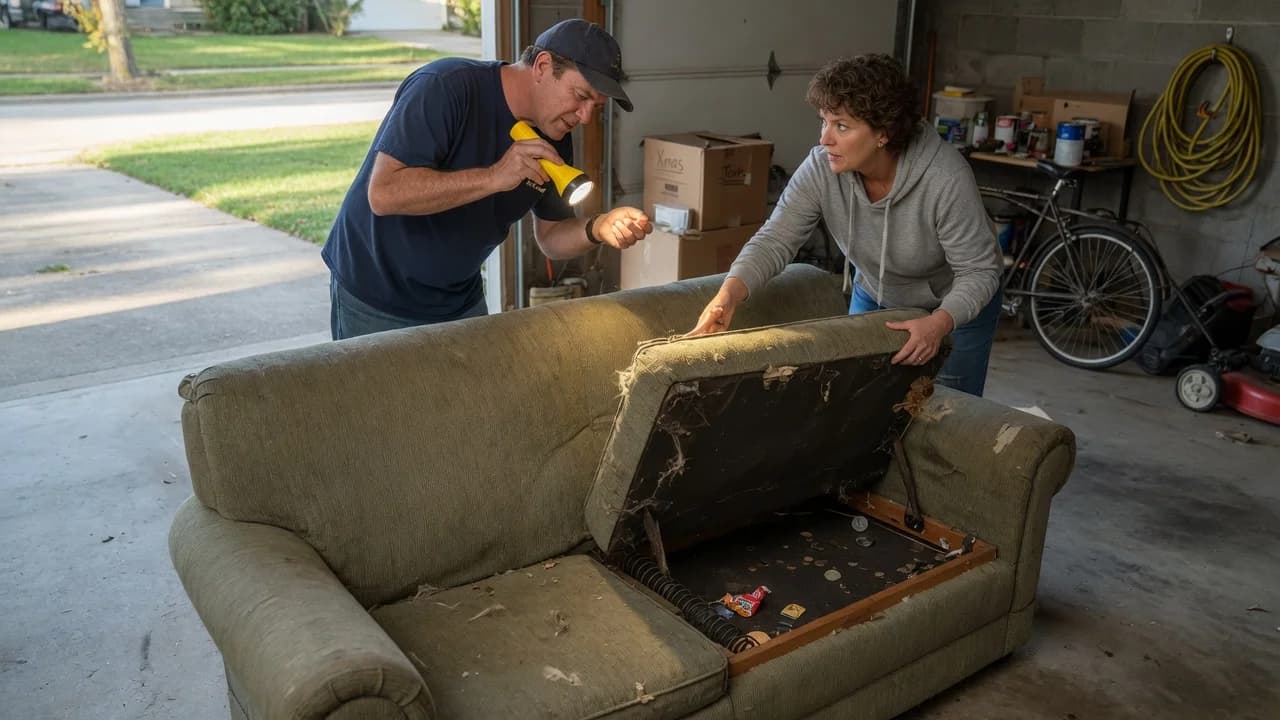
You need three tools: a flashlight (your phone light works), something thin and rigid like a credit card or putty knife, and five uninterrupted minutes.
Start at the back of the piece. Run your card along every seam, especially where fabric meets the frame. Bed bug fecal spotting looks like someone dotted the fabric with a black felt-tip marker—small dark stains that bleed slightly into the weave[1]. A few dots might be nothing. A cluster of them, especially near seams and corners, means an active infestation was here, and where there were adults, there were eggs.
Lift every cushion. Check the Velcro strips and zipper tracks—bed bugs gravitate toward the crevice where the zipper meets the fabric. Look at the deck—the platform under the cushions—for reddish-brown smears. Those are crushed bugs that fed recently. Cornell's Integrated Pest Management program identifies these rust-colored stains as one of the most reliable visual indicators on upholstery[3].
Turn the piece over. If there's a dust cover stapled to the bottom, peel back a corner and shine your light inside the frame. Bed bugs congregate near staple lines and screw holes. You're looking for three things simultaneously: live bugs—apple-seed-sized, reddish-brown—their shed skins that are translucent and lighter, and the black fecal dots.
Oklahoma State University Extension advises that any live or dead bug on a piece of furniture is a red flag, regardless of how clean the rest of it looks[4]. A single bed bug found during inspection means there are almost certainly more you can't see.
That understates it. A single visible bed bug on a used piece of upholstery isn't a negotiation point—it's a reason to leave. The eggs are glued into crevices and nearly impossible to spot without magnification. The EPA confirms that bed bug eggs are about 1mm, pale yellow, and resist many treatment methods[5]. You can't see them all. And you can't kill the ones you miss with a steam cleaner alone.
What you're actually buying isn't furniture. You're buying the absence of infestation and the presence of usable comfort. If either is missing, the price doesn't matter.
When the Deal Isn't Worth It
Some furniture isn't salvageable, and the math is simpler than most buyers admit.
A professional bed bug heat treatment for a single room runs $1,000 to $2,000 in most U.S. markets. If the piece you're buying costs less than that, you're betting your entire home against a cheap sofa. The EPA's Integrated Pest Management guidance notes that bed bug control requires a combination of methods—heat, monitoring, vacuuming, and sometimes pesticides—and that DIY approaches frequently fail without professional-grade equipment[5].
So the calculation works like this: cost of furniture plus the probability of infestation multiplied by the cost of treatment. If you're buying a $200 armchair and there's even a 10% chance it brings bed bugs into a home where treatment costs $1,500, your expected cost isn't $200. It's $200 plus $150, or $350. And that's before accounting for the disruption of living out of plastic bags for weeks.
Odors follow a similar logic. Enzyme treatments, ozone generators, and professional hot-water extraction each cost between $100 and $300. If the piece has a strong biological odor that you can't identify, assume the worst case—that it's in the frame—and treat the furniture as unrestorable unless you're willing to replace the foam and reupholster.
The alternative isn't "do nothing." It's buying new budget furniture from a retailer with a return policy. A $350 sofa from IKEA that arrives clean and pest-free is cheaper than a $75 vintage couch that needs a four-figure extermination bill. The math doesn't lie, and neither does your nose.
Right now, before you open Facebook Marketplace again: put a flashlight and an old credit card in your car. That's your inspection kit. It takes thirty seconds.
When you arrive to look at a piece today, do the nose test first. Smell forces a decision faster than sight. If it fails the ammonia test, leave. Don't negotiate. Don't wonder if you can fix it.
Within the first week of bringing any secondhand upholstery home—even a piece that passed inspection—quarantine it in a garage or spare room. Run a steam cleaner over every seam at 130°F minimum[5]. Vacuum thoroughly and dispose of the bag outside. If you live in a warm climate and the piece fits, a sealed black plastic bag in direct sun for a full afternoon can push internal temperatures past 120°F, which kills bed bugs at all life stages[5].
You're not trying to restore a museum piece. You're trying to avoid turning a furniture purchase into a pest control invoice. If the piece smells wrong or shows clustered black spotting along the seams, somebody else's $75 sofa can be somebody else's problem.