A furniture restorer will tell you to flip the piece over before you look at anything else, and there's a reason for that. The underside reveals how a piece was built, and the show surface won't. You're hunting for structural integrity, joinery quality, material honesty, and any sign that something living came with the piece.
A dresser can sit square on the thrift store floor and still have joints pulling apart. A chair can feel solid and still carry wood-boring beetles in the back rail. The things that matter most are the things you can't see at a glance.
That's the tension. Most damage worth worrying about stays invisible until you know where to look. Generic thrifting advice tells you to find "quality." That word means nothing until you can read a joint, identify a material, and recognize a smell that signals trouble. You need a system that takes about three minutes and catches the four problems that turn a deal into a regret.
Start With the Frame
Structural problems are the most expensive to fix and the easiest to miss when you're distracted by a nice finish. The frame is the skeleton. If it's compromised, nothing else matters.
Grab the piece at two opposite corners and push. Not gently. Rock it diagonally. A solid piece resists with almost no movement. A loose one shifts, creaks, or clicks. That click is joinery failing. Corner blocks, glued dowels, or metal brackets that have worked loose all produce the same result: a piece that wobbles now and will collapse later.
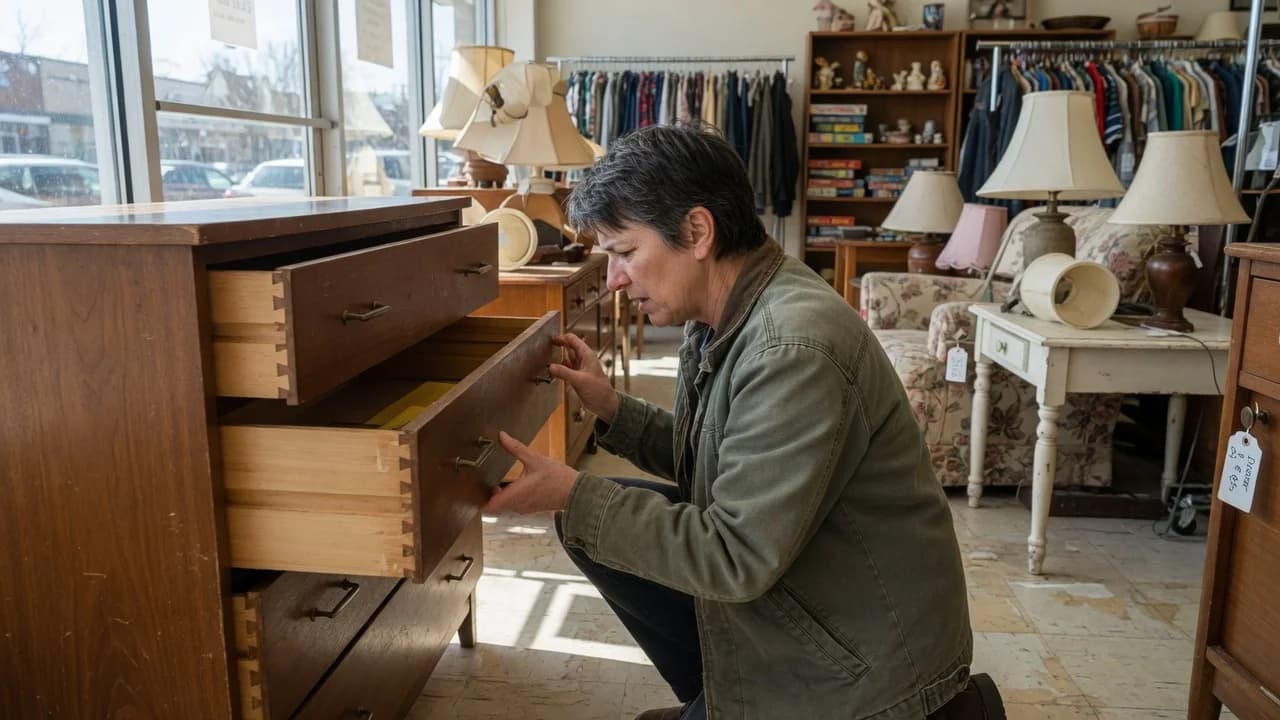
Pull out every drawer. Look at the corner where the drawer side meets the front. Dovetail joints, with their interlocking fan-shaped pins and tails, are what you want. They're mechanically self-locking and get stronger under load. Staples, nails, or flat glued butt joints are what you'll find on pieces built to a price point, not a lifespan. Those drawers will fail. It's not a question of if.
Or rather, it's a question of when. A stapled drawer in a dresser used daily might last two years. A dovetailed drawer from the 1960s will outlast you. The joinery tells you everything about how the piece was made and how seriously the manufacturer took their work.
Check the underside too. Look for corner blocks, those triangular wooden braces screwed or glued into the inside corners of chairs and tables. Their absence on a piece that should have them (dining chairs, end tables, anything that bears weight) means the manufacturer cut a structural corner. You'll pay for that cut later.
Know What It's Made Of
Thrift stores are full of furniture that looks like wood but isn't. Calling a piece "wood" tells you nothing. What matters is whether it's solid lumber, veneer over plywood, veneer over MDF, or straight particle board with a printed finish. Each behaves differently over time and each has a different ceiling on how much repair it can take.
The fastest test: run your hand along the edge where two surfaces meet. On solid wood, the grain continues through the edge. On veneered pieces, the face grain stops abruptly and a thin line of edge banding takes over. Flip the piece and check the underside. If the bottom looks like a different material from the top, you're looking at veneer. Solid wood is consistent throughout.
Knock on it. Solid hardwood produces a deep, short tone. MDF sounds flat and dull, like knocking on a cardboard box. Weight alone won't tell you. MDF is often heavier than solid pine or poplar. But the knock test combined with the edge check is reliable.
Here's how the three main categories compare when you're standing in the aisle trying to decide:
| What You're Checking | Solid Wood | Quality Veneer (Plywood Core) | MDF or Particle Board |
|---|---|---|---|
| Edge grain | Grain runs continuously through | Face layer visible, often edge-banded | Uniform texture, no grain at all |
| Weight feel | Heavy, proportionate to size | Moderate, feels solid | Unnaturally heavy and dense |
| Repair ceiling | Can sand, refinish, repair joints | Limited; sand-through ruins it | None; swells with moisture, can't be fixed |
| Knock sound | Deep, short resonance | Muted but solid | Flat, dull thud |
The material you can't see matters more than the one you can. Veneer isn't automatically bad. A high-quality veneer over plywood, common in mid-century American furniture, is stable, resists warping, and can last decades. The problem is veneer over MDF or particle board. When that gets wet, it swells and crumbles. There's no fixing it. If you see bubbling, raised edges, or a soft, spongy feel anywhere on the surface, the substrate underneath has already failed.
The Pest Problem Nobody Talks About
The price tag is the cheapest part of any piece of thrifted furniture. The real cost shows up weeks later when you notice tiny dark spots on the wall behind your new dresser.
Bed bugs can survive months without feeding, and used furniture is one of the primary ways they spread between homes. The EPA identifies rusty or reddish stains, dark spots of excrement about the size of a period on a page, and pale yellow shed skins as the key visual signs of infestation.[1] Look in seams, under cushions, along the piping of upholstered pieces, and where fabric attaches to the frame. Run a credit card along crevices. If it fits, a bed bug fits.
Wood-boring beetles leave different evidence. Tiny round exit holes, typically 1/16 to 1/8 inch across, with fine powdery sawdust around them. That powder is frass, insect waste mixed with wood dust. Fresh holes look clean and light-colored. Old holes darken over time. Frass means active infestation. The beetles are still in there, eating. Pass on the piece.
According to the National Pest Management Association's best management practices, professional bed bug inspections include removing drawers, inspecting inside and underneath furniture, checking screw holes and hardware recesses, and examining every seam and crevice.[2] You don't need to be a professional to do a version of this. Pull every drawer all the way out. Flip chairs upside down. Shine a flashlight into every joint and corner. If you find live insects, eggs, or fresh frass, the inspection is over. Walk away.
This is where the downside case sharpens. If you're buying a piece you can't fully inspect (sealed upholstery, a glued-on dust cover you can't remove, an antique with inaccessible cavities), assume the worst. The savings vanish the moment you need a professional exterminator. A single heat treatment for bed bugs runs hundreds of dollars in most US markets. That deal dresser just became the most expensive piece of furniture you own.
Smell, Stains, and the Stuff You Can't Sand Out
Your nose is a diagnostic tool. Use it before your eyes.
Open every drawer and smell inside. A musty, earthy odor means mold or mildew has penetrated the wood. That smell doesn't go away with airing out. It's in the fibers. On upholstered pieces, press your nose into the cushion seams. Pet odors, cigarette smoke, and mildew live in foam and padding permanently. Professional cleaning helps, but it rarely eliminates deep-set smells completely.
Water damage shows up as dark rings, white cloudy spots, or raised, bubbled finish on wood surfaces. Light surface rings might sand out. But if the damage has swollen the wood fibers, caused the veneer to lift, or created soft spots you can press with a fingernail, the piece is structurally compromised. Rot and warping from prolonged moisture exposure are irreversible without replacing the affected section, which costs more than most thrifted pieces are worth.
I'd start with the smell test on every piece, every time. You can negotiate a wobbly leg. You can't negotiate mold out of upholstery foam.
The Five-Second Decisions
Some problems announce themselves the moment you know what you're looking at. Others take a minute. A few should trigger an immediate walk-away, no second thoughts.
Walk away immediately if you find: active pest infestation of any kind, mold that has penetrated beyond the surface, MDF or particle board with swelling or water damage, structural cracks through load-bearing members, or a smell you can't identify but know isn't right. These aren't negotiation points. They're dealbreakers.
Negotiate hard if: the joinery is solid but the finish is rough, drawer bottoms are thin but intact, upholstery is dated but the frame underneath is hardwood, or hardware is missing but replacement is straightforward. These are projects, not problems.
Buy without hesitation if: the frame is rock-solid with traditional joinery, the material is solid wood or quality veneer over plywood, there's no sign of pests or moisture, and the piece has survived decades already. A piece that's held up for 40 years of daily use will hold up for 40 more.
This isn't a guide to spotting mid-century gems or negotiating prices. Those are separate skills. This is about not bringing home something that'll cost you more than you saved. Skip the inspection and you're gambling. Sometimes you win. More often, you end up with a dresser that smells like a basement, a chair that wobbles, or worse, an infestation that costs more to eradicate than the purchase price. The three minutes you spend checking are the cheapest insurance you'll ever buy.
If the frame is solid, the joinery is traditional, and you've found no sign of pests or moisture, buy it. That's the piece worth your money. If the materials are compromised (MDF with swelling, veneer lifting from a failed substrate), walk. You're buying problems, not furniture. If you're unsure about the joinery, pull a drawer and look at the corners. Staples mean no. Dovetails mean yes. That one check alone filters out most of what's wrong in a thrift store aisle.
If you do nothing else, check the joinery and check for pests. Those two things catch the problems that turn a fifty-dollar dresser into a five-hundred-dollar headache. The furniture that lasts isn't the prettiest piece in the store. It's the one that was built to be invisible, with corner blocks and dovetails you'll never see unless you flip it over and look.